The front lines of modern warfare and industrial security are no longer defined by heavy armor and billion-dollar fighter jets. They are defined by the “Attritable Signal”—low-cost, high-intelligence drones that can be produced at a scale that overwhelms legacy systems.
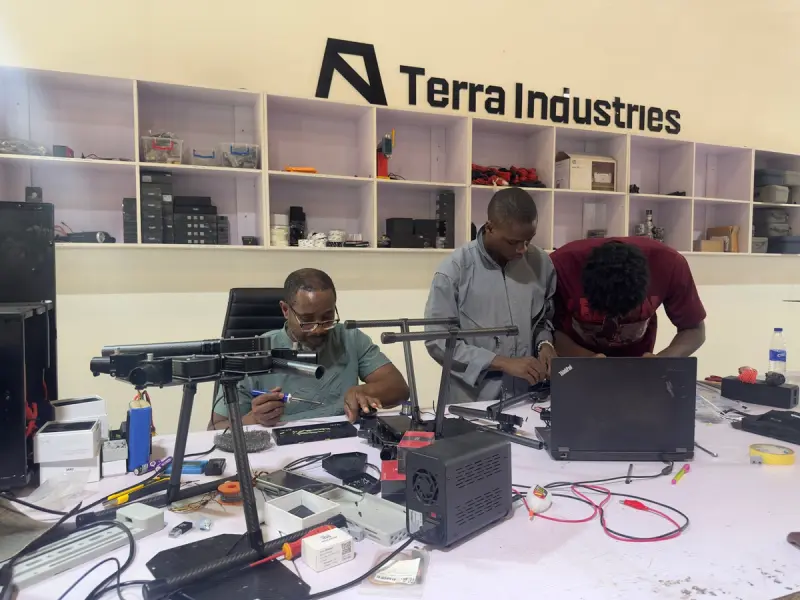
Terra Industries, a startup founded by two Nigerian engineers in their early twenties, is moving to emulate the Ukrainian UAV Revolution by stripping away the “Military-Industrial Complex” and replacing it with the Apple Playbook. Their target? A production capacity of 30,000 drones a year to defend $11 billion of Africa’s most critical infrastructure.
Traditional defense contractors rely on a fragmented supply chain: they buy engines from one country, sensors from another, and software from a third. This creates “Systemic Friction” and data vulnerabilities.
Terra Industries has rejected this model in favor of Vertical Integration. Following the “Apple Playbook,” they design and manufacture almost everything in-house:
-
The Hardware: Airframes, propellers, and high-density lithium-ion battery packs are forged in their Abuja factory—the largest drone facility on the continent.
-
The Software (ArtemisOS): Instead of using open-source or foreign kernels, Terra built its own operating system from scratch. This ensures Data Sovereignty, keeping the intelligence of African mines and refineries out of foreign clouds.
-
The “Kill Switch” Model: In a direct leaf out of the Silicon Valley subscription book, the hardware is tied to an annual software license. If the subscription lapses, the drone ceases to function. This ensures recurring revenue and prevents sensitive tech from being repurposed by unauthorized actors.
The war in Ukraine proved that 1,000 “disposable” $500 drones are often more effective than one $50 million tank. Terra Industries is applying this “High-Volume, Low-Cost” logic to Infrastructure Defense.
-
The Production Alpha: At a target of 30,000 units annually, Terra isn’t building “Boutique Drones.” They are building a Swarms-as-a-Service infrastructure.
-
The Cost Moat: By manufacturing locally, Terra claims their hardware is 55% cheaper than international competitors. This allows an oil refinery in the Niger Delta or a lithium mine in Zimbabwe to deploy a “Security Grid” that was previously financially impossible.
-
The Impact: Terra is already exporting to eight African countries and Canada, protecting critical assets ranging from hydroelectric power plants to gold mines.
The most striking part of the Terra story is the Capital Efficiency. While Western defense startups raise hundreds of millions before shipping a product, Terra reached $1.9 million in revenue with less than $600,000 in initial funding.
However, the “Big Signal” arrived in January 2026, when 8VC—the venture firm co-founded by Palantir’s Joe Lonsdale—led an $11.75 million seed round. This investment positions Terra as Africa’s first “Neo-Prime”—a technology-first defense company capable of competing with legacy giants like Lockheed Martin or DJI.
- The Data Moat: To maintain Sovereignty, Terra has partnered with local cloud providers like PipeOps instead of global giants. CEO Nathan Nwachukwu is clear: “We must keep the data within African hands.”
-
The Infrastructure Risk: Maintaining 30,000 drones requires a reliable software update grid. In regions with uneven 4G/5G connectivity, the “Subscription-to-Function” model could face operational hurdles if a drone cannot “check-in” with the home server.
-
The Quality Paradox: Scaling from a “Boutique Factory” to 30,000 units a year is an industrial nightmare. Terra’s success depends on whether their Abuja Forge can maintain Apple-level quality control at Ukrainian-level speed.
By late 2026, Terra Industries won’t just be a drone company; they will be the Operating System for African Security. As they expand into land and sea-based autonomous systems, the Abuja factory is becoming the blueprint for a new kind of African industrialization—one that doesn’t just export raw materials, but exports High-End Intelligence.
Terra Industries is proving that the “Question Mark” of Africa’s security can be answered with a locally-coded, vertically-integrated solution. In the 2026 economy, the “Titan” is the one who owns the sky.
Index Report: Terra Industries Vitals
| Component | Status | Strategic Significance |
| Founders | Nathan Nwachuku & Maxwell Maduka | Gen-Z engineers leading the “Neo-Prime” shift. |
| Output Target | 30,000 Units/Year | Industrial-scale production to rival global competitors. |
| Funding | $12M+ (Led by 8VC) | Strategic backing from Palantir-linked capital. |
| Core Moat | Vertical Integration | In-house OS (ArtemisOS) and hardware manufacturing. |
Sources & References
-
TechRadar (Apr 5, 2026): ‘30,000 drones a year’: African start-up looks to emulate Ukrainian UAV revolution
-
Empower Africa (Jan 13, 2026): Nigerian Drone Startup Terra Industries Secures $11.75m to Expand Homegrown Defence Technology
-
Resilience Media (Jan 12, 2026): Terra Industries raises $12M to become ‘Africa’s first neo-prime’