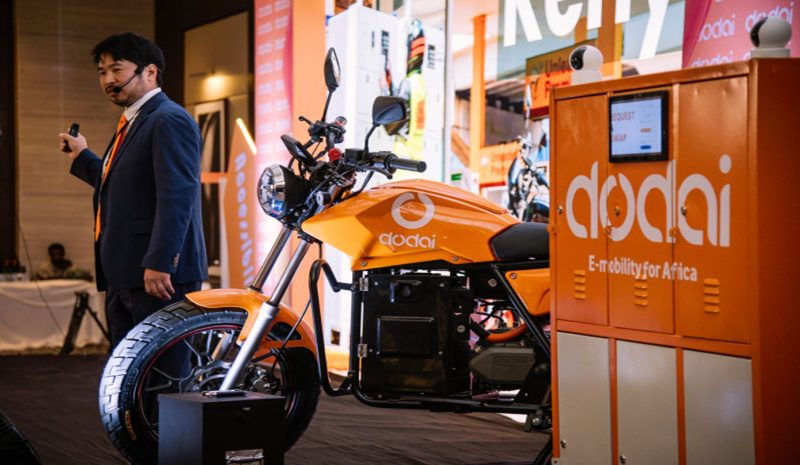
The Forced Transition
In 2024, the Ethiopian government issued a decree that sounded like science fiction to the rest of the continent: a total ban on the import of fossil-fuel-powered passenger vehicles. Two years later, the “potential” has become a Sovereign Mandate.
With fuel imports costing the state billions in scarce foreign exchange and the country defaulting on sovereign bonds in late 2023, Ethiopia didn’t pivot to EVs for the climate—it pivoted for Survival. Dodai, led by CEO Yuma Sasaki, is the industrial beneficiary of this macro-shift. Their $13M Series A (closed today, April 28, 2026) is the capital required to turn a policy mandate into a functional urban grid.
Equity for Brains, Debt for Batteries
The composition of this round—$8 million in equity and $5 million in debt—is a textbook example of Capital Efficiency in the “Hard-Asset” era.
-
The Equity Rail ($8M): Funded by a high-signal Japanese consortium (including UTokyo Innovation Platform and Inclusion Japan), this capital is earmarked for the “Intelligence” of the company—local assembly expansion, R&D, and market entry into cities like Abidjan and Accra.
-
The Debt Rail ($5M): Provided by British International Investment (BII), this is the “Mechanical Fuel.” Debt is used to finance the Battery-Swapping Infrastructure. In 2026, savvy founders know you don’t dilute your equity to buy batteries; you use debt to finance assets that generate predictable, recurring revenue.
Solving the “Uptime Friction”
Dodai’s model succeeds where imported “Western” EV models fail because it prioritizes Zero-Latency Energy.
-
Local Assembly: By utilizing “Completely Knocked Down” (CKD) kits, Dodai enjoys zero import duties under Ethiopia’s current tax regime. This makes a Dodai e-bike (~150,000 Birr) price-competitive with increasingly expensive used gasoline bikes.
-
The Swapping Network: For a commercial rider, a 4-hour charge time is a 4-hour loss of income. Dodai’s goal of 30 stations in 12 months and 1,000 stations in 3 years is designed to make “refueling” faster than a gas station visit.
-
Cost Arbitrage: Drivers switching to Dodai report 80–90% savings on fuel and maintenance. In an inflationary environment, this isn’t a “green choice”; it’s a Survival Play.
Dodai Strategic Scorecard (Q2 2026)
| Metric | Details |
| Total Series A | $13 Million ($8M Equity / $5M Debt) |
| Lead Debt Partner | British International Investment (BII) |
| Target Infrastructure | 1,000 Swapping Stations (3-year goal) |
| User Milestone | 2,000 bikes deployed; 30,000 user target |
| Expansion Nodes | Addis Ababa (Current), Abidjan, Accra, Dar es Salaam |
Index Brief: Key Stakeholders (2026)
-
The Architect: Yuma Sasaki (Founder/CEO) and Hilina Legesse (SVP).
-
The Financiers: BII, UTokyo Innovation Platform, Persistent Energy.
-
The Policy Rail: Ethiopian Ministry of Transport & Logistics.
Sources & References
-
TechCabal: Dodai raises $13 million to scale electric motorbikes in Ethiopia
-
Africa Global Funds: BII Commits $5 Million to Dodai Series A
-
Launch Base Africa: Dodai Model: Infrastructure-led growth in Addis Ababa
-
Daba Finance: Ethiopia EV Adoption Gains Pace After Gas Car Import Ban
The “Index” Take: In 2026, the “App era” is a footnote. The real alpha is in Physical Interoperability. Dodai is proving that if you control the battery-swapping station, you control the city’s movement. By leveraging Ethiopia’s aggressive fiscal policies and BII’s “Patient Debt,” Dodai is hard-coding the first truly Sovereign Electric Grid in East Africa. If you aren’t building the infrastructure, you are just renting the future.