I. THE DISRUPTION: The Dopamine Crash
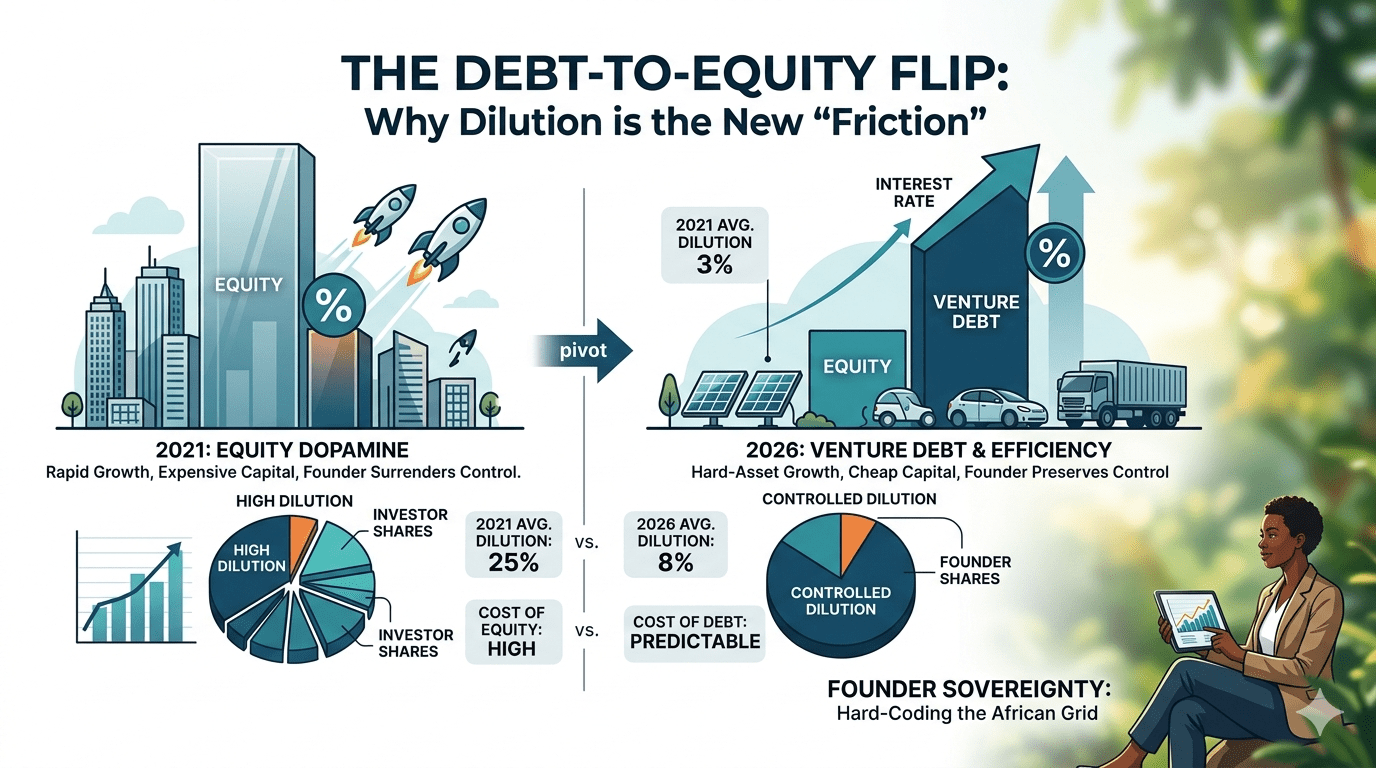
In the vintage era of 2021, a “Series A” was a celebration of dilution. Founders bragged about the millions raised, often ignoring the fact that they were selling off 20-25% of their future for a check today. It was an era of Equity Dopamine—high-growth projections fueled by expensive, permanent capital.
Fast forward to April 28, 2026, and that dopamine has been replaced by Unit Economic Discipline. The data is clear: Venture debt now accounts for nearly 50% of the total capital volume in Africa’s top tech hubs. The reason? Founders have identified Dilution Friction. If your company is doubling in value every 12 months, selling equity is mathematically the most expensive way to fund a motorcycle or a solar panel.
II. THE “UNIT ECONOMIC PROOF”: Why 12% is Cheaper than 20%
To understand the “Flip,” you have to look at the Cost of Capital Arbitrage.
Imagine a startup valued at $10 million today, projected to be worth $40 million in 24 months.
-
The Equity Path: You sell 20% of your company for $2M. In two years, that $2M check has cost you $8 million in equity value. Your “interest rate” was effectively 300%.
-
The Debt Path: You take a $2M venture debt facility at a 12% annual interest rate. Over two years, you pay back $2.48M. Your cost of capital is $480,000, and you still own 100% of that equity growth.
In 2026, for “Hard-Asset” companies with predictable cash flows, the choice isn’t just strategic—it’s a mathematical necessity.
III. CASE STUDIES: The Architecture of the Mix
1. Dodai (Ethiopia): The $13M Series A Hybrid
As we reported earlier today, Dodai’s latest round is the blueprint for the 2026 “Mixed-Rail” funding strategy.
-
The Equity ($8M): Used for “Soft Assets”—talent, software R&D, and market expansion. This is capital that can afford to be “patient” while the company enters new territories like Abidjan.
-
The Debt ($5M): Sourced from British International Investment (BII). This capital is hard-coded to the Battery-Swapping Network. Because a battery generates daily revenue, it can service its own debt. This allows Dodai to scale its infrastructure without wiping out the founder’s stake.
2. MAX (Nigeria): Financing the E-Mobility Rail
MAX has moved aggressively away from pure equity for its vehicle financing.
-
The Mechanism: By utilizing specialized debt facilities for their EV fleet, MAX treats their electric bikes as Yield-Generating Assets rather than venture experiments.
-
The Outcome: The debt is collateralized by the vehicles themselves. As the riders pay their daily fees, the debt is amortized. The equity remains “clean,” reserved for the high-value software platform that manages the fleet.
IV. THE INFRASTRUCTURE: Why “Hard Assets” Demand Debt
The surge in debt is tied directly to the Infrastructure Pivot of 2026. You don’t use equity to buy things that depreciate.
-
Solar & EVs: These are “Body” assets. They are predictable, physical, and have clear lifespans.
-
Logistics: Warehousing and delivery fleets are now being funded through Asset-Backed Securities (ABS), allowing logistics startups to compete with traditional giants without the “Burn Rate” typical of the 2021 era.
V. THE VITALS: The 2026 Funding Scorecard
| Funding Type | 2021 Usage | 2026 Usage | Strategic Role |
| Equity | 90% | 50% | R&D, Talent, Expansion |
| Venture Debt | <10% | 45%+ | Equipment, Vehicles, Inventory |
| Grants/Hybrid | Minimal | Increasing | R&D and Sustainability Proofs |
Index Brief: The Playbook for 2026 Founders
-
The Golden Ratio: Aim for a 60:40 Equity-to-Debt ratio for hardware-heavy businesses.
-
The Revenue Anchor: Do not take debt until your Monthly Recurring Revenue (MRR) is 3x your debt service obligation.
-
The Exit Guard: Ensure your debt agreements don’t include “toxic” warrants that allow lenders to take equity chunks at a discount later.
Sources & References
-
IndexPrima Analytics: The State of African Venture Debt 2026
-
BII Report: Financing the Transition to Electric Mobility in Africa
-
Launch Base Africa: Why MAX and Spiro are Pivoting to Debt-Led Growth
The “Index” Take: In 2021, we were obsessed with the “Raise.” In 2026, we are obsessed with the “Return.” Venture debt is the tool that has allowed the African founder to stop being a “tenant” in their own company and start being the Landlord of the Infrastructure. If you’re still funding your hardware with equity, you aren’t scaling—you’re surrendering.