Emerging tech ecosystems frequently fall into a classic capital allocation trap: pouring direct pre-seed and seed funding into early-stage startups while ignoring the fragile institutional frameworks meant to support them. Without robust, highly capable local incubators and accelerators, injected capital often vaporizes due to poor market validation, unrefined business models, and low investment readiness.
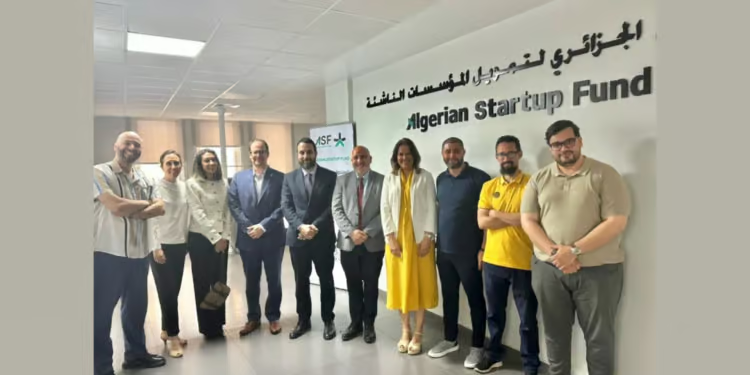
Algeria is choosing a different structural route. In a coordinated multi-stakeholder push, Flat6Labs and the International Finance Corporation (IFC)—in alignment with Algeria’s Ministry of Knowledge Economy, Startups and Micro-Enterprises and the Government of the Netherlands—have launched StartAlgeria.
This initiative represents a deliberate pivot from retail venture deployment to wholesale ecosystem plumbing. Instead of backing individual founders, StartAlgeria targets the institutional capacity of Entrepreneur Support Organizations (ESOs) and incubators to create a long-term systemic multiplier effect.
The Infrastructure Pivot: Fixing the Enabler Gap
Algeria’s startup landscape is experiencing a sharp period of policy-driven expansion. As the nation aggressively seeks to diversify its economy away from hydrocarbon dependency, the state has rolled out dedicated startup legislation, official labeling frameworks, and venture funds. However, a major bottleneck remains: the lack of standardized, high-quality local incubation infrastructure capable of graduating startups from abstract concepts to internationally investable ventures.
                THE STARTUP TALENT MULTIPLIER FUNNEL

  [State Ambition]   ──► Diversify Beyond Hydrocarbons (Knowledge Economy)
                                       │
                                       ▼
  [Systemic Problem] ──► Immature Incubation Rails & Weak Post-Program Survival
                                       │
                              (StartAlgeria Pivot)
                                       ▼
  [The Blueprint]    ──► Upgrade ESOs ➔ Standardize Selection ➔ Scale Startups
StartAlgeria aims to fix this by treating incubators not just as real estate projects providing co-working spaces, but as programmatic factories that must be optimized for quality control, mentorship delivery, and financial sustainability.
Programmatic Design: From Core Curriculum to Mentorship Loops
The rollout of StartAlgeria is structured to combine immediate international framework transfers with extended operational safety nets for local enablers.
-
The Algiers Pilot Focus: The pilot phase concentrates exclusively on a selected cohort of incubators operating within the capital, Algiers. This allows the program to refine its localized baseline before scaling the architecture to secondary and tertiary Algerian markets.
-
The Structured Learning Core: Selected ESOs undergo intensive masterclasses and workshops covering foundational operational mechanics:
-
Data-Driven Startup Selection: Eradicating subjective vetting by implementing objective, metric-based screening funnels.
-
Program Design & Delivery: Transitioning from generic business lectures to iterative product-market fit sprints.
-
Investment Readiness Frameworks: Training hub managers on how to structure seed-stage data rooms and cap tables that line up with international venture capital expectations.
-
-
The 6-Month Post-Program Runway: Recognizing that training workshops rarely stick without long-term execution support, the initiative features a mandatory 6-month post-program mentorship loop. This phase provides hub executives with continuous advisory support on fundraising strategies for their own hubs, corporate partnership construction, and moving away from reliance on erratic grant funding toward self-sustaining revenue models.
Structural Comparison: Direct Capital vs. Institutional Capacity Building
Understanding the difference between traditional direct-to-founder funding and the StartAlgeria capability architecture reveals why developmental finance institutions are shifting upstream.
| Vector | Traditional Direct Financing Model | StartAlgeria Capacity Architecture |
| Primary Target | Individual early-stage founders & tech startups. | Entrepreneur Support Organizations (ESOs) & Hubs. |
| Operational Goal | Immediate product launch and micro-capital runway. | Scaling institutional capabilities and long-term ecosystem plumbing. |
| Risk Profile | High attrition; startups fail if the local hub lacks mentorship depth. | Low attrition; builds standard rails that benefit multiple future cohorts. |
| Market Expansion | Highly localized; founders struggle to navigate cross-border regulatory walls. | Globally integrated; links local hubs directly to global VC and policy networks. |
| Sustainability | Relies on continuous follow-on equity rounds. | Focuses on building recurring revenue models for the enabler hubs. |
The Macro View: Positioning for Regional Dominance
The backing of the IFC and the Dutch government, combined with Flat6Labs’ footprint across 15 countries, highlights the broader geopolitical and macroeconomic currents shaping North African technology. Algeria possesses an ambitious, highly educated youth demographic, yet its regional venture capture has historically lagged behind neighbors like Egypt, Morocco, or Tunisia.
“Algeria’s startup ecosystem is demonstrating remarkable potential and a rapidly growing level of maturity. The opportunity today lies in further empowering entrepreneurship support organizations to match this momentum by strengthening their ability to identify and nurture high-potential startups.”
— Yehia Houry, CEO of Flat6Labs
By transforming local incubators from passive physical real estate into active network accelerators, StartAlgeria builds an institutional shield for early-stage capital. If the pilot in Algiers successfully translates into better-run programs and higher investment readiness scores for local startups, it will create a scalable template for how sovereign states can co-design tech infrastructure alongside global developmental financial institutions.
The ultimate test for Algeria will be whether these upgraded hubs can consistently push native innovations past the borders of the domestic market and smoothly plug them into international corporate supply chains.
Sources & Reference Context
-
[1] Financial Afrik Portal: In Algeria, Flat6Labs and IFC launch StartAlgeria to strengthen incubators
-
[2] Techbuild Africa Ecosystem Insights: Flat6Labs, IFC Launch StartAlgeria To Strengthen Algeria’s Startup Support Ecosystem
-
[3] Tech.Africa Regional Report: Flat6Labs, IFC launch StartAlgeria for incubators
-
[4] Zawya / APO Group Intelligence Wire: Flat6Labs and International Finance Corporation (IFC) Launch StartAlgeria to Empower ESOs
-
[5] Arab Founders Corporate Analysis: Algeria Partners with Flat6Labs and IFC to Boost Early-Stage Startups