In a world increasingly shaped by Artificial Intelligence, one question continues to emerge across developing communities: how do we ensure that young people are not merely spectators of technological change but active participants and leaders in shaping the future?
For two Mandela Washington Fellows from different cohorts, the answer was clear: bring practical AI education directly to young people and students in their communities.
Through the support of the Mandela Washington Fellows Alumni Association of Nigeria (MWFAAN) and its Inter-Cohort Collaboration Grant Initiative, DigiSkills Makurdi: AI Tools Bootcamp for Youth and Students in Benue State became a reality. Led by Michael Benjamin, a 2024 Mandela Washington Fellow, and co-facilitated by Solomon Kershima Yateghtegh, a 2025 Mandela Washington Fellow, the initiative sought to bridge the growing gap between emerging technologies and the young people who stand to benefit most from them.
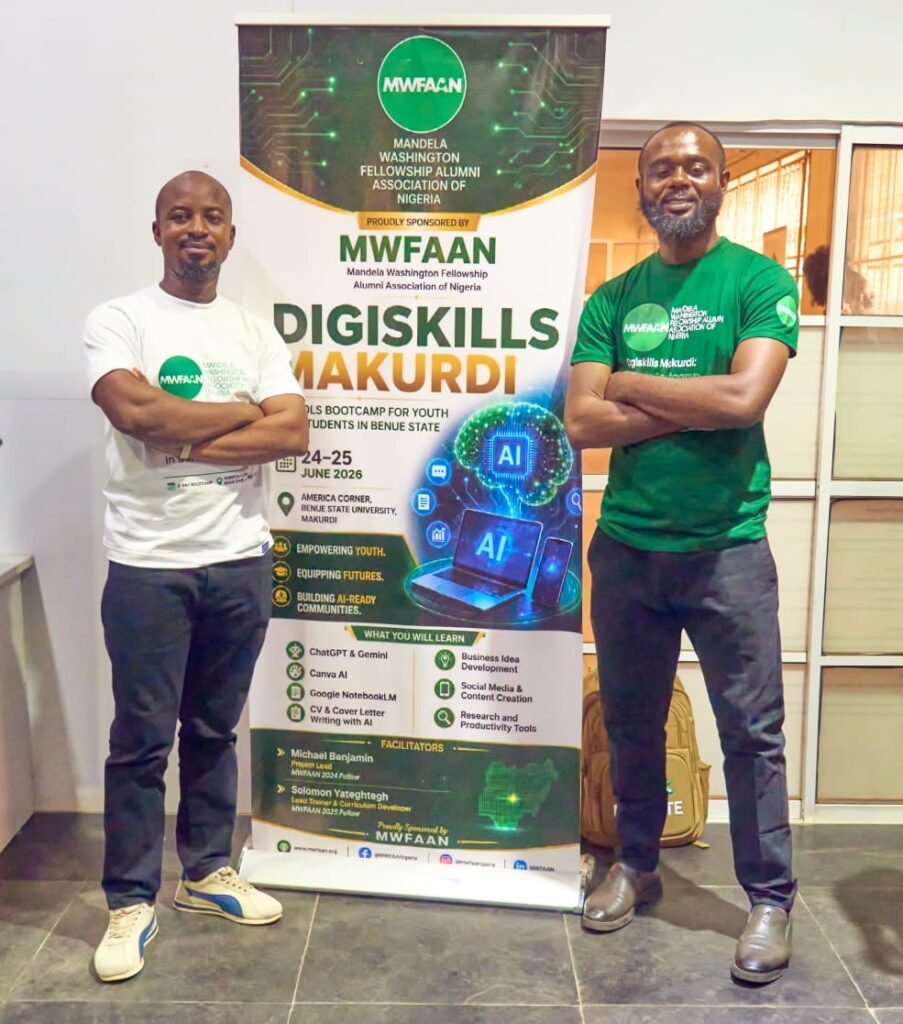
Held on June 24–25, 2026, at the Window on America, Moses Orshio Adasu University, Makurdi, the two-day bootcamp brought together 40 + young people and students from diverse educational and professional backgrounds to explore the practical applications of Artificial Intelligence in today’s economy.
From Global Leadership to Local Impact
One of the most powerful aspects of the Mandela Washington Fellowship is the emphasis on translating global experiences into local solutions. The collaboration between fellows from the 2024 and 2025 cohorts exemplifies this principle.
The Inter-Cohort Collaboration Grant Initiative created by MWFAAN provides an important platform for fellows from different cohorts to work together, combining experiences, expertise, and networks to address pressing community challenges.
For the DigiSkills Makurdi team, the challenge was clear: while conversations around Artificial Intelligence continue to accelerate globally, many young people in communities such as Benue State remain excluded from practical opportunities to understand and leverage these technologies.
The objective was not simply to teach participants about AI. The objective was to empower them to use AI.
Day One: Demystifying Artificial Intelligence
The first day of the bootcamp focused on building foundational understanding.
Participants explored what Artificial Intelligence really is, how it already influences everyday life, and why AI literacy is rapidly becoming an essential skill for the future workforce.
The sessions introduced participants to practical AI tools, including ChatGPT and Google Gemini, through guided demonstrations and hands-on exercises. Participants experimented with prompts, explored use cases, and discussed both the opportunities and potential risks associated with AI technologies.
Perhaps the most impactful aspect of the day was hearing participants share their own experiences, concerns, and aspirations regarding Artificial Intelligence. For many, this was their first opportunity to engage with AI beyond headlines and social media discussions.
As participants quickly discovered, AI is not about replacing human intelligence—it is about amplifying human potential.
Day Two: Putting AI to Work
If Day One focused on understanding AI, Day Two focused on application.
Participants learned how to leverage Artificial Intelligence for career advancement, entrepreneurship, academic research, productivity, and content creation.
Using ChatGPT, participants developed professional CVs and cover letters. Through Google Gemini, they explored business planning and market research. Canva AI enabled them to create professional designs and marketing materials, while NotebookLM introduced them to AI-assisted research and knowledge management.
To encourage collaboration and experimentation, participants were divided into groups to develop practical AI strategies across business, career development, academic research, and productivity.
The results were remarkable.
Within just two days, participants moved from curiosity to competence, confidently applying AI tools to real-world challenges and opportunities.
More Than a Training Programme
One of the most revealing outcomes of the bootcamp came during the participant feedback sessions.
While participants expressed overwhelming enthusiasm and appreciation for the programme, many shared a common sentiment: two days simply were not enough.
Several participants recommended that future editions of the bootcamp run for at least one week, allowing for deeper exploration, more practical exercises, and advanced learning opportunities.
This feedback was perhaps the strongest indicator of the programme’s success.
When learners request more time to learn, it demonstrates not only engagement but also a recognition that the skills being taught have immediate value and long-term relevance.
Building an AI-Ready Generation
The success of DigiSkills Makurdi reinforces an important reality: Artificial Intelligence education cannot remain limited to major cities, elite institutions, or technology professionals.
Young people in communities across Nigeria and Africa deserve access to practical AI education that prepares them for the future of work, entrepreneurship, research, and innovation.
The collaboration between Michael Benjamin and Solomon Kershima Yateghtegh demonstrates what is possible when alumni networks, leadership development programmes, and local communities work together to create meaningful opportunities.
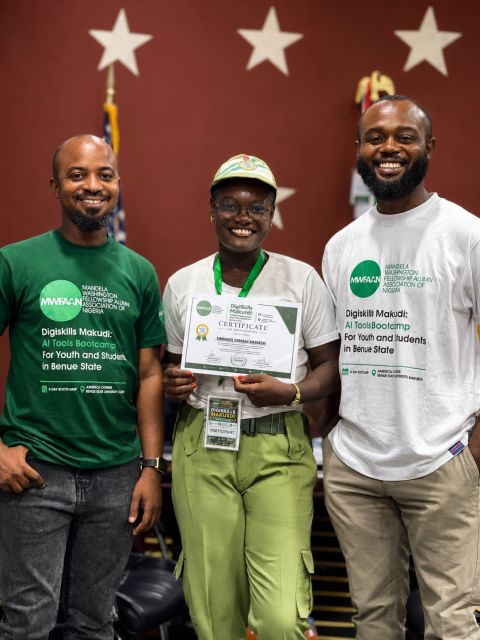
A total of 40+ participants completed the bootcamp, received certificates of participation, engaged in practical learning experiences, and joined a growing community of AI learners and innovators in Benue State.
The Power of Alumni-Led Innovation
The DigiSkills Makurdi AI Tools Bootcamp would not have been possible without the vision and support of the Mandela Washington Fellows Alumni Association of Nigeria (MWFAAN) and its leadership.
Special appreciation is due to Julius Ilori, President of MWFAAN, for championing the Inter-Cohort Collaboration Grant Initiative and creating opportunities for fellows to extend their impact beyond their individual fellowship experiences.
As Artificial Intelligence continues to reshape economies and societies around the world, initiatives such as DigiSkills Makurdi provide a compelling model for how local leadership, strategic collaboration, and investment in young people can help communities prepare for the future.
The two-day bootcamp may have concluded, but the journey toward building an AI-ready generation in Benue State has only just begun.
Because when young people are given access to the right tools, skills, and opportunities, entire communities are transformed.