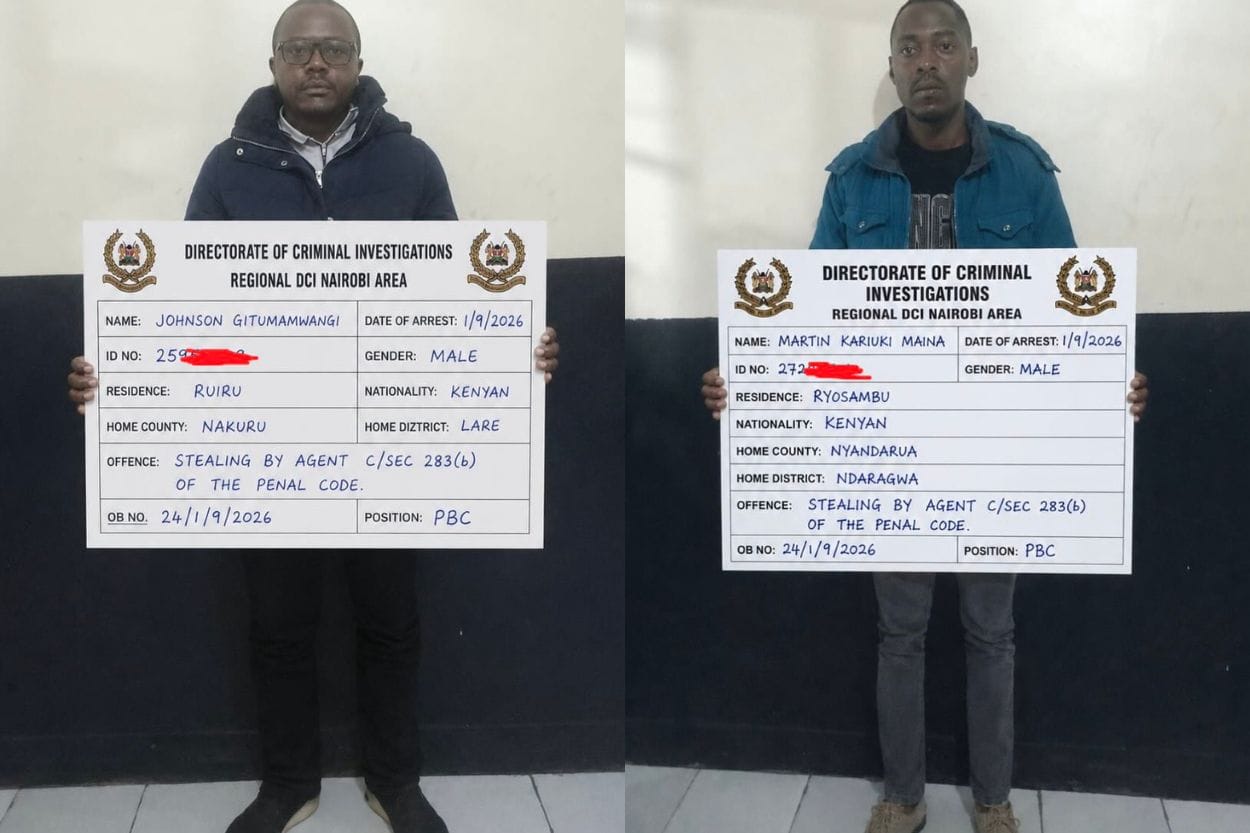
Kenya’s Directorate of Criminal Investigations arrested two directors of Flexitech Group Limited, the company behind save-now-buy-later fintech FlexPay, this week over the alleged theft of KES 31.2 million, roughly $242,000, belonging to an unnamed major retail chain. Martin Kariuki Maina and Johnson Gituma Mwangi were arrested in Roysambu, Nairobi, with Mwangi notably identified by FlexPay itself back in 2023 as the company’s co-founder and long-serving Chief Operating Officer, putting one of the business’s senior executives directly at the centre of the investigation rather than a peripheral figure.
What They’re Accused of Doing
According to the DCI, Flexitech had been acting as an agent for the retailer, collecting payments from customers who purchased goods and picked them up at various branches, with that money meant to be remitted onward to the retailer afterward. “The funds had been entrusted to the suspects for onward remittance to the retailer,” the DCI said in its statement, adding that detectives established the two allegedly diverted the funds for their own use, acting jointly with other suspects who remain at large. The specific amount involved, KES 31,213,700.95, gives the case an unusually precise figure rather than a rounded estimate, suggesting investigators have already traced the transactions in some detail.
Where the Case Actually Stands
Maina and Mwangi are expected to be arraigned at the Milimani Law Courts and charged with stealing by agent under Section 283(b) of Kenya’s Penal Code. The DCI says its investigation remains ongoing, with detectives continuing to pursue other individuals believed to be involved. It’s worth being precise about what has and hasn’t been established at this stage: these are allegations that will need to be tested through Kenya’s legal process, an arrest and an expected charge are not a finding of guilt, and both men are presumed innocent unless and until proven otherwise in court.
A Business Already Under Strain
The arrests land at a genuinely difficult moment for FlexPay independent of this specific case. In the months leading up to the arrests, the company had been facing a steady stream of customer complaints about delayed withdrawals and difficulty accessing money saved on the platform, along with slow responses from customer support. Recent Google Play reviews cited by TechCabal include a customer who said a KES 15,000 refund requested in June still hadn’t been resolved by July. It’s important to note that the DCI has not linked these customer complaints to the alleged KES 31.2 million theft involving the retailer specifically, they appear to be separate issues rather than the same underlying matter, but both are unfolding during the same stretch of scrutiny for the company, which compounds the pressure on FlexPay regardless of how directly connected the two threads turn out to be.
What FlexPay Actually Does
FlexPay built its business around a save-now-buy-later model, something close to a modern, digital version of the old lay-by system, where customers deposit money in instalments until they reach a savings goal and only then complete a purchase. The pitch was explicitly about financial inclusion, positioning FlexPay as a debt-free alternative to buy-now-pay-later products and protecting customers from the risks of taking on credit they might struggle to repay. Over three years of operation, the company built a base reportedly exceeding 200,000 customers, in a country that already has deep experience with mobile-first financial products as the birthplace of M-Pesa, Africa’s first mobile money service.
Why This Matters Beyond One Company
This case is a sharp illustration of a structural risk that runs through a lot of consumer fintech, not just FlexPay specifically: when a platform or its agents handle large volumes of customer or merchant money on someone else’s behalf, the entire model depends on that money actually moving where it’s supposed to go, every time, without exception. When that trust breaks down, whether through mismanagement, alleged fraud, or some combination of both, the people most exposed are rarely the ones with the resources to absorb the loss quickly. A customer waiting on a few thousand shillings they’d saved toward sending a child back to school doesn’t have easy access to a lawyer or a regulator the way a large retail chain does, which is part of why the retailer in this case was able to file a complaint and trigger an investigation while individual customers were left navigating slow refunds through app store reviews instead.
What Happens Next
The case now moves through Kenya’s courts, where the specific allegations, the mechanics of how the funds were allegedly diverted, and the identity of the still-unnamed retailer will presumably become clearer as proceedings continue. For FlexPay, the more immediate question is whether the company can keep operating and serving its existing customer base while two of its own directors face a criminal case tied directly to money that was supposed to pass through its hands to a business partner.