Here is a single fact that explains more about Africa’s connectivity problem than any coverage map ever will: moving data from Lagos to London costs roughly four times less than moving the same data from Lagos to Abuja. Not to another continent. To Nigeria’s own capital city, about 700 kilometres away.
That is not a rounding error or a quirk of one route. It is the clearest possible symptom of how African network infrastructure has actually been built over the past two decades, and why the standard diagnosis, that Africa simply needs more infrastructure, keeps producing investment that doesn’t fix the problem it was meant to solve. The continent does not have an infrastructure shortage in any simple sense. It has an infrastructure shape problem. Enormous capacity has been built at the top of the stack, where the money and the headlines are. Comparatively little has been built in the unglamorous middle, and almost nothing has been done about the two constraints that ultimately determine whether any of it gets used: electricity and affordability.
The Coverage Argument Is Largely Over, and Almost Nobody Has Noticed
Start with the number that should have reframed this entire conversation years ago. According to GSMA’s most recent continental assessment, roughly 63% of Africa’s population lives inside mobile broadband coverage and does not use mobile internet. That is close to one billion people who are, technically speaking, already connected. The network reaches them. They are not using it.
Globally, GSMA has measured the usage gap at roughly nine times the size of the coverage gap. In Sub-Saharan Africa specifically, the coverage gap has been measured in the low teens as a percentage of population while the usage gap sits around 60%. The distinction matters enormously, because the two problems have almost nothing in common. A coverage gap is a capital expenditure problem: towers, spectrum, backhaul, slow and expensive but well understood. A usage gap is not an infrastructure problem at all. It is the price of a handset measured against a daily wage, whether someone can read the interface, whether anything on the network is worth paying for, and whether the electricity exists to charge the device in the first place.
Malawi illustrates how stark this can get. GSMA found that 80% of Malawians live within mobile broadband coverage without using mobile internet, against a regional average closer to 65%. Smartphone adoption in the country sits at 33%. You could build another thousand towers in Malawi tomorrow and it would not move that number, because the binding constraint is not signal.
The Money Went to the Top of the Stack
Africa now has something on the order of 77 submarine cables landing on its coasts, and the continent’s international bandwidth has expanded dramatically. Equiano, 2Africa, and a string of newer systems have poured capacity into landing stations from Lagos to Mombasa to Cape Town. This is genuine progress, and it was genuinely necessary.
It also stops at the shoreline. Having a cable land on your coast does not mean fast internet reaches people inland, because bandwidth needs national fibre backbones to get anywhere. The African Telecommunications Union and Africa Analysis put Africa’s operational terrestrial fibre at roughly 2.13 million kilometres, of which about 1.34 million kilometres is actually active, across a landmass of 30 million square kilometres. For comparison, that is a fibre network serving a continent larger than China, India, the United States, and most of Europe combined.
The consequence shows up hardest in landlocked countries, which have no coastline and therefore no landing station of their own, and must reach the sea through fibre routes, commercial agreements, and regulatory regimes belonging to their neighbours. The ITU estimates that only about 25% of people across Africa’s 16 landlocked developing countries were using the internet in 2024, against 68% globally. Mobile broadband coverage across those same countries sits around 86%. Once again, the signal is there. The usable, affordable, routable connection is not.
There is an image from a research visit to Angola that captures this better than any statistic. The Sangano cable landing station is a genuinely impressive, high-technology facility operated by a competent company, routing internet traffic across the country. The school a few hundred metres away does not have electricity.
The Power Layer Is the Constraint Nobody Budgets For
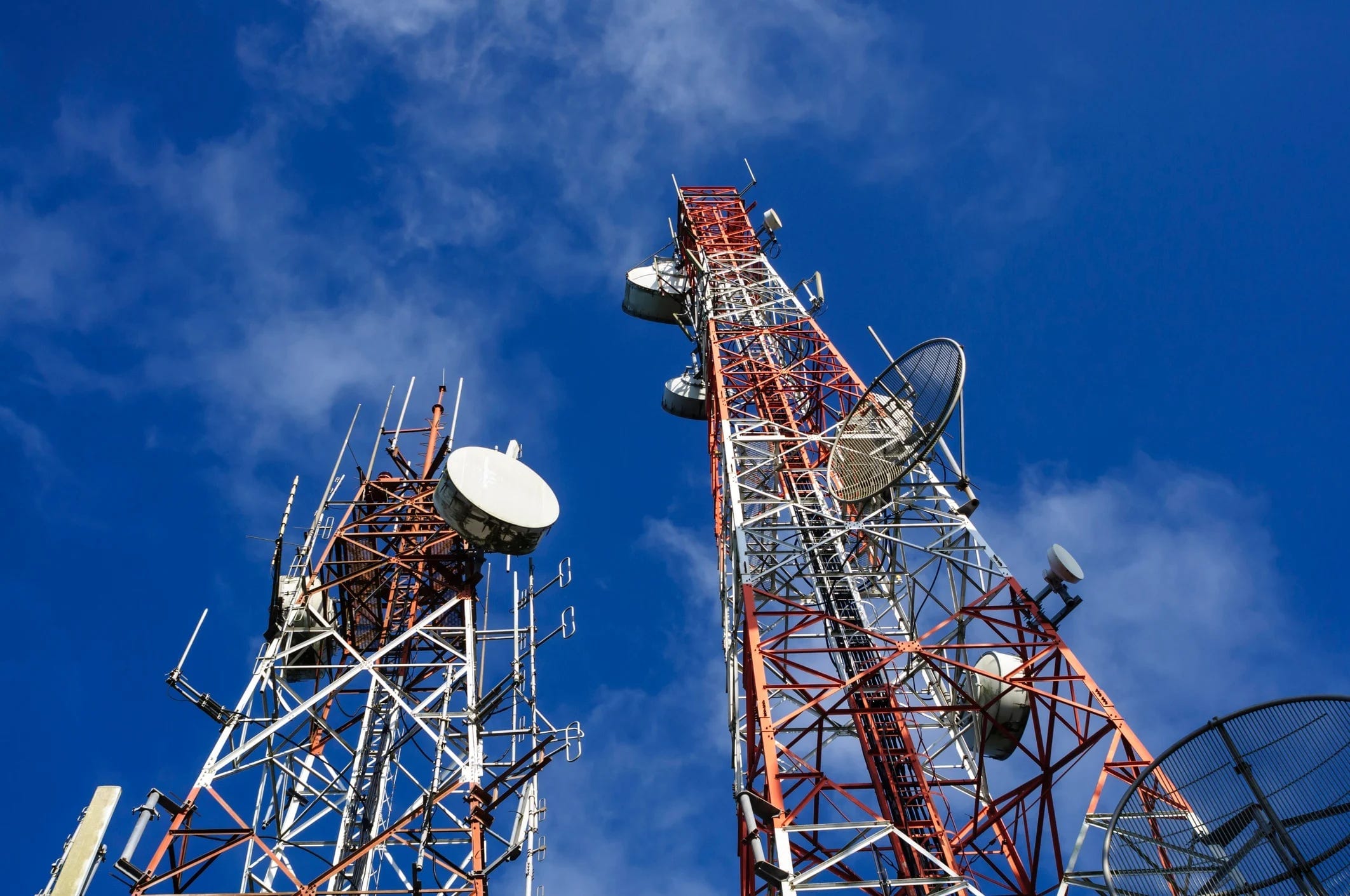
Which brings us to the problem that quietly governs everything else. Africa runs roughly 500,000 telecommunications towers, and the majority of them are powered by diesel generators rather than grid electricity. In developed markets, the pattern is inverted: towers connect to the grid and keep diesel as backup. In much of Africa, diesel is the primary power source, because the grid either does not reach the site or cannot be relied upon when it does.
The economics of this are brutal. Energy accounts for as much as 60% of operating costs for towers in off-grid areas, and diesel prices across many African markets rose somewhere between 40% and 60% over a recent two-year stretch. Fuel has to be trucked to remote sites on dedicated logistics chains, a meaningful share of fuel budgets gets lost to theft, and generators need servicing every few hundred operating hours, each visit potentially a full day’s drive from the nearest depot. When a generator fails between scheduled visits, the tower goes dark, and with it mobile money, emergency calls, and everything else people actually depend on. Fuel shortages in northern Nigeria and parts of Congo have produced exactly that outcome.
This is the hidden tax on every other layer of the stack. It is why a tower that costs $30,000 to $50,000 to install conventionally can be brought in closer to $10,000 using integrated off-grid solar power systems, and why the cost of reaching rural populations has stayed stubbornly high even as equipment prices fell. It is also why a technology company building a data centre in Douala, Cameroon this year concluded that the sensible thing to do was build its own power plant alongside it rather than trust the national grid to keep AI hardware running. When a $75 million project decides the cheapest path to reliability is generating its own electricity, that tells you the power layer has become the actual bottleneck, not a background inconvenience.
Affordability Is Where the Whole Stack Terminates
Suppose the cable lands, the backhaul reaches inland, and the tower stays powered. A person still needs a device and a data bundle.
GSMA’s most recent connectivity research found that the poorest 20% of people in low and middle income countries spend an average of 44% of their monthly income to buy an entry level smartphone. In Sub-Saharan Africa specifically, that figure rises to 76%. Three quarters of a month’s income, for the cheapest device that can meaningfully access the internet. In Nigeria, GSMA has found roughly 60% of people with 4G coverage had never used mobile internet, with 42% of those non-users simply lacking an internet-capable device.
And that pressure is about to intensify from an unexpected direction. Rising memory and chipset costs, driven substantially by global demand for AI infrastructure, are pushing entry-level smartphone prices up. The same AI boom generating optimistic headlines about African data centres is, at the component level, making the devices that would let Africans actually use those services more expensive. There is an obvious irony in building AI compute capacity on a continent where a billion covered people cannot afford the handset needed to reach it.
The Whole Structure Is Also Fragile in a Way That Rarely Gets Priced In
In March 2024, four submarine cables off West Africa failed within roughly a day of each other. Thirteen countries experienced degraded service or near-total internet outages. Ghana’s regulator estimated five weeks for full restoration from the moment repair vessels were dispatched. Banks, stock exchanges, mobile money operators, and ordinary businesses across the region simply stopped functioning normally for weeks. A separate incident in the Red Sea weeks earlier had already severed three cables carrying a substantial share of Europe-to-Asia traffic through Egypt.
This is what a top-heavy infrastructure stack looks like under stress. When most of a region’s international capacity runs through a small number of physical paths, and when the domestic alternative routes are thin or nonexistent, a single event at sea becomes a continental economic event. Resilience is not really about how many cables you have. It is about whether traffic has anywhere else to go when one fails, which is a question about terrestrial routes, cross-border interconnection, and internet exchange points, all of which sit in exactly the middle layer that keeps getting underfunded.
Why the Money Keeps Going to the Wrong Place
If the middle mile and the power layer are the binding constraints, why does capital keep flowing to submarine cables and, more recently, to AI data centres?
Because those investments are legible. A submarine cable has a name, a landing ceremony, a capacity figure in terabits, and a clear owner who can monetise wholesale capacity. A data centre has a megawatt number and a hyperscaler tenant. National fibre backhaul across 400 kilometres of difficult terrain has none of that. It requires right-of-way permissions from multiple authorities, survives or dies on protection from vandalism and road construction, generates revenue slowly, and produces no photograph worth putting in an annual report. Tower power systems are worse still: they are a cost line, not a revenue line.
The result is a pattern visible across the continent this year. Ghana appointed an exclusive 5G infrastructure provider that missed its commercial launch deadline and built 49 live sites against a planned 4,400, and even when its network went live in three cities, no operator had actually connected to it. Kenya committed to 588 digital hubs and has completed 177, with 233 not yet started. These are not failures of ambition or of capital availability. They are failures at exactly the layer where infrastructure stops being glamorous and starts being logistics.
Nigeria’s own operators have been candid about the same thing from the other direction. Fibre vandalism and site lockouts continue to disrupt service regardless of how much gets spent on network capacity, because the problem is not the capacity, it is the physical and institutional environment the capacity has to survive in.
What Is Actually Working
The encouraging part is that the interventions targeting the right layers are starting to appear, and they look quite different from the ones that dominated the previous decade.
Solar is genuinely transforming tower economics rather than just tower emissions. One tower operator in Kenya has moved 82% of a 500-tower portfolio to solar and committed $52.5 million to build 300 more solar-powered sites serving Safaricom, Airtel, and Telkom. A pan-African operator managing over 500 remote sites reported cutting generator runtime by more than 70% and reaching 99.5% average power uptime by moving to managed solar. Nigeria’s regulator has gone further conceptually, encouraging operators to integrate towers into solar minigrids that also supply surrounding homes and businesses, which turns a cost centre into shared community infrastructure.
Direct-to-phone satellite is attacking the coverage gap in exactly the places where the tower economics never worked. The commercial launch of satellite-to-mobile service in the Democratic Republic of Congo this year, in a country where roughly 30% of the population used the internet as of 2023 and where forest, terrain, and security make tower construction genuinely impractical, is a more honest response to that specific problem than pretending more towers were coming.
Protected terrestrial routes are being built deliberately for resilience rather than just capacity. Kenya’s new coastal cable system pairs a submarine route with a parallel protected land route specifically so that damage to one does not sever the connection, which is precisely the middle-layer redundancy the 2024 outages proved was missing. A protected fibre route running from the Kenyan coast into eastern DRC does the same thing for a landlocked region that previously had no reliable path to a landing station at all.
And the handset problem is finally being treated as an infrastructure problem rather than a consumer one. GSMA’s Handset Affordability Coalition has been piloting a roughly $40 smartphone across Nigeria and five other African markets. That is a more direct attack on the usage gap than any tower.
So What Is the Problem, Actually
My honest read is this. Africa’s network infrastructure problem is not scarcity, and framing it that way has quietly misdirected a decade of investment. The problem is that the continent has built a stack that is heavy at the top, thin in the middle, and disconnected from the two conditions that determine whether any of it converts into usage.
International bandwidth is abundant and getting more so. National and cross-border terrestrial fibre is scarce, expensive, and fragile, which is why moving data within a country can cost several times more than moving it across an ocean. Tower power is largely privatised onto diesel supply chains that are volatile, expensive, and a primary cause of the outages people actually experience. And at the end of the chain, roughly a billion people who are already covered cannot afford the device to use what has been built for them.
The practical implication is uncomfortable for the way this sector talks about itself. The highest-return infrastructure investment available on the continent right now is probably not another submarine cable or another AI data centre. It is national backhaul, cross-border interconnection, internet exchange points, tower power systems, and handset financing. None of those produce a good launch photograph. All of them are what determines whether the good launch photographs end up meaning anything.
Until the middle of the stack gets built with the same seriousness as the top, Africa will keep landing world-class capacity on its coastlines and keep discovering that it costs four times more to move data to its own capital cities than to someone else’s.