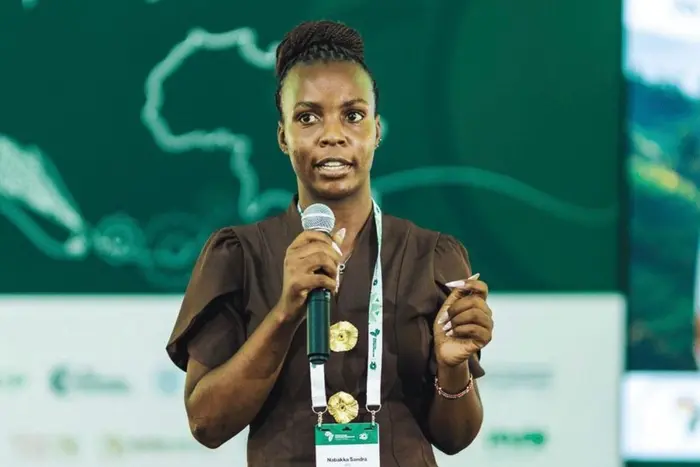
Sandi AI, a Ugandan agritech startup, has built a precision irrigation system that layers satellite monitoring of weather and field conditions on top of ground sensors that read soil moisture directly, feeding both into an AI assistant that turns the combined data into plain-language watering recommendations for smallholder farmers. The company is led by founder and CEO Sandra Nabakka, an AI specialist with a master’s degree in artificial intelligence for sustainable development from University College London, who built Sandi AI around a conviction that the hard part of smallholder irrigation was never really the engineering.
“Farmers should not be limited by systems that were not designed around their realities,” Nabakka has said of the gap she set out to close. The specific barrier she’s described publicly is financing: solar pumps, moisture sensors and satellite-based analysis tools all exist and work, but banks typically want collateral and land titles smallholders don’t have, equipment suppliers want full payment upfront, and newer online lenders want a credit history most rural farmers have never had the chance to build. Sandi AI’s answer is to route around all three at once by financing equipment through community savings groups instead, with members pooling contributions to progressively afford a solar pump first, then moisture sensors, then access to the satellite analysis layer, rather than needing to qualify for a loan against any of it upfront.
“Farmers have always saved together in circles of trust,” Nabakka said when the company’s irrigation-specific product, branded Sandi Moisture Intelligence, launched. “With Sandi Moisture Intelligence, we’re evolving that trust into smart, data-driven action. Farmers no longer have to guess where to start their day; they know exactly which part of their garden is under stress and needs water first.” The pitch is that a financing structure already familiar to rural communities, the rotating savings group, becomes the on-ramp to technology that would otherwise require exactly the kind of formal credit history those communities tend to lack.
The scale Sandi AI claims is substantial, and also a useful reminder to read startup-reported numbers carefully. Recent coverage puts the company at more than 4,100 farmer groups across Uganda, Kenya and Tanzania, with up to 90% irrigation water savings for users of its full system, figures that come from the company itself with no independent methodology published alongside them. Those same figures get harder to pin down the further back you look: Sandi AI’s own announcement in March 2026 put its active rotational savings groups past 10,000, already higher than the 4,100 figure circulating since, which suggests either a change in how the company counts its own user base or simply inconsistent reporting from one update to the next. Neither version has outside verification, and the gap between them is reason enough to treat both as directional rather than precise.
What is independently verifiable is the momentum around the company. Sandi AI won the $50,000 GoGettaz Agripreneur Prize in September at the Africa Food Systems Forum in Kigali, recognized as the summit’s top female-led venture after competing against agrifood businesses from across the continent, with the prize earmarked for platform development and expansion into new farming communities. The company has already expanded from its Kampala base into Nairobi and a Dar es Salaam headquarters in Masaki, and has named Zambia and Malawi as its next markets by the end of this year.
Sandi AI isn’t working this problem alone. Kenya’s SunCulture sells solar irrigation equipment on its own alternative financing terms and closed $10 million in senior secured financing from Mirova just last month to extend that reach to more smallholders. Between the two approaches, community savings pools on one side and asset-backed debt financing on the other, East Africa’s irrigation-financing gap is attracting real experimentation rather than a single obvious answer. Whichever model ends up scaling further will likely be decided less by whose satellite feed or AI model is more precise and more by which structure actually gets a solar pump onto a smallholder’s land without demanding the collateral, upfront cash or credit history that kept it out of reach in the first place.
Nigerian Fintech CreditChek Deepens East Africa Push With Uganda’s Algosys Acquisition