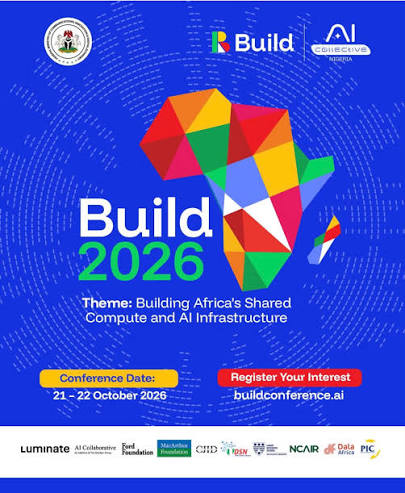
Abuja will host BUILD 2026, Africa’s Shared Compute and AI Infrastructure Conference, on October 21 and 22. It is organised by the Nigeria AI Collective under the Federal Ministry of Communications, Innovation and Digital Economy, and its stated aim is to advance the infrastructure, investment, policy and partnerships Africa needs to strengthen its position in the global AI ecosystem. The conference site lists six tracks: infrastructure (energy, shared compute and AI-ready digital infrastructure), economy, digital sovereignty, governance and ethics, tech justice, and innovation catalysis. Formats include plenaries, ministerial dialogues, technical workshops, executive roundtables, an investment and partnership forum, a research-to-innovation forum and an innovation expo.
There are three ways to take part. To attend, apply at buildconference.ai/registration. The form asks for personal and organisation details, your sector, age category, years of experience, domain of AI expertise (policy, technical and research, generative media, or ethics and safety), your LinkedIn profile, areas of interest and a short statement on why you want to attend. It also asks you to upload a valid means of identification. To showcase a product, apply for the Innovation Expo, where the application asks about your product, stage, traction and market opportunity. Researchers can submit an abstract for a paper or poster presentation, with optional consideration for Best Research Paper and Best Research Poster awards. The main page is buildconference.ai, and questions go to hello@buildconference.ai.
Several practical details are not published. This newsroom could not find registration fees, application deadlines, selection criteria or an exact venue on any of the pages, and the main page does not name its confirmed speakers. The abstract and expo pages likewise give no deadline or notification date, so anyone planning to apply should email the organisers and apply early rather than assume there is time. The only address given is the secretariat’s, in Jahi District, Abuja.
The timing makes sense because the numbers are stark. Africa holds about 0.6% of global data centre capacity, according to the Data Centres in Africa 2026 report as cited by Techeconomy, and capacity is expected to roughly triple to about 1.2 gigawatts by 2030, which tracks global growth rather than closing the gap. Outside South Africa, only about a third of built capacity is fully used. Nigeria has around 25 data centres, second on the continent, but a Techpoint analysis puts operational capacity at roughly 86 megawatts, with the article itself giving a lower figure elsewhere, so treat the exact number with care. Power is a structural cost, with self-generated electricity at about $0.28 to $0.33 per kilowatt-hour, and offshore compute adds latency of 70 to 90 milliseconds against under 5 for a local facility.
Money and projects are moving. Techpoint lists Kasi Cloud in Lekki, a $250 million AI-focused campus backed by the Nigeria Sovereign Investment Authority with a first 5.5 megawatt phase and room to scale to 100 megawatts, alongside Airtel’s planned Nxtra facility at Eko Atlantic and an AI-optimised GPU phase from MTN’s Genova unit. Large-scale model training stays constrained until the 100 megawatt sites are online. The Nigeria AI Collective behind the conference is a federal initiative announced by Minister Bosun Tijani, with Luminate committing $1.5 million, and the conference lists the Ford Foundation and the MacArthur Foundation among its partners.
For founders, researchers, investors and policymakers, the draw is access to the people deciding how shared compute will be financed and governed. The test will be whether the two days produce commitments with numbers attached, such as capacity, pricing and access rules for startups and universities, rather than another round of declarations.