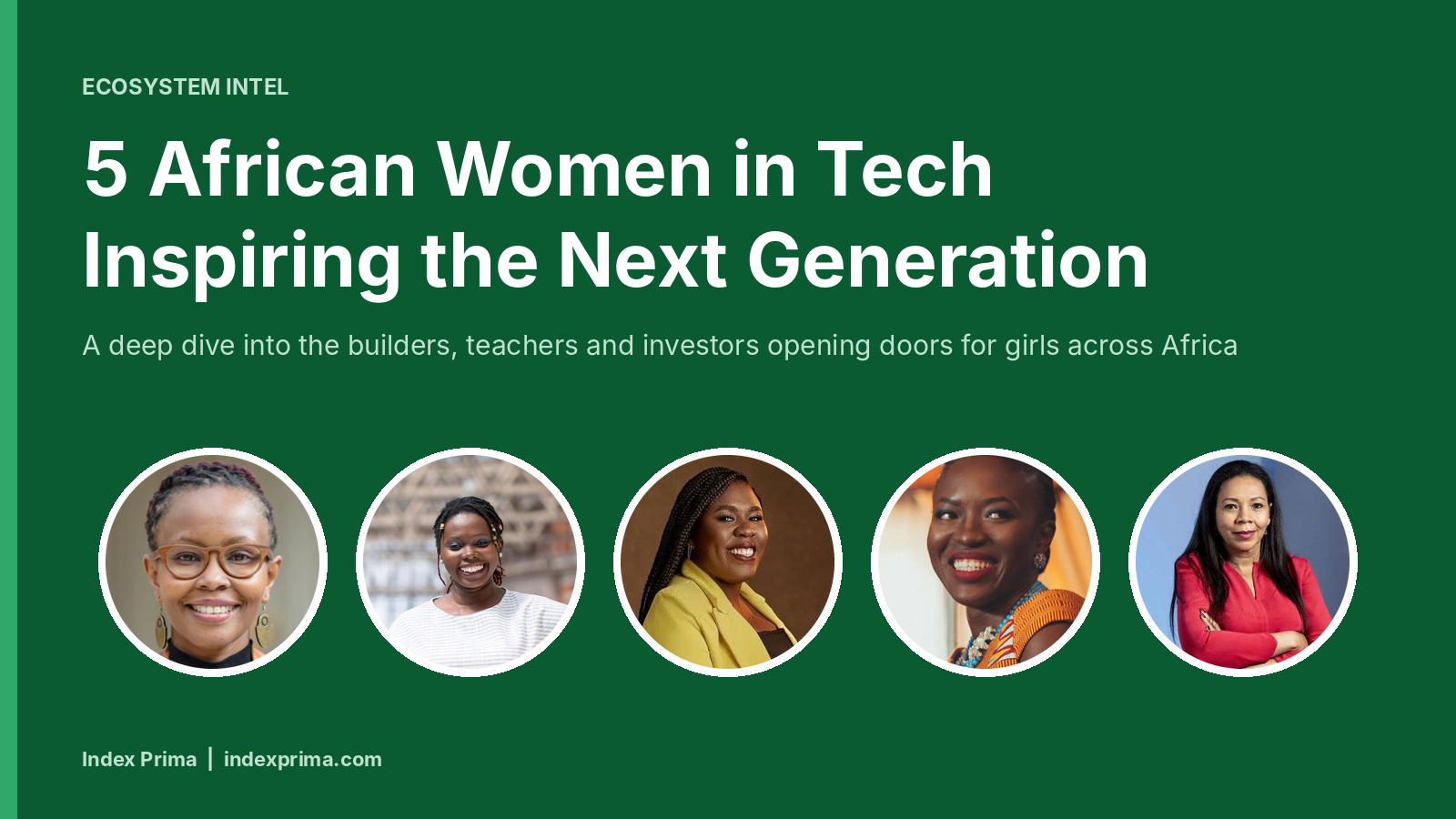
They built the apps, the hubs and the classrooms. Now they are showing girls across Africa what is possible.
Five African women stand out for what they built and for how they lift others. Rebecca Enonchong of Cameroon, Juliana Rotich of Kenya, Regina Honu of Ghana, Odunayo Eweniyi of Nigeria and Mariéme Jamme of Senegal work in different fields, from software to savings. Each has built something that outlives her own company, and each opens doors for the girls and women who follow. Their work matters more now, because women founders still win only a sliver of Africa’s startup funding.
Start with the gap, since it explains why these stories count. The Diversity Dividend report, which looked at more than 3,000 African startups, found that 19.2% had at least one female co-founder, up from 17.3% in 2024. Only 12.1% had a female CEO. Funding tells a harsher story. The report says female-founded startups got just 0.9% of the $3.2 billion raised in 2025, the lowest share in four years. In the first quarter of 2026, they got $49 million of $597 million, or 8.2%. Only five of the 60 startups that raised money in the first five months of 2026 had a female CEO. Against that backdrop, the five women below are proof that the talent is there.
 Rebecca Enonchong was born in Cameroon in 1967 and built her career at the top of enterprise software. She founded AppsTech in 1999 in Bethesda, Maryland. It is an Oracle Platinum Partner with customers in more than 40 countries. Then she turned to the next wave. She chairs ActivSpaces, a tech hub and incubator in Buea, part of Cameroon’s Silicon Mountain scene. She founded the Africa Technology Forum, a non-profit that backs African startups. She chaired AfriLabs, the network of innovation hubs across the continent, after being elected in 2017 and again in 2019. Forbes named her to its 50 Over 50 EMEA list in 2022. Her profile says she became a vice-chair of the International Chamber of Commerce in June 2026. Her lesson for young founders is simple. Build a company, then build the places where others can start theirs.
 Juliana Rotich, born in Kenya in 1977, studied computer science in the United States and came home to build tools for her own region. In 2008, she co-founded Ushahidi, a non-profit that makes open-source software for crowdsourced crisis reporting. It was first used during Kenya’s 2007 to 2008 election crisis. The name is Swahili for “testimony.” She later helped start iHub, a tech collective in Nairobi, and co-founded BRCK. BRCK makes a battery-powered modem that keeps people online through power cuts. She led Ushahidi as executive director from 2011 to 2015 and has won global honours, including the Schwab Foundation Social Entrepreneur of the Year in Africa in 2011. She was named head of fintech integration solutions at Safaricom in 2022. Her path shows girls that a tech career can mean open-source tools, hardware and big-company finance, all in one life.
 Regina Honu trained as a computer scientist at Ashesi University and worked in IT at two Ghanaian banks. Then she left to start Soronko Academy. Soronko comes from the Twi word for “unique.” TechCabal calls it the first coding and human-centred design school for children and young adults in West Africa. It says the academy has trained more than 20,000 young people in Ghana and Burkina Faso, and linked about 5,000 of them to jobs. She is a Mandela Washington Fellow and an Ashoka Fellow. She now wants a bigger space and a residential programme to serve more women. Her view on progress is blunt: “We shouldn’t count the minorities and privileged as progress.” For girls outside the big cities, her academy is a ladder they can actually reach.
 Odunayo Eweniyi shows what a young engineer can do with a plain idea. She graduated in computer engineering from Covenant University in 2013 and later co-founded PiggyVest in 2016. The app is a digital version of the kolo, the traditional savings box. Co-founders include Joshua Chibueze and Somto Ifezue. Guardian Nigeria reports about 5.8 million users, and said the firm would mark its 10th year in April 2026. In 2020, she also helped start the Feminist Coalition, which raised money for medical and legal help during the End SARS protests. TIME named her to its TIME100 Next list in 2021. In January 2021, she co-launched FirstCheck, a group of female business angels who back women-led startups across Africa. She is helping close the funding gap from the investor side as well as the founder side.
 Mariéme Jamme was born in Dakar, Senegal, and is a technology entrepreneur and activist. She is the founder of the iamtheCODE foundation, which aims to teach coding and other STEAM skills to girls in under-served areas of Africa, South America and the Middle East. Its goal is to reach one million girls and women by 2030. In 2017, ITWeb reported that its methods and mentoring had been used by more than 400 creative spaces in 50 countries. She told the audience that coding is a “21st century skill” and that investing in girls is “a moral imperative.” She became the first Black woman on the board of the World Wide Web Foundation in 2017 and was on the BBC 100 Women list that year. Her focus on scale is a reminder that one teacher can reach thousands, but a network can reach millions.
Why it matters: The funding numbers show a gap, not a lack of talent. These five women made their mark through hubs, schools, savings tools and investor networks, and not only through their own companies. For a girl in Buea, Accra, Nairobi, Lagos or Dakar, each is a visible example. They also point to what works: training that leads to jobs, funds that back women, and hubs that give people a place to start. The next step is for investors to match the talent with cheques.
What to watch next: whether the share of funding going to women founders recovers in the coming reports, how many more women reach the CEO chair, and whether programmes like Soronko Academy and iamtheCODE hit their reach goals.
Sources: WeeTracker on the Diversity Dividend report; Wikipedia on Rebecca Enonchong; Wikipedia on Juliana Rotich; TED, Juliana Rotich on BRCK; TechCabal on Regina Honu; Wikipedia on Odunayo Eweniyi; Guardian Nigeria on PiggyVest; ITWeb on iamtheCODE; Wikipedia on Mariéme Jamme.
A note for startup founders: Don’t practice on investors. Practice on AI first. RaiseReady by Index Prima is an AI fundraising simulator for African founders: upload your pitch deck, get a readiness score and face a tough AI investor before the real meeting. Find this post, and every post we publish, at raiseready.indexprima.com.