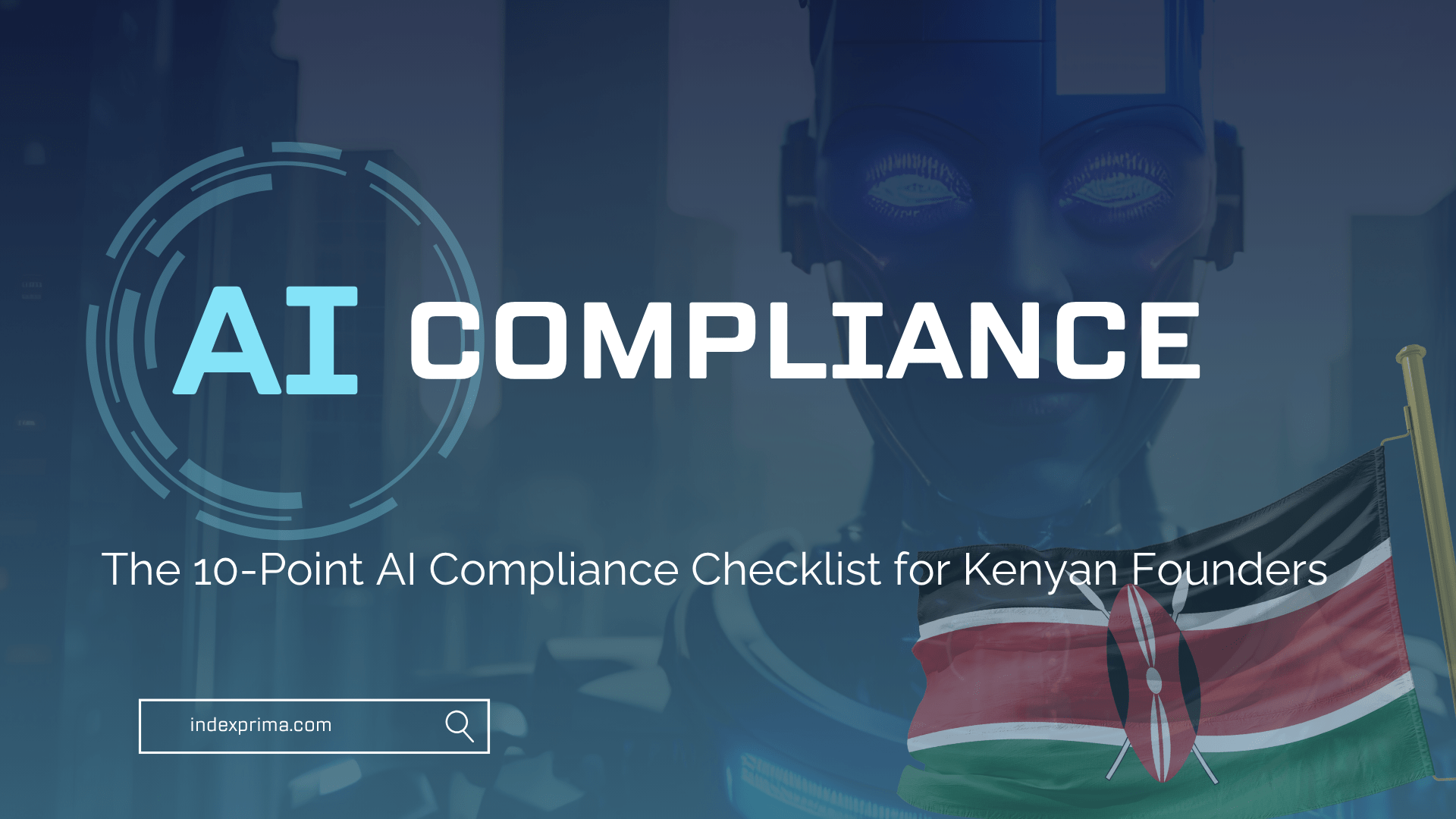
The Kenya Artificial Intelligence Bill, 2026 (Senate Bill No. 4), sponsored by Senator Karen Nyamu, has officially moved from a “draft” to a “deadline.” For the Silicon Savannah, the era of “Move Fast and Break Things” has been replaced by “Audit Fast and Build Safely.”
If you are a founder in Nairobi, Kisumu, or Eldoret, compliance is no longer a legal footnote—it is a core product requirement. Here is your 10-point survival guide to the new AI regime.
1. The “Label” Audit: Classify Your Risk Tier
The law follows the EU-style risk pyramid. You must determine if your AI is Unacceptable, High, Limited, or Minimal Risk.
-
The Rule: If you are in Fintech (credit scoring), Health (diagnostics), or HR (automated hiring), you are automatically High-Risk.
2. Register with the “AI Commissioner”
The Bill establishes the Office of the Artificial Intelligence Commissioner.
-
The Mandate: All high-risk systems must be entered into a Public Register. Operating an unlisted high-risk AI is now a criminal offense carrying a fine of up to Ksh 5 Million or 2 years in prison.
3. Activate “Human-in-the-Loop” (HITL) Controls
The law mandates that “critical decisions” cannot be made by machines alone.
-
The Action: You must appoint a qualified individual to oversee, review, and—if necessary—override AI outputs. You can no longer say, “the algorithm did it.”
4. Five-Year Data Lineage (Logs)
One of the most intensive requirements is the Data Retention Mandate.
-
The Action: You must maintain detailed records of all training datasets, input data, and system outputs for a minimum of five years. This is for forensic auditing in cases of bias or harm.
5. Conduct a “Human Rights Impact Assessment” (HRIA)
Before deploying a high-risk system, you must perform a formal assessment of how your AI affects the fundamental rights of Kenyans.
-
The Focus: Pay specific attention to Algorithmic Bias—ensure your model doesn’t discriminate against specific demographics or tribes.
6. The “Deepfake” Disclosure
If your startup uses synthetic media (AI-generated images, video, or voice), transparency is mandatory.
-
The Action: You must obtain clear consent before using a person’s likeness and include a permanent, visible watermark/label identifying the content as AI-generated.
7. Workforce Impact & Reskilling Plan
If your AI product is designed to replace or augment human labor (e.g., in BPO or Manufacturing), you are required to conduct a Workforce Impact Assessment.
-
The Action: You must document how you are mitigating job losses through reskilling or transition programs.
8. Apply for the “Regulatory Sandbox”
This is your secret weapon. The Commissioner will manage a Regulatory Sandbox for innovative testing.
-
The Strategy: Being in the sandbox grants you a “Safe Harbor” status, allowing you to iterate under supervision without the immediate threat of full-scale penalties.
9. Secure Your “Pioneer” Data Residency
While the AI Bill focuses on intelligence, it reinforces the Data Protection Act (2019).
-
The Rule: Sensitive data used for training AI must be stored locally in Kenya to satisfy Data Sovereignty requirements.
10. Personal Liability for Directors
The 2026 Bill is unique because it attaches Criminal Liability to leadership.
-
The Warning: Directors and senior officers are personally liable for violations unless they can prove they exercised “Due Diligence.” Ignorance is no longer a defense.
The “Terminal” Verdict
The Kenya AI Bill 2026 isn’t a barrier; it’s a Quality Standard. Founders who adopt these 10 points today aren’t just complying with the law—they are building a “Trust Moat” that makes them the preferred partner for global VCs looking for “Ethical AI” in Africa.
Strategic Links:
-
Full Bill Text: Kenya Gazette Supplement No. 15 (Senate Bill No. 4)
-
Official Enforcement News: Capital Business: Bill proposes AI regulator, Sh5mn fine for offenders
-
Legal Analysis: Cliffe Dekker Hofmeyr: Regulating Emerging Tech in the Silicon Savannah
-
Founder Intelligence: TechCabal: Kenya moves to criminalize unapproved high-risk AI deployment