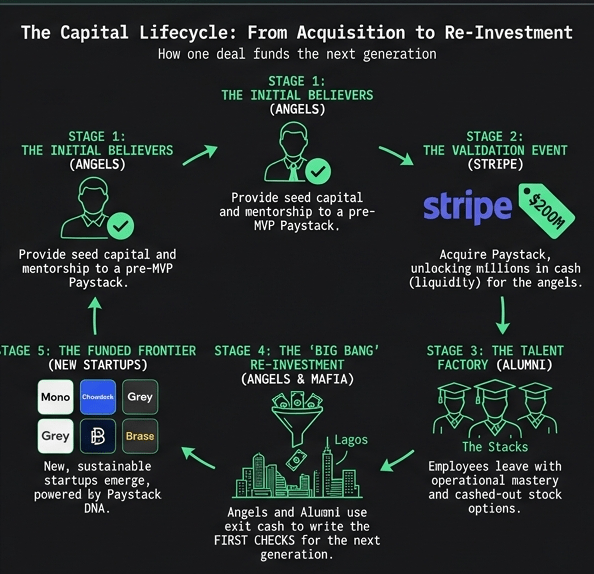
In October 2020, when Stripe announced its acquisition of Paystack, the headlines focused on the numbers. $200 million was a massive figure for a five-year-old Nigerian startup. But to the architects of the ecosystem, the dollar amount was secondary. The real value was the unfreezing of the cap table.
Here is the in-depth anatomy of the “Big Bang” that funded a new generation of African giants.
1. The Liquidity Event: Converting “Paper Wealth” to “Angel Fire”
Before 2020, Nigerian tech wealth was largely theoretical. Founders had high valuations, but they lacked liquidity. Angel investors—the pioneers who wrote the first $5,000 and $25,000 checks—were essentially holding “lottery tickets” with no clear way to cash them in.
-
The Multiplier Effect: The Paystack acquisition didn’t just reward the founders; it provided a massive exit for early-stage angels like Olumide Soyombo and Tosin Eniolorunda.
-
The Result: For the first time, a local cohort of investors had millions of dollars in liquid cash derived entirely from tech. They didn’t buy real estate in London; they doubled down on the ecosystem. This created a self-sustaining cycle of “Recycled Capital” that exists independently of Silicon Valley’s whims.
2. The “Paystack Mafia”: The Talent-Capital Hybrid
The most potent legacy of the deal isn’t the money—it’s the people. Much like the “PayPal Mafia” (Elon Musk, Peter Thiel, Reid Hoffman) defined the 2000s in California, the “Paystack Mafia” is defining the 2020s in Africa.
-
The Operational Blueprint: Paystack employees—”The Stacks”—graduated with a masterclass in world-class engineering, high-growth operations, and radical transparency.
-
The New Founders: We are currently indexing dozens of high-growth startups founded by Paystack alumni. From Mono (Open Banking) to Chowdeck (Logistics) and Grey (Cross-border payments), these companies were built with the discipline learned at the Paystack altar.
-
The Angel Mafia: These alumni aren’t just building; they are investing. They understand the “Zero to One” phase better than any institutional VC because they have lived it.
3. The “Institutional Trust” Bridge
Prior to the acquisition, global VCs viewed Nigeria through a lens of “Extreme Risk.” Stripe—a company known for its rigorous engineering culture and conservative M&A strategy—effectively acted as a Sovereign De-risker.
-
The Validation: If Stripe was willing to bet $200M on Nigerian infrastructure, it signaled to the world that the “Plumbing” of the African digital economy was sound.
-
The Inflow: In the 24 months following the deal, venture capital inflow into Nigeria skyrocketed, hitting record highs in 2021 and 2022. The deal proved that an “Exit” was not only possible but profitable on a global scale.
4. Structural Change: The Birth of Syndicate Investing
The Paystack deal forced a professionalization of how local angels work. We saw the rise of Angel Syndicates (like Voltron Capital) where successful founders pool their capital to lead seed rounds for new startups.
-
The Power Shift: This moved the power away from predatory “old money” investors and put it back into the hands of those who understand software.
-
The 2026 Reality: Today, a founder in Lagos or Makurdi can raise a $500k pre-seed round entirely from local “Paystack-era” angels without ever speaking to a VC in San Francisco. This is true financial sovereignty.
The Verdict: The Perpetual Motion Machine
The Stripe/Paystack acquisition was the “Big Bang” because it proved the Circular Economy of Innovation. It took local talent, applied global capital, achieved a liquidity event, and then redistributed that capital and talent back into the local market.
Strategic Intelligence:
-
The Announcement: Stripe Official: Stripe to acquire Paystack to accelerate online commerce in Africa
-
Angel Impact: Olumide Soyombo on the Paystack Exit and the Rise of Voltron Capital
-
The Alumni Network: The Condia: How the ‘Paystack Mafia’ is building the future of African Tech
-
Market Analysis: Briter Bridges: The Multiplier Effect of Large Exits in Emerging Markets