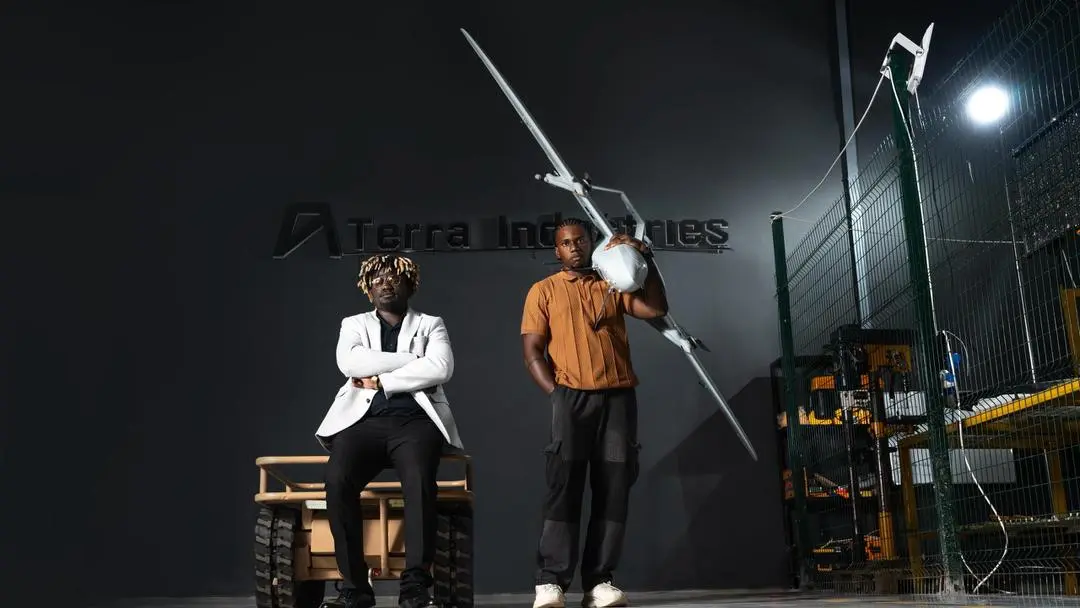
For decades, the African defense narrative was one of dependency—a multi-billion dollar “import-only” cycle where the continent’s security was tethered to the manufacturing timelines of Ankara, Beijing, or Washington. But in 2026, the silence of the ocean floor and the static of legacy systems have been replaced by the hum of indigenous rotors. We are witnessing a structural decoupling. With the operationalization of the DICON Act 2023 and a record-breaking $34 million in early-stage capital flowing into a single local player, Nigeria is no longer just a customer in the global arms market; it is becoming a “Prime.”
This is the era of Strategic Autonomy, and at the heart of this revolution is a company being called the “Anduril of Africa.”
The Terra Paradigm: Inside Africa’s First Defense Prime
1. The Young, Audacious, and Indigenous Founders:
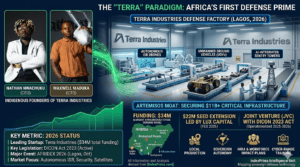
Behind the meteoric rise of Terra Industries (formerly Terrahaptix) are two young Nigerians who represent a new breed of industrialist: Nathan Nwachuku and Maxwell Maduka.
Unlike the defense contractors of old who relied on political connections to import foreign gear, Nwachuku and Maduka are engineers and strategists. They founded the company with a singular, provocative vision: to build a sovereign defense stack for Africa.
- Nathan Nwachuku (CEO): Known for his aggressive “builder” mentality, Nwachuku has positioned Terra as a fast-moving AI-first company rather than a slow-moving hardware manufacturer.
-
Maxwell Maduka (CTO): The technical architect, Maduka has led the development of the proprietary OS that allows Terra’s hardware to “think” in real-time.
Together, they have managed to do the impossible: convince Silicon Valley’s most elite defense-tech investors—including Lux Capital (early backers of Anduril and Palantir)—that Nigeria is the most viable place on earth to build the future of autonomous warfare.
2. The “ArtemisOS” Moat: How Their Solution Works
Terra’s true genius isn’t just in the carbon fiber of their drones; it is in the code. They have developed ArtemisOS, a localized AI-powered operating system that solves the “black box” problem of African security.
The Case Study: Protecting $11B in Critical Infrastructure
Imagine a 500km pipeline or a remote mining site in the Middle Belt. Traditionally, this requires thousands of human guards, who are vulnerable to ambush and fatigue.
-
The Terra Solution: Under the Terra Paradigm, a fleet of autonomous drones (ISR), unmanned ground vehicles (UGVs), and AI-integrated sentry towers are deployed.
-
The Intelligence: ArtemisOS coordinates these assets as a single “mesh.” If a sentry tower detects an anomaly, it automatically launches a drone to intercept and provide high-definition thermal imaging. The AI filters out “noise” (wildlife) and alerts human command only when a verified threat is detected.
-
The Resilience: ArtemisOS is designed for low-connectivity environments, capable of operating “at the edge” without constant satellite pings to foreign servers.
3. The Capital Injection: A Record-Breaking Signal
In February 2026, Terra closed a $22 million Seed Extension led by Lux Capital. This brought their total war chest to $34 million—the largest ever for an African defense startup.
-
Why this matters: It proves that “Defense Tech” is the new high-alpha frontier. Global investors aren’t just betting on a Nigerian company; they are betting on the stabilization of African markets through indigenous technology.
4. The DICON 2023 Act: Opening the “Garrison Gates”
The real catalyst for Terra’s scale is the DICON Act 2023. For 60 years, the Defence Industries Corporation of Nigeria (DICON) was a closed system. The new Act transformed it into a Regulator and Venture Partner.
The Joint Venture Model (JVC):
In February 2026, DICON and Terra Industries signed a landmark MoU to create a Joint Venture. This is a massive “Buy Nigeria” pivot.
-
Instance: Rather than purchasing $50 million worth of tactical drones from Turkey, the Nigerian Armed Forces can now procure them through the DICON-Terra JVC.
-
The Benefit: Localized maintenance, faster iteration based on local combat data, and zero risk of “remote deactivation” by foreign governments.
5. Beyond Drones: The $200M Satellite and Tactical Hub
The Terra Paradigm is just one pillar. In March 2026, Nigus International and Elmirate Capital announced a $200 million deal to launch a defense tech and satellite hub.
-
The Goal: To produce Earth Observation Satellites locally. Currently, Nigeria spends millions annually on foreign satellite imagery for counter-insurgency operations. A local hub moves the eye in the sky from “rented” to “owned.”
The “IndexPrima” Verdict: The Secondary Supply Chain
Defense tech is the “New Fintech” because it creates a massive downstream economy. For B2B founders, the opportunity isn’t just building drones; it’s the Secondary Supply Chain:
-
Cyber-Range Training: Someone needs to train the thousands of operators who will use ArtemisOS.
-
Specialized Manufacturing: There is a growing demand for local carbon fiber, high-grade aluminum, and sensor assembly.
-
Alternative Power: Remote defense sentries need hydrogen or solar fuel cells to stay active without being tethered to a vulnerable power grid.
Intelligence Sources & References:
-
Terra Industries Funding: Lux Capital Leads $22M Extension for Terra Industries (Financial Intelligence Report 2026)
-
DICON-Terra MoU: Official Release: DICON and Terra Industries Form Defense JVC (Ministry of Defence Nigeria)
-
DIMDEX 2026: Global Defense Review: Nigeria Debuts DICON-D7G at Doha (Analysis)
-
Founders Profile: TechCrunch: How Nathan Nwachuku is building the ‘Anduril of Africa’