For years, the concept of “Big Brother” in Nigeria was a digital ghost—a collection of grainy CCTV cameras on Lagos lamp posts that rarely worked and even more rarely led to an arrest. But as we move through March 2024, that ghost has taken on a high-definition, AI-powered form. Nigeria has officially crossed the Rubicon into the era of the Sovereign Shield.
With a staggering $470 million earmarked for AI-driven surveillance and smart-city infrastructure, the Nigerian government is no longer just “watching”; it is building a predictive, biometric, and automated security apparatus. While the headlines focus on the eye-watering cost, the IndexPrima lens sees something else: the birth of a massive, high-alpha B2B market for startups specializing in the “Business of State Security.”
1. The $470M Breakdown: Beyond the Cameras
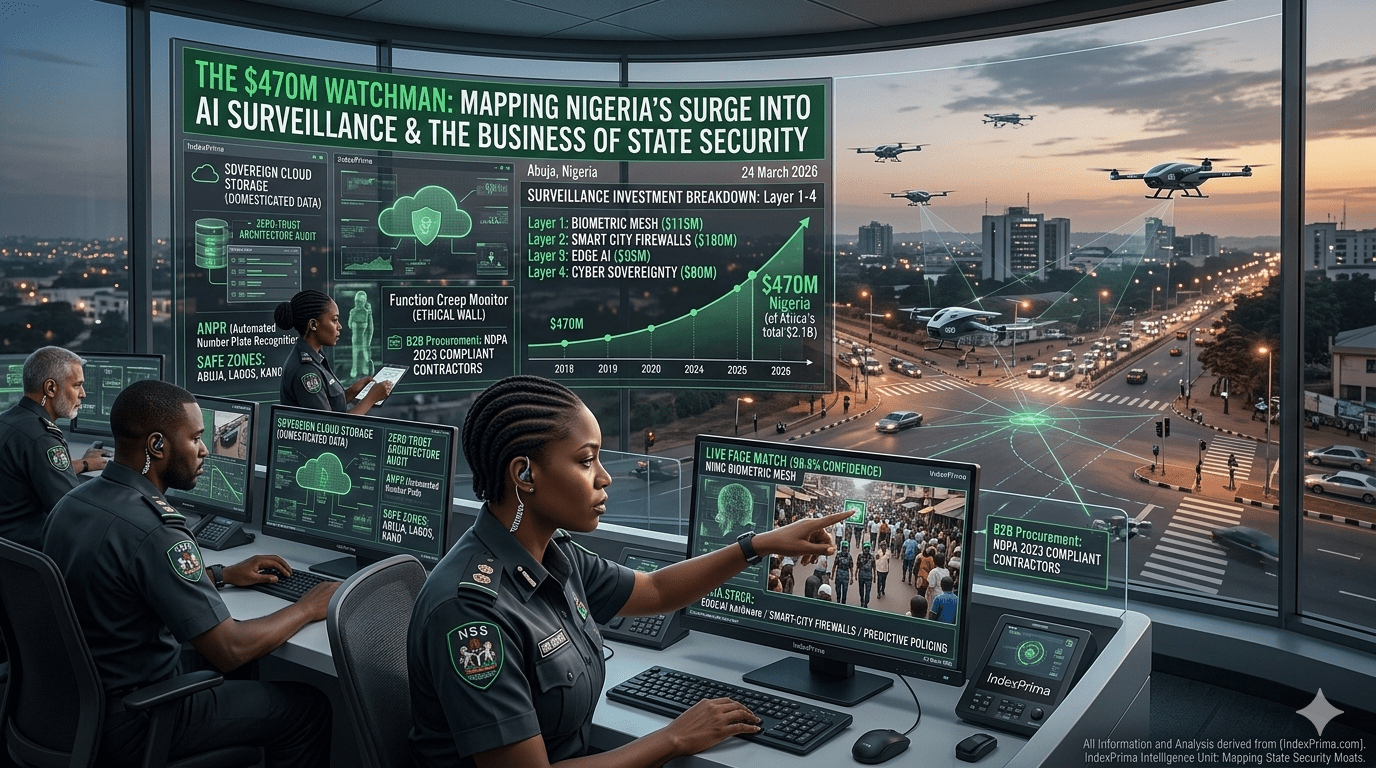
The “Watchman” isn’t just a collection of lenses; it is a stack of technologies. The $470 million spend—representing nearly 22% of Africa’s total $2.1 billion surveillance investment—is being deployed across four critical digital layers:
-
Layer 1: The Biometric Mesh (Facial Recognition): The integration of the National Identity Management Commission (NIMC) database with real-time street-level feeds. This turns every camera from a passive observer into an active identification agent.
-
Layer 2: Smart-City Firewalls: The creation of “Safe Zones” in Abuja, Lagos, and Kano. These are digital perimeters where AI-driven “Smart Firewalls” monitor vehicle license plates (ANPR), track unusual crowd movements, and detect acoustic signatures of gunfire.
-
Layer 3: The Edge-Computing Infrastructure: To avoid the “Latency Trap” (sending data to a central server and back), much of this $470M is going toward Edge AI hardware—cameras that process data on-device to provide instant alerts to local law enforcement.
-
Layer 4: Cyber-Sovereignty Tools: Protecting this massive data lake from foreign interference. This includes state-funded R&D into indigenous encryption and “Sovereign Cloud” storage to house biometric data within Nigerian borders.
2. The B2B Opportunity: The “Secondary Watchman” Supply Chain
For the digital tech strategist, the “Watchman” represents the most significant GovTech procurement cycle in a generation. The government cannot build this alone. We are seeing the emergence of a Secondary Watchman Economy, where B2B startups are the primary beneficiaries.
The New Gold Mines for Founders:
-
Facial Recognition Localized for African Phenotypes: Most global AI models (trained in the US or China) have a “Bias Gap” when identifying African faces in low-light settings. Startups that can “fine-tune” computer vision models specifically for the Nigerian context are winning eight-figure contracts.
-
Biometric Data Security & Auditing: With $470M of infrastructure comes the massive risk of data leaks. Startups providing Zero-Trust architecture and automated auditing for state databases are the new “Cyber-Guardians.”
-
Predictive Policing Analytics: Moving from “What happened?” to “What is likely to happen?” Companies building AI models that ingest crime data, economic indicators, and real-time surveillance to predict high-risk windows in urban centers.
3. The “Sovereign Shield” vs. The Ethical Wall
The rise of the $470M Watchman brings us to a fundamental tension. Proponents argue this is the Sovereign Shield—the only way to secure a nation of 200 million people against insurgency, kidnapping, and urban crime in a digital age.
However, the Ethical Wall is thin.
-
The Privacy Paradox: Nigeria’s Data Protection Act (NDPA) 2023 is being tested to its limits. When the state spends half a billion dollars to watch you, who watches the watchers?
-
Function Creep: There is a legitimate fear that tools built to catch “kidnappers” will inevitably be used to monitor “dissenters.” The Business of State Security is lucrative, but it requires a new framework of Digital Ethics and Oversight.
4. The IndexVerdict: The Industrialization of Safety
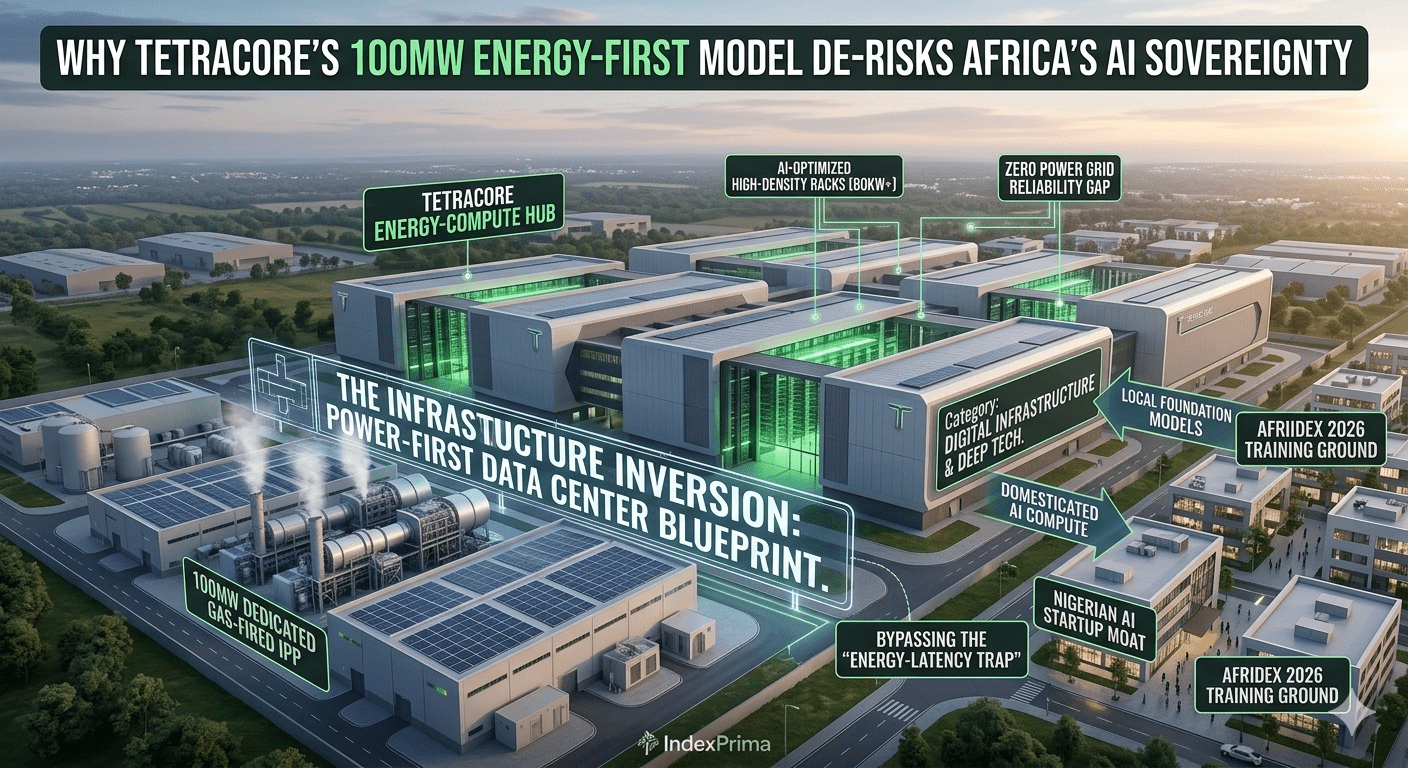
At IndexPrima, we believe the “Infrastructure Inversion” we saw in the power sector (Tetracore) is now happening in security. The government has realized that Security is a Utility. The $470M spend is a signal that Nigeria is moving away from the “Imported Security” model (buying foreign hardware) and toward a “Domesticated Intelligence” model. For B2B founders, the message is clear: The “Watchman” needs a local brain, local sensors, and local firewalls.
Sources & References (2024–2026 Archive)
-
Investment Intelligence: Nigeria Ranks as Top African Spender in AI Surveillance Market (BusinessDay Nigeria, 2024).
-
Industry Analysis: The Rise of Africa’s $2.1 Billion Surveillance Economy (TechCabal, 2024).
-
Regulatory Framework: Nigeria Data Protection Commission (NDPC) Annual Guidance on Biometric Data (Federal Gazette, 2024/2025).
-
Global Context: State of AI Surveillance: Africa’s Growing Appetite for High-Tech Security (Carnegie Endowment for International Peace – Reference for Trend Analysis).