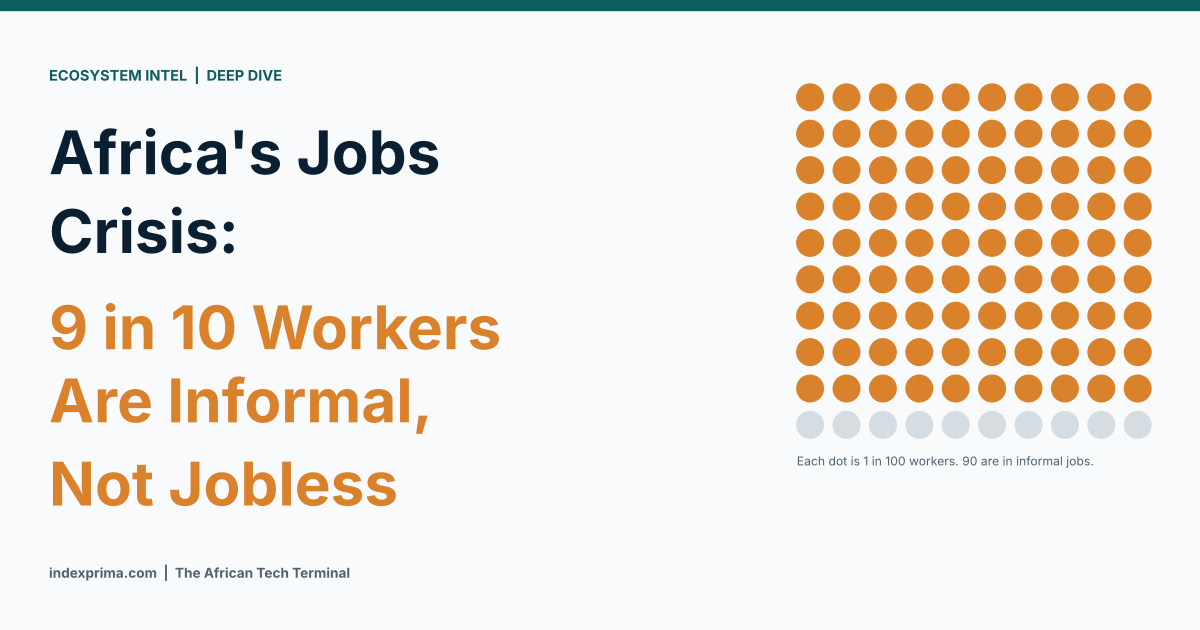
Ask how well a country is doing on jobs, and you will usually hear one number: the unemployment rate. In much of Africa, that number is the wrong place to look. In Nigeria it has sat near 4 percent. Yet most people there work in jobs with no contract, no pension and little pay. The real problem is what work pays, how secure it is, and whether it leads anywhere.
This deep dive pulls together the latest figures from the International Labour Organization (ILO), Stats SA, Nigeria’s statistics office and the Africa Youth Employment Outlook 2026. It explains why the headline rate misleads. It shows what the data says about job quality. It also asks what this means for founders and investors. Where sources disagree, we say so.
The number that hides the story
Unemployment counts people who have no work, are looking for work and are available to start. That definition fits a country where most people hold formal jobs and can afford to stay jobless while they search. It fits much less well where most people cannot afford to do nothing.
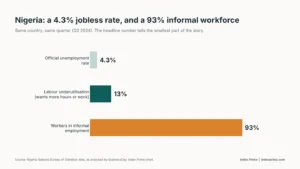
Under ILO guidance, a person who worked at least one hour in the past week counts as employed. A street vendor who sold sachet water for two hours, a farmer on a small plot and a motorcycle taxi rider all count. Nigeria switched to this approach in late 2022. Under the older method, its unemployment rate hit 33.3% in the last quarter of 2020. Under the new one, BusinessDay reports it was 4.3% in the second quarter of 2024. The economy did not change that much. The ruler did.
The same BusinessDay analysis shows how much the headline hides. Nigeria’s broader “labour underutilisation” rate, which includes people who want more hours, was about 13% in that quarter, roughly three times the headline. About 93% of workers were in informal employment. Those are 2024 figures, the latest we could verify.
What the ILO found
The ILO’s Employment and Social Trends 2026 report gives the clearest regional picture for sub-Saharan Africa. The table below uses figures reported by Nairametrics and Ecofin Agency.
| Measure (sub-Saharan Africa) | Figure |
|---|---|
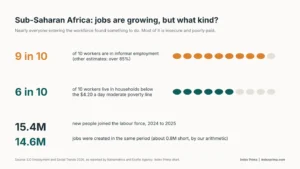
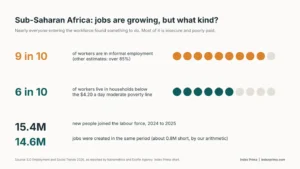
| Growth in the labour force, 2024 to 2025 | 15.4 million |
| Jobs created over the same period | 14.6 million |
| Workers in informal employment | Nearly 9 in 10 (other estimates say over 85%) |
| Workers in households below $4.20 a day (moderate poverty line) | Close to 6 in 10 |
| Young people (15 to 29) who never attended school or stopped before primary | About 21% |
| Young people who completed technical and vocational training | About 6.5% |
Notice the first two rows. Jobs grew almost as fast as the labour force. By our own arithmetic, about 800,000 more people entered the workforce than found work, though Ecofin rounds this to about one million. On the surface, that looks manageable. The third and fourth rows show why it is not. Most of those jobs are informal, and most workers still live in poverty. Africa has plenty of people working. It has too few people earning enough to climb out of poverty.
Youth: the sharpest edge
Africa has about 550 million people aged 15 to 35, more than 22% of the world’s young people, according to the Africa Youth Employment Outlook 2026. It was produced by World Data Lab with the Mastercard Foundation and the University of Cape Town. About 10 million young people enter the labour market every year. Around 90% of employed young Africans work informally.
The report adds detail that should change how we talk about this. Youth jobs are formal in 22% of services, 12% of industry and only 3% of agriculture. Young women are 61% of young people not in employment, education or training, about 62 million people. Among women outside the labour force in sub-Saharan Africa, 28% cite unpaid care duties, compared with 3% of men. And about 104 million young workers, 34% of the total, live in extremely poor households.
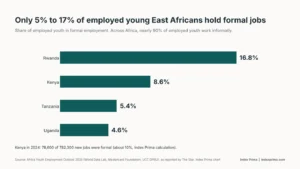
Country gaps are large too. The table below shows the share of employed young people who hold formal jobs, as reported by The Star in February 2026.
| Country | Formal share of employed youth |
|---|---|
| Rwanda | 16.8% |
| Kenya | 8.6% |
| Tanzania | 5.4% |
| Uganda | 4.6% |
Kenya’s own numbers show the pattern. Of the 782,300 jobs it created in 2024, only 78,600 were formal. That is about 10%, by our calculation. Another estimate cited by Ecofin, from Think Business Africa, says only about a quarter of new entrants in the region found formal work. We could not verify that estimate independently, so treat it as indicative.
South Africa: a high rate, the same weak jobs
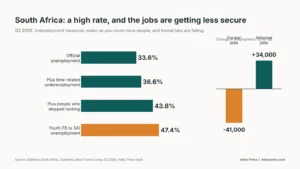
South Africa shows the opposite problem. It also shows that formal job creation is hard even in the continent’s most developed labour market. In the second quarter of 2026, Stats SA reported an official unemployment rate of 33.6%, up from 32.7%. Youth unemployment (ages 15 to 34) reached 47.4%, with about 5 million young people jobless. A wider measure that adds people who gave up looking was 43.8%.
Look at where the jobs moved. Employment fell by 16,000 to 16.7 million. Formal sector employment fell by 41,000, while informal employment rose by 34,000. Even there, the trend points toward more insecure work.
Put the two countries side by side and the lesson is clear. Nigeria’s low rate and South Africa’s high rate describe very different measuring systems. Neither tells you how many people earn a decent living. Compare job quality instead of headline rates.
Why this is happening
No single cause explains this, but the sources point to a few.
- Population growth outpaces formal firms. High birth rates mean the labour force grows by millions each year, while formal employers hire in the thousands. BusinessDay estimates that Nigeria’s formal job creation is about 200,000 a year against roughly 4 million new entrants. That is one analyst’s estimate and not an official count.
- Skills gaps. With only about 6.5% of young people finishing technical training, many workers enter the market with few skills employers can use.
- Low productivity where most people work. Family farming, street trading and small services make up most informal work. These activities rarely have the tools, credit or customers to grow.
- Unpaid care work. It keeps millions of women out of paid work altogether.
- Too little manufacturing. The Institute for Security Studies argues that industrialisation absorbs semi-skilled workers better than most sectors. It also notes that raising job quality matters as much as job numbers.
What could change the picture
Researchers agree on direction, if not on details. The Institute for Security Studies suggests raising job quality through fair wages and worker protections, shifting education toward creating opportunity, and expanding manufacturing. In one of its modelled scenarios, formal employment could reach 60% of the labour force by 2043. The Mastercard Foundation urges moving beyond “any work” to dignified and fulfilling work.
Notice what these ideas share. They stop treating the informal economy as a problem to eliminate and start treating it as the place where most Africans already work and need better tools.
What this means for founders and investors
This section is our own analysis and not a finding from the reports above.
If nine in ten workers are informal, the largest market in Africa is the informal economy. The biggest opportunities may be tools that make informal work more productive and more secure: payments that give traders a record of income, credit that small shops can actually get, simple software for farmers and artisans, and training that leads to paid work. Embedded credit is a good example. Companies such as Kuunda build the rails that let banks lend to small businesses inside services they already use. Our recent obituary of its co-founder Andrew Milne describes how that works.
It also changes how we should read tech job claims. A startup that employs 50 people matters. But the continent adds roughly 10 million young workers a year. No single sector will absorb that number, so the strongest ventures are likely to be those that lift earnings for the people who are already working.
For policymakers, the message is to measure better. Report underemployment, informality and working poverty next to the unemployment rate, and set targets for earnings and job security.
What we could not confirm
Some figures come from news summaries of larger reports, and we could not open every original. The ILO and Africa Youth Employment Outlook numbers are as reported by Nairametrics, Ecofin, The Star and the report’s producers. Estimates of informality differ between “nearly 9 in 10” and “over 85%”. Nigeria’s figures are from 2024, the latest we could verify. Regional unemployment rates differ across sources depending on whether North Africa is included, so we have not used one here.
Sources: Nairametrics on the ILO Employment and Social Trends 2026 report; Ecofin Agency; Mastercard Foundation on the Africa Youth Employment Outlook 2026; World Data Lab: five insights from the Outlook; The Star on formal youth jobs by country; Stats SA, Quarterly Labour Force Survey Q2 2026; BusinessDay on Nigeria’s unemployment figures; Institute for Security Studies on working poverty and informality.
A note for startup founders: Don’t practice on investors. Practice on AI first. RaiseReady by Index Prima is an AI fundraising simulator for African founders: upload your pitch deck, get a readiness score and face a tough AI investor before the real meeting. Find this post, and every post we publish, at raiseready.indexprima.com.