For a decade, “Nigerian Tech” was a synonym for “Lagos Tech.” But as the National Digital Economy and E-Governance Act 2025 settles into law, a second wave of regulation is hitting the sub-national level. States like Edo, Kaduna, and Kano are no longer waiting for Abuja; they are passing their own “Digital Economy Bills” and “Startup Acts.”
For B2B founders, this isn’t just more red tape—it is the opening of 36 new, high-value markets.
1. The “EdoCloud” Blueprint: Sovereignty at the State Level
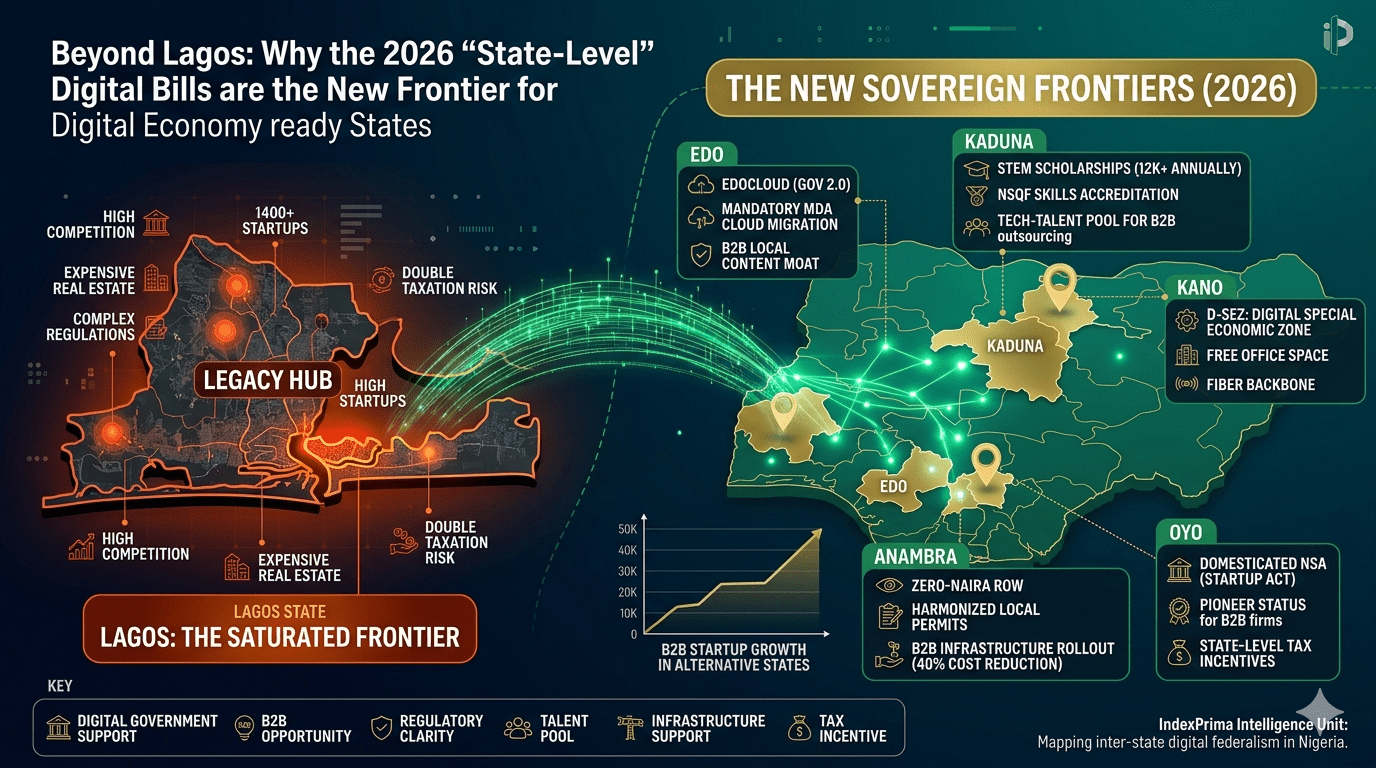
Edo State has become the first to launch Edo-Gov 2.0 (EdoCloud), a fully managed digital governance platform.
-
The Intelligence: Unlike previous efforts that relied on external vendors, Edo is mandating that all state MDAs (Ministries, Departments, Agencies) migrate to a locally-governed cloud.
-
The Opportunity: For B2B SaaS startups, this creates a “Local Content” mandate. If you provide e-invoicing, biometric verification, or payroll software that integrates with EdoCloud, you have a locked-in provincial moat that a global giant like SAP cannot easily pierce.
2. Kaduna’s AI and Skills Mandate
Kaduna State has formally established the Information Technology and Digital Economy Agency (2025).
-
The Mechanism: The state is now offering specific STEM scholarships and “Vocational Skills” certifications (NSQF) to 12,000+ youths annually.
-
The B2B Play: Startups in the EdTech and HR-Tech space are now seeing “State-Level Accreditation” as more valuable than federal recognition. Kaduna is effectively creating a pre-vetted talent pool for B2B firms looking to outsource technical operations away from the high-cost Lagos hub.
3. The “One-Stop” Licensing Trap
The Nigeria Startup Act (NSA) has now been domesticated in over 10 states. While the Federal Act gives you “Pioneer Status,” the State Acts control the “Right of Way” (RoW) and “Local Permits.”
-
The B2B Warning: A B2B logistics startup can be compliant in Abuja but face “Double Taxation” or “Seizure of Assets” in a state that hasn’t synchronized its local digital laws.
-
The Advantage: Founders who prioritize states with “Zero-Naira RoW” (like Kaduna and Anambra) are seeing infrastructure rollout costs drop by 40% compared to uncooperative regions.
4. The “SME Democratization” of Tax Relief
Under the Nigeria Tax Act 2025, companies with turnovers under ₦50 Million now pay 0% CIT.
-
The Shift: States are using this federal floor to build their own “State Incentives.” We are seeing the rise of “Digital Special Economic Zones” (D-SEZs) outside of Lagos, offering free office space and high-speed fiber for B2B startups that move their headquarters to secondary cities.
The “Terminal” Verdict
The “Lagos Premium” is fading. In 2026, the most successful B2B founders aren’t those who win the Lagos market, but those who build “Inter-State Interoperability.” If your software can handle the specific digital laws of 5 different Nigerian states, you aren’t just a startup—you are a national infrastructure provider.