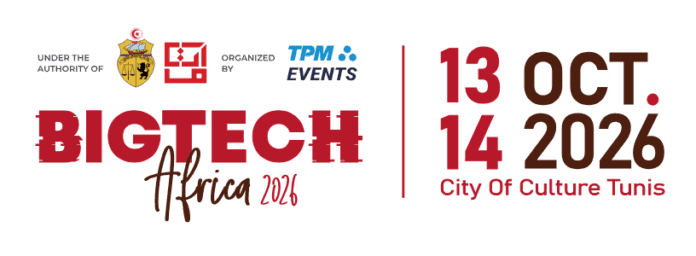
Tunis hosts the third edition of BIGTECH Africa on October 13 and 14, at the Cité de la Culture, organized by TPM Events alongside Tunisia’s Ministry of Communication Technologies under Minister Sofiene Hemissi. Organizers expect more than 4,000 participants, over 100 speakers and delegations from more than 20 countries, built around three pillars (Africa and international cooperation, business and technology, and investment and startups) and a deal-focused track of investor rooms, a deal lounge, an AI hackathon and roughly 1,000 pre-scheduled B2B meetings run through a dedicated matchmaking platform.
Calling it the third edition undersells how long Tunis has actually been doing this. BIGTECH Africa is itself a 2024 rebrand that folded together the long-running Tunisia Digital Summit, which had already reached its seventh edition under that name, with AFRIC’UP, the Africa Startup Summit that had been running independently since at least 2019, plus Developer Days, GEEC and a Job Fair. So the underlying event lineage goes back closer to a decade than to three years; what’s actually new, since 2024, is the single Africa-facing brand stitching all of it together.
It’s also worth weighing this year’s projections against last year’s rather than taking either at face value. BIGTECH Africa’s second edition, held at the Kram Exhibition Center in September 2025, was promoted beforehand as expecting more than 12,000 participants from 12 countries across 10,000 square meters, with nearly 200 startups and 50 investors. This year’s pre-event figure of 4,000 attendees is roughly a third of that, even though the country count being promoted (20-plus) is close to double. No post-event attendance report for 2025 turned up to confirm whether that figure was actually reached, so this isn’t evidence the event shrank, but the shift toward a smaller projected headcount alongside a heavier emphasis on pre-arranged investor meetings and a deal lounge reads like a deliberate move from a broad public expo toward a more curated dealmaking format, prioritizing density of serious conversations over footfall.
The funding case for Tunisia as a hub is also weaker than the pitch suggests, by the government’s own account. Hemissi has publicly named access to finance as the single biggest obstacle facing Tunisian founders, and the credential this entire event leans on, Tunisia’s 2018 Startup Act, has certified 1,352 startups in eight years through an 8-year tax exemption and simplified currency-transfer label, a number the government itself considers insufficient and is already trying to fix with a draft “Startup Act 2.0” aimed squarely at the financing gap. The continental data backs up that admission. In the first half of 2026, Egypt led all African startup funding with $327 million, ahead of Nigeria’s $254 million, Kenya’s $126 million and South Africa’s $83 million, together 58% of everything raised on the continent, and the specific second tier of emerging hubs named alongside them, Morocco, Tanzania and Côte d’Ivoire, each pulling in more than $25 million, doesn’t include Tunisia at all.
The one concrete example of the cross-regional cooperation the agenda promises is worth more attention than the attendance figures. Palestine’s Ministry of Telecommunications and Digital Economy, working with the Palestinian IT Association of Companies, is organizing an official delegation of Palestinian ICT firms to attend with pre-arranged B2B meetings already in place, a real, bilateral instance of the Gulf-and-Mediterranean-facing positioning the event is pitching as an alternative to the usual Europe-first playbook. Whether more delegations like that one get built, rather than how many thousand people pass through the Cité de la Culture, is the more useful thing to watch this time around.