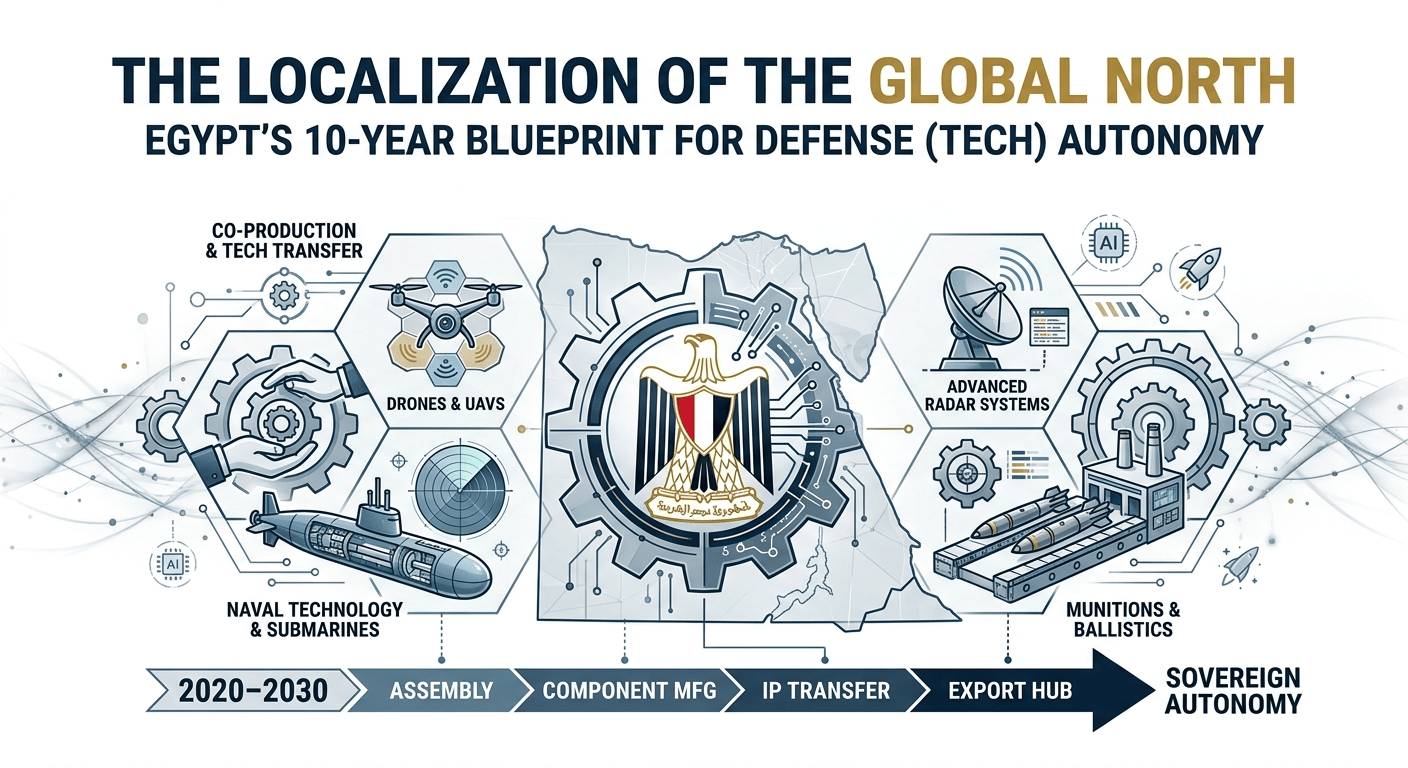
For decades, Egypt was the world’s most loyal buyer of foreign defense tech. But the 2020–2030 Integrated Development Plan has flipped the script. Cairo is no longer writing checks for finished products; it is negotiating for factories. By 2026, Egypt has successfully positioned itself as the “Industrial Heavyweight” of the continent, transforming the Suez corridor into a high-tech armory for the MENA and Sub-Saharan regions.
1. The Context: The 2030 Industrial Engine
Egypt’s defense pivot is not an isolated military strategy; it is the cornerstone of its national industrialization. Under the leadership of the Ministry of Military Production (MoMP), Egypt has spent the last six years “debugging” its manufacturing sector to meet global ISO standards.
-
The Goal: To move from “Screw-Driver” assembly (CKD) to 70% local component manufacturing by 2030.
-
The Scale: Operating 20+ specialized industrial complexes, Egypt is now utilizing its massive domestic workforce to “absorb” the IP of partners from the US, France, China, and Russia.
2. The Breakdown: The Sovereign Co-production Stack
Egypt’s dominance in 2026 is defined by three high-tech “Sovereign Pillars” that represent a massive leap in local engineering:
A. The Drone “Brain” (Wing Loong-1D Localization)
Egypt has moved beyond merely flying Chinese-designed UAVs. Through a deep partnership with AVIC, Egypt is now manufacturing the Wing Loong-1D locally.
-
The Alpha: This isn’t just assembly. Cairo is moving into Carbon-Fiber Airframe production and the localization of high-end optoelectronic sensors.
-
The Result: Egypt is currently the primary “Service and Parts Hub” for Chinese drone tech in Africa, ensuring that neighboring air forces must look to Cairo for maintenance and upgrades.
B. Undersea Sovereignty (Type 039A Submarines)
In one of the most ambitious naval projects in African history, Egypt is localizing the production of advanced naval vessels, including variants of the Type 039A (Yuan-class) submarine.
-
The Edge: Naval tech is the most difficult IP to master. By building these hulls in the Alexandria Shipyard, Egypt is mastering “AIP” (Air-Independent Propulsion) technology, which allows for ultra-silent, long-endurance underwater operations.
C. The Munitions Pipeline (Volume & Export)
While the world faced a global munitions shortage in 2024–2025, Egypt scaled its Small-to-Heavy Munitions lines.
-
The Play: By producing NATO-standard and Eastern-bloc ammunition in massive volumes, Egypt has become the “Warehouse of the Global South.”
-
The Impact: Egyptian-made munitions are now a staple in Sub-Saharan stabilization missions, providing a steady stream of Hard Currency for the Egyptian treasury.
3. The Signal: The “Regional Export Hub”
The real IndexPrima Signal here is the shift in Egypt’s “Trade Balance.”
-
The Alpha: Egypt is no longer just “defending” itself; it is “equipping” its neighbors.
-
The Implication: By 2026, defense exports have become a top-tier GDP contributor. When a Sub-Saharan nation buys an Egyptian-made armored vehicle or drone, they aren’t just buying hardware—they are entering Cairo’s Geopolitical Orbit.
4. Tradeoffs & Risks: The “IP Friction”
-
The Partner Paradox: Managing technology transfers from both the US (M1A1 Abrams) and China (Wing Loong) requires a “Diplomatic Tightrope.” If Cairo leans too far into Eastern IP, it risks triggering sanctions or “Tech-Blockades” from its traditional Western allies.
-
The Quality Control Hurdle: To be a global exporter, Egypt must maintain 100% reliability. Any failure in an Egyptian-made sensor or shell on a foreign battlefield could damage the “Made in Egypt” brand for a decade.
5. The Forward View: The “Suez Tech-Corridor”
By late 2026, watch for the launch of the Suez Defense & Space Zone. This will be a specialized economic zone dedicated to Satellite Manufacturing and Electronic Warfare (EW). Egypt isn’t just building for the land and sea; it is looking at the “High Ground” of space to cement its 2030 dominance.
Egypt is proving that you don’t need to invent the wheel to lead the market—you just need to own the factory. By localizing the Global North, Cairo has become the continent’s indispensable industrial engine.
Index Report: Egypt Defense Localization 2026
| Metric | 2020 Baseline | 2026 Milestone |
| Local Content % | 15–20% | 45–55% (Varies by sector) |
| Export Markets | Domestic Only | 20+ MENA & African Nations |
| Key Export Hub | Alexandria (Naval) | Suez (Drones & Munitions) |
| Strategy Focus | Import-Substitution | Sovereign Co-production |
Sources & References:
-
Egypt State Information Service (2026): Review of the 10-Year Integrated Industrialization Plan
-
Military Africa (Mar 2026): Cairo’s Drone Ambitions: The Wing Loong Localization Breakdown
-
Alexandria Shipyard Quarterly (2026): Mastering the Hull: Progress on the Local Submarine Program