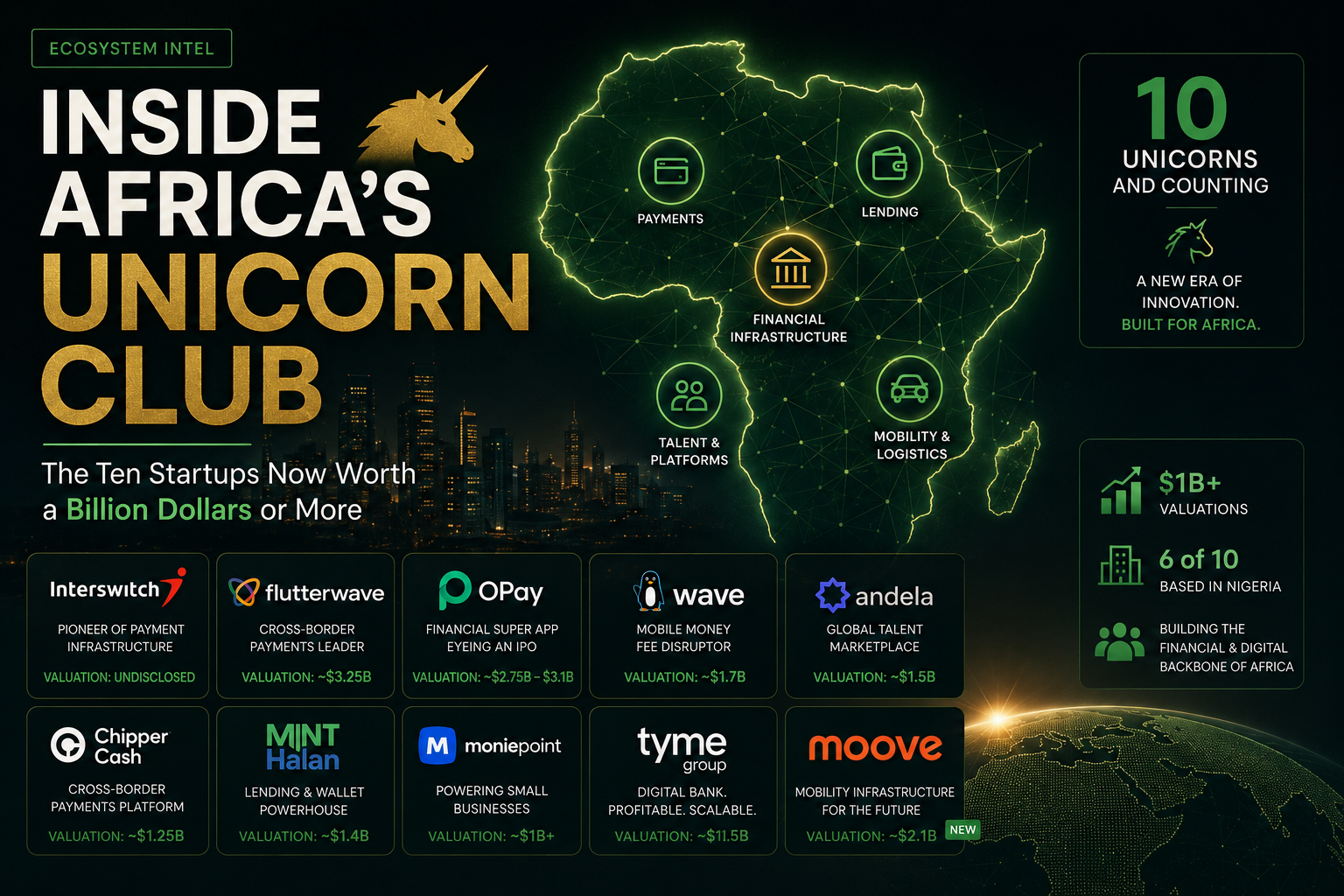
Africa’s tech ecosystem just crossed a genuine milestone. Ten privately held startups on the continent are now valued at $1 billion or more, with mobility and fleet financing company Moove becoming the newest member this week at a $2.1 billion valuation. Getting here took most of a decade, survived a brutal funding winter, and produced a club that looks nothing like Silicon Valley’s version of the same idea. There is no social network here, no consumer app chasing eyeballs for ad revenue. Almost every company on this list makes its money by moving, lending, or safeguarding other people’s cash, or by building the physical and digital rails that let that happen. Here is the story behind each one, and what the full picture says about where African tech is actually headed.
Interswitch: The Quiet Pioneer That Started It All
Interswitch is Africa’s oldest unicorn, and its story explains a lot about why the continent’s tech boom looks the way it does today. Founded in Nigeria in 2002, long before “startup” was a common word in Lagos, Interswitch built the unglamorous plumbing behind Nigerian banking: interbank transaction switching, card processing, and its own domestic card scheme called Verve, which still rivals Visa and Mastercard for everyday transactions across the country. It crossed the billion dollar mark in 2019 after a strategic investment from Visa confirmed what insiders already suspected, that whoever controlled Nigeria’s payment switching infrastructure controlled something genuinely indispensable. Interswitch has flirted with a public listing for years without pulling the trigger, and its current valuation remains undisclosed, but its influence is hard to overstate. Every fintech that came after it, in some way, built on ground Interswitch cleared first.
Flutterwave: Africa’s Most Valuable Startup, Built on Cross-Border Payments
Flutterwave is the name most people outside Africa actually recognize, and for good reason. Founded in Lagos in 2016 by Olugbenga Agboola, Iyinoluwa Aboyeji, and Adeleke Adekoya, the company set out to solve a problem that sounds simple and is not: letting a business in one African country accept payment from a customer in another, or from anywhere in the world, without stitching together a dozen separate banking relationships. It started small, a $230,000 seed round through Y Combinator, and climbed methodically through funding rounds until a $170 million Series C in 2021 pushed it past the billion dollar mark. A Series D the following year took it to $3 billion, at the time the highest valuation any African startup had ever reached. Today Flutterwave sits at roughly $3.25 billion, having processed more than $40 billion in payments and over a billion transactions. In January 2026 it acquired Mono, a smaller open banking startup, in an all stock deal that also handed Flutterwave a Nigerian microfinance banking licence, a sign the company is diversifying beyond pure payments processing as global investors push African fintechs harder on profitability rather than pure growth.
OPay: The Super App Betting on an IPO
OPay grew out of Opera, the Norwegian browser company, and used that unusual parentage to scale fast into one of Nigeria’s dominant consumer financial platforms, combining mobile wallets, agency banking, and micro merchant payment tools into something closer to a financial super app than a single product. It now sits among Africa’s two or three most valuable startups, with reported figures ranging from roughly $2.75 billion to $3.1 billion depending on the source and the date of the estimate. What makes OPay worth watching right now is the direction it is heading: reports through 2026 point to the company preparing for a public listing at a valuation higher than its last private round. If that IPO happens and prices well, it becomes a real test case for whether public markets will actually pay what private investors have been claiming African fintechs are worth, a question the whole ecosystem has a stake in answering.
Wave: The Fee Killer That Beat the Telcos at Their Own Game
Wave took a different path entirely, and it is arguably the most disruptive business model on this entire list. Founded in 2016 and launched in Senegal in November 2017, Wave built its entire pitch around a number: 1 percent. That is the flat fee it charges on transfers, with cash deposits and withdrawals free entirely, a radical undercut of the mobile money fees that telecom operators across West Africa had charged for years. It worked. Wave became the largest mobile money provider in Senegal, beating out entrenched telco competitors on their home turf, and expanded into Côte d’Ivoire, Mali, Uganda, and beyond. It hit unicorn status in 2021 with a $200 million round backed by Stripe, Sequoia Heritage, Ribbit Capital, and Founders Fund, reaching a $1.7 billion valuation and calling itself the first unicorn in Francophone Africa. Today Wave serves more than 20 million monthly users through a network of roughly 150,000 agents, proof that in a market where price sensitivity is extreme, being radically cheaper can beat being first.
Andela: From Training Junior Developers to a Global Talent Marketplace
Andela’s story involves one of the sharper pivots on this list. Founded in 2014 by Iyinoluwa Aboyeji, who later left to co-found Flutterwave, and Jeremy Johnson, who became CEO, Andela started as a hire, train, and deploy operation, identifying promising junior developers across Africa, training them intensively, and placing them as full time distributed engineers with global companies. In 2019 the company made a hard strategic turn away from that model, shifting toward placing already experienced, senior engineers instead, effectively becoming a global talent marketplace rather than a training academy. That pivot came with real pain, including layoffs and a narrower mission, but it also aligned the business with what enterprise clients actually wanted to pay for. Andela reached a $1.5 billion valuation in September 2021 on a $200 million Series E round, and remains Nigeria’s clearest example of a startup that exports talent and expertise rather than a physical product or financial service.
Chipper Cash: Cross-Border Payments Without the Fees
Chipper Cash was founded in 2018 by Ham Serunjogi, from Uganda, and Maijid Moujaled, from Ghana, built on a simple premise that mirrors Wave’s in spirit if not in geography: peer to peer payments across African borders without the fees traditional remittance and banking channels charge. Based in San Francisco but built for African users from day one, Chipper Cash expanded rapidly across Uganda, Ghana, Kenya, Nigeria, and beyond, often partnering with local players like Paystack to get there faster. It reached unicorn status with a valuation of roughly $1.25 billion, and today competes directly with Flutterwave and Wave on cross-border transfers and merchant processing, a reminder that even within Africa’s own unicorn club, several of these companies are fighting over the same customers rather than operating in neat, separate lanes.
MNT-Halan: Egypt’s Lending and E-Wallet Giant
MNT-Halan represents Africa’s fintech story outside the usual Nigeria and Kenya headlines. Founded in Egypt in 2017, the company built a wide platform spanning business and consumer loans, prepaid cards, e-wallets, savings products, and e-commerce, delivered through its Halan app and a large physical agent presence across the country. It has served more than 8 million customers and disbursed over $4.4 billion in loans, and it has expanded beyond Egypt into Turkey, Pakistan, and the UAE, a genuinely unusual footprint for an African fintech. MNT-Halan crossed the billion dollar threshold and has since climbed to a disclosed valuation of $1.4 billion, making it one of the few companies on this list to have a recently confirmed, updated number rather than an estimate frozen at its last funding round.
Moniepoint: Built for Small Businesses, and Built to Last Through a Crisis
Few unicorn stories on this list are as improbable as Moniepoint’s. The Nigerian fintech reached billion dollar status in October 2024, not during the easy money years of 2021, but in the middle of a serious funding drought and while the naira was losing significant value against the dollar. It got there anyway, on the strength of a business model built around Nigeria’s small and informal merchants: point of sale terminals, agency banking, and business accounts for the shopkeepers, market traders, and small operators that larger banks have historically ignored. That focus paid off in a very concrete way. Moniepoint says it handled 80 percent of Nigeria’s in-person payment transactions in 2025, an extraordinary claim that, if accurate, makes it one of the most quietly dominant pieces of financial infrastructure in Africa’s largest economy, unicorn valuation aside.
Tyme Group: A Digital Bank That Went Profitable Before It Went Big
Tyme Group took the more traditional banking route to unicorn status, but with a distinctly hybrid twist. The South African company runs TymeBank domestically and GoTyme in the Philippines, onboarding customers through fully digital accounts activated at thousands of in-store kiosks inside retail partners like Pick n Pay and The Foschini Group, rather than relying purely on branches or purely on app downloads. That hybrid approach helped Tyme cross 15 to 17 million customers across both markets and, notably, reach profitability in South Africa before it raised the round that made it a unicorn. Tyme hit that milestone in December 2024 with a $250 million Series D led by Brazilian neobank Nubank, valuing the company at $1.5 billion and funding further expansion across Southeast Asia, proof that African fintech playbooks can travel outward as well as inward.
Moove: The Newest Member, and a Different Kind of Bet Entirely
Moove rounds out the list as the freshest addition, and the one that looks least like the others. Rather than payments or banking, Moove finances, owns, and operates vehicle fleets for mobility platforms, functioning as an infrastructure layer underneath ride hailing and delivery networks rather than a financial product aimed at consumers directly. It is Uber’s largest global fleet partner and has moved into autonomous vehicle operations through a partnership with Waymo. Founded in 2020, it reached its $2.1 billion valuation this month on the back of a $250 million Series C, and its entry into the club is being read by analysts as a signal that African tech’s next wave of billion dollar companies might come from physical infrastructure and logistics rather than another payments app.
What the Full List Actually Reveals
Step back from the individual stories and a few patterns jump out immediately. Nigeria alone produced six of these ten companies, Interswitch, Flutterwave, OPay, Andela, Moniepoint, and Moove, a level of concentration that says as much about Nigeria’s sheer market size and banking gaps as it does about any one city’s startup culture. Financial services dominate almost the entire list, and that is not an accident either. Across much of Africa, banking remains fragmented, under-penetrated, and inefficient enough that building better payment rails, agent networks, or lending infrastructure is not just a business opportunity, it is closing a gap that households and small businesses feel every single day.
The other pattern worth sitting with is how little of this valuation is actually fresh. Several companies on this list, Interswitch, Wave, Andela, and Chipper Cash among them, have not announced a new priced round in years, meaning their billion dollar tags reflect a snapshot from an earlier, more generous funding environment rather than a current market price. That matters because it means the real test for several of these unicorns has not happened yet. OPay’s rumored IPO, if it goes ahead, will be the first time public markets get to say whether they agree with what private investors decided these companies were worth. Given how sharply funding priorities have shifted toward profitability and away from growth at any cost, that verdict is far from guaranteed to match the number on the slide.
For now, though, ten is the number, and it keeps climbing. Algeria’s Yassir has reportedly cleared the billion dollar threshold too without formally confirming it, and every founder building infrastructure, lending, or logistics businesses across the continent right now is watching this list closely, because Moove’s arrival just proved there is more than one way onto it.