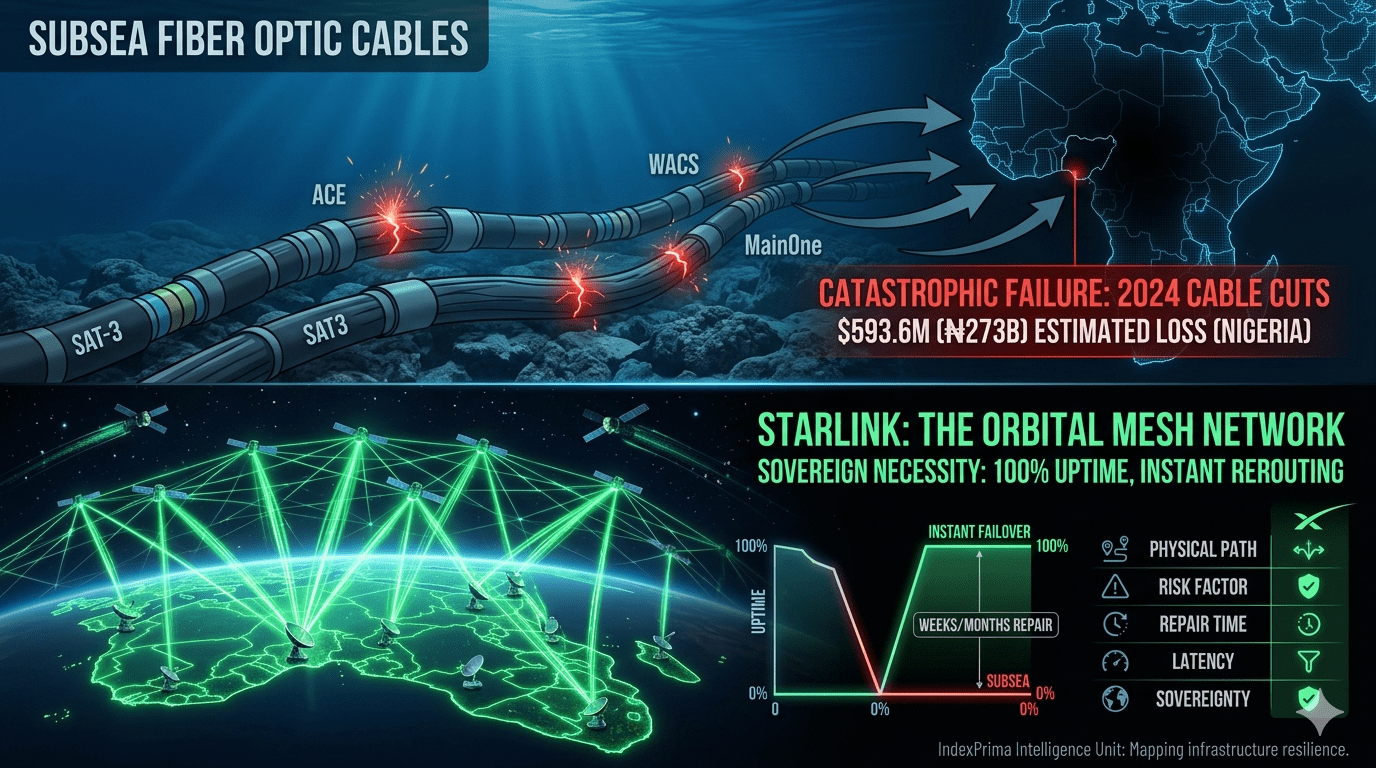
For decades, the African internet has been built on a fragile paradox: 99% of our data travels through fiber-optic cables no thicker than a soda can, resting on the unpredictable ocean floor. The 2024 “Great Blackout” exposed the vulnerability of this centralized architecture and fast-tracked the transition to Sovereign Satellite Infrastructure.
1. The Single Point of Failure: The Anatomy of the 2024 Crash
On that Thursday in March, a suspected underwater rockslide triggered a cascading failure. Because multiple cables converged at a single physical point near Côte d’Ivoire, a single geographical event crippled a continent.
-
The Data: Nigeria alone lost an estimated $593.6 million (₦273 billion) in just four days of downtime.
-
The “Black Box” Effect: Unlike terrestrial fiber, repairing subsea cables requires specialized vessels, international permits, and favorable weather. In 2024, some repairs took over two months to finalize, leaving businesses in a state of indefinite paralysis.
2. Starlink: The Mesh Network vs. The Single Cord
While subsea cables are “point-to-point” (if the cord cuts, the link dies), Low Earth Orbit (LEO) satellites like Starlink operate as a mesh network.
| Feature | Subsea Fiber (Legacy) | Starlink / LEO (Sovereign) |
| Physical Path | Static (Ocean Floor) | Dynamic (Orbital Mesh) |
| Risk Factor | Anchors, Rockslides, Sabotage | Solar Flares (Lower Risk) |
| Repair Time | Weeks to Months | Instant (Auto-rerouting) |
| Latency | 20ms – 50ms (Superior) | 30ms – 60ms (Comparable) |
| Sovereignty | Dependent on Landing States | Independent of Terrestrial Borders |
3. Why Satellite is Now a “Sovereign Necessity”
In 2026, “Sovereignty” means the ability of a nation to remain online regardless of what happens in international waters.
-
The Policy Pivot: Following the cuts, regulators in Ghana, Nigeria, and South Africa shifted from viewing Starlink as a “luxury competitor” to a “critical backup.” Ghana, for instance, rushed through Starlink’s licensing specifically to build a “Space-Based Redundancy Layer.”
-
Banking Resilience: We are now seeing Nigerian Tier-1 banks installing Starlink terminals at every branch. This isn’t for their primary internet—it’s so that even if the entire Atlantic floor is severed, the ATM and USSD networks stay alive.
4. The Economic “Insurance Policy”
The 2024 cuts taught us that the cheapest internet (Subsea) becomes the most expensive when it fails.
-
The Hybrid Model: The winning infrastructure strategy for West Africa is no longer “Subsea OR Satellite,” but Subsea AND Satellite. * The “Terminal” Intel: LEO satellites provide a Geographic Moat. By bypassing coastal landing stations, a startup in a landlocked country like Niger or a rural area in Benue can access the same uptime as a tech firm in Lagos.
The Verdict
The 2024 cable cuts were a painful but necessary “stress test.” They proved that as long as Africa’s digital heart beats only through a few underwater pipes, our sovereignty is at the mercy of the seabed.
Today, satellite isn’t just about “connecting the unconnected”; it’s about ensuring that the connected never go offline again.
Key Data Points & Sources:
-
Economic Loss: Techpoint Africa: Nigeria’s $593M Loss Analysis
-
Outage Mapping: Internet Society: 2024 West Africa Cable Outage Report
-
Policy Shift: ITW Africa: The Diversification into Satellite Post-2024
-
Infrastructure Resilience: Recorded Future: The Escalating Risk Environment for Subsea Cable