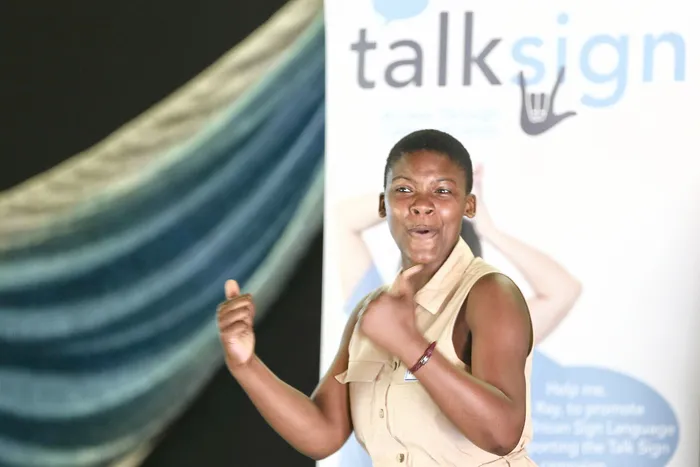
Globally, over 70 million people rely on sign language, yet the world faces a chronic shortage of qualified human interpreters. Talksign’s high-fidelity AI models address this “Accessibility Fragility” by providing real-time, bidirectional translation that functions under 100 milliseconds—fast enough for natural, conversational pacing.
The Core Problem: Most digital infrastructure (Zoom, Government portals, Banking apps) assumes audio/text input, effectively “muting” the deaf community.
The Solution Logic: Moving from a human-dependent model to a Real-Time AI Rail that enables instant translation using nothing more than a standard webcam or smart glasses.
The Talksign ecosystem is built on two primary models that work in tandem to create a continuous communication loop:
Palm 1.0 (The Interpreter): An input model that tracks hand gestures and facial expressions via webcam, converting American Sign Language (ASL) into text or spoken audio with 84.2% semantic accuracy.
Echo 1.0 (The Avatar): An output model that takes spoken or typed words and generates a photorealistic 3D avatar that signs back in real time.
Low-Latency Engine: Engineered to process translation in <100ms, deleting the awkward “processing pause” typical of earlier assistive technologies.
Talksign isn’t just building an app; they are building a Public Infrastructure Layer. By focusing on “Sovereign Accessibility,” they are targeting sectors where communication is a critical failure point:
Financial Institutions: Deleting the friction of deaf individuals accessing banking services without a third party present.
Government Agencies: Ensuring public service announcements and emergency broadcasts are hard-coded with sign language avatars.
Telecommunications: Partnering with video conferencing platforms to integrate Palm and Echo directly into the call rail.
Talksign 2026 Product Scorecard
| Metric | Details |
| Founding Region | Nigeria & United Kingdom |
| Core Models | Palm 1.0 (ASL to Speech) & Echo 1.0 (Speech to Avatar) |
| Accuracy Rate | 84.2% Semantic Accuracy |
| Processing Speed | < 100 Milliseconds |
| Hardware Agnostic | Works on Standard Webcams, Smartphones, & Smart Glasses |
| Primary Language | American Sign Language (ASL) |
The launch of Talksign signals a massive shift in the Assistive AI Sector. For builders in this space, the 2026 playbook is clear:
Efficiency over Aesthetics: Echo 1.0 succeeds because it is Real-Time. In accessibility, a “perfect” avatar that takes 10 seconds to load is a bug; a “good” avatar that signs instantly is a feature.
The “Human-in-the-Loop” Replacement: The goal is not to “replace” interpreters but to provide a Baseline Utility where interpreters are unavailable, creating a new market for 24/7 accessibility.
Regional Specialization: While Talksign leads in ASL, there is a significant “White Space” for regional variations (e.g., Nigerian Sign Language or BSL). Startups like Kenya’s Signverse are already following this regionalized high-fidelity model.
Sources & References
[1] TechCabal: Talksign debuts AI models for real-time ASL speech translation
[2] WIRED: The Rise of Sign Language AI: Bridging the Deaf-Hearing Gap
[3] Google Search: Talksign AI Startup and Product Launch
The “Index” Take: In 2021, sign language translation was a “Lab Project.” In 2026, Talksign is proving it is a Mission-Critical Product. By hard-coding bidirectional translation into the Palm and Echo models, they are giving the deaf community the Digital Voice they’ve always had, but that the world was too slow to hear. This isn’t just “inclusion”; it is the Optimization of Human Connection.“