For a decade, the story of African tech was written in the ink of Venture Capital equity. We celebrated the “Unicorns,” the massive Series A rounds, and the dilution of founders as a badge of honor. But as we cross the threshold of 2026, the data suggests a seismic shift in the tectonic plates of the continent’s digital economy.
The “Funding Winter” hasn’t just ended; it has thawed into a landscape that is colder, sharper, and far more calculated. According to the latest 2026 projections and 2025 performance data, the ecosystem is undergoing a “Grand Correction.”
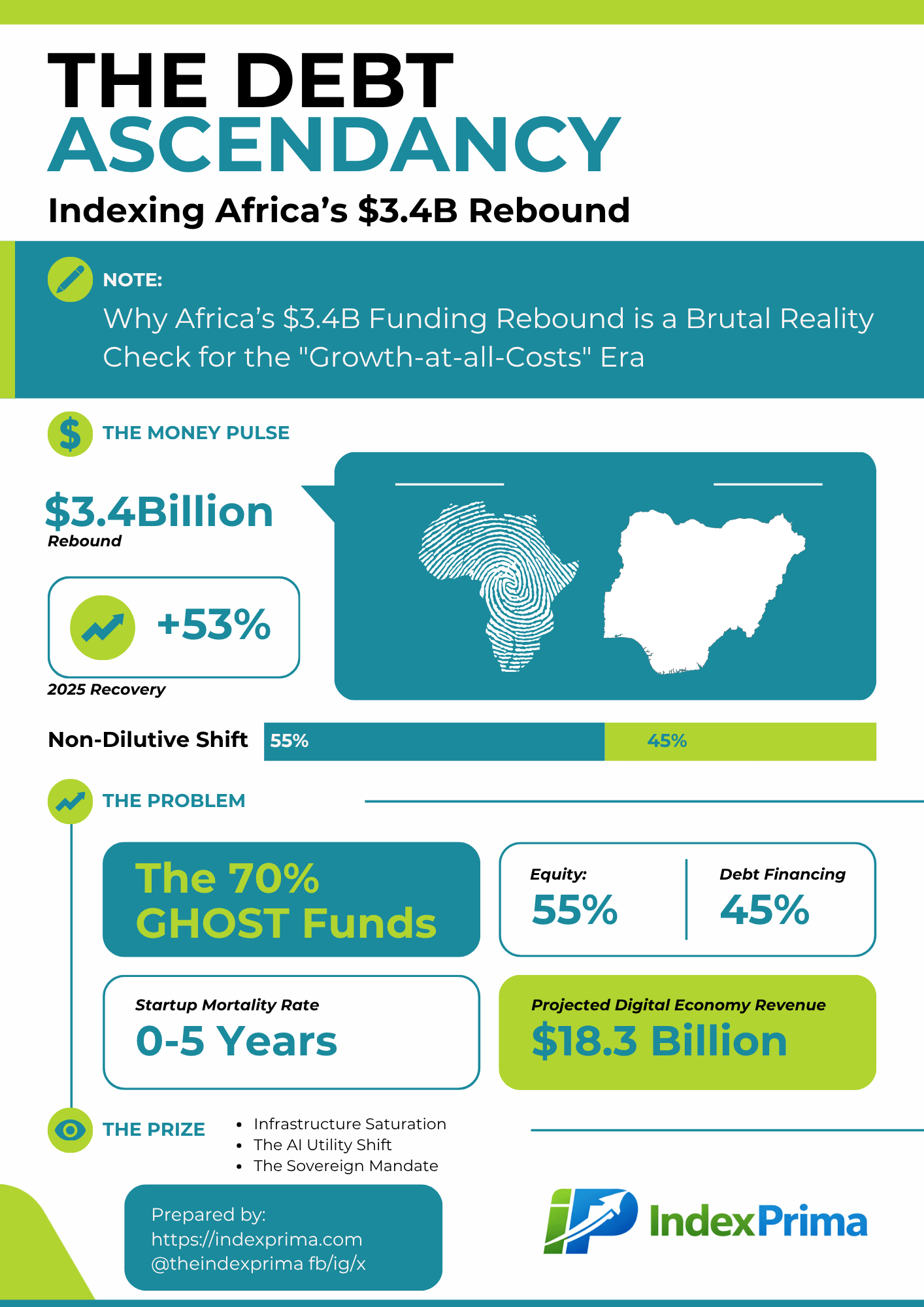
The $3.42 Billion Rebound
In 2025, total funding into African tech reached $3.42 billion. This represents a 53% year-on-year growth in capital recovery from the stagnant lows of 2024.
On the surface, this looks like a return to the “Glory Days” of 2021. But look closer at the architecture of these deals, and the Index tells a different story. This is not a “rebound” to the old ways; it is a total pivot in how the frontier is financed.
1. The Rise of the “Shadow Capital”: The 45% Debt Pivot
The most significant statistic of 2026 is not how much was raised, but how it was raised. 45% of total funding in 2025 was Debt Financing. In 2019, debt accounted for only 17% of the ecosystem’s capital. Today, it is nearly half.
- The Strategy: High-growth companies like M-KOPA, Moove, and BasiGo are no longer willing to sell 20% of their soul for a growth round. Instead, they are leveraging their predictable revenues to secure asset-backed loans.
- The Intelligence: Debt is a “Sober” instrument. You cannot pay back a loan with “Daily Active Users” or “Engagement Metrics.” You pay it back with cash flow. The surge in debt proves that African startups are finally generating real, bankable revenue.
2. The Survival Gap: The 70% Mortality Rate
While the billions flow in at the top, the floor is falling out at the bottom. 70% of African startups are now estimated to fail within their first 5 years. In the last 18 months, startup shutdowns jumped by 50%, erasing over $52 million in previously raised investor capital.
From the quiet exit of early-stage edtechs to the high-profile collapse of logistics giants, the message is clear: Capital is no longer a moat.
- The Cause: High inflation (peaking at 30%+ in core markets), currency volatility, and a “mismatch” between Silicon Valley business models and African street realities.
- The Index Take: We are seeing a “Flight to Quality.” Investors are no longer “spraying and praying.” They are doubling down on the 30% that show a path to profitability, leaving the “Hype-heavy” 70% to wither.
3. The Prize: Nigeria’s $18.3 Billion Digital Frontier
Despite the failure rates, the macro prize remains staggering. Nigeria’s digital economy revenue is projected to hit $18.3 billion by the end of 2026. This isn’t just “internet money.” It is driven by three foundational shifts:
- Infrastructure Saturation: Starlink and 5G fiber expansion are pushing internet penetration toward the 60% mark.
- The AI Utility Shift: AI has moved from a “buzzword” to a “utility,” specifically in credit scoring for the unbanked and Agri-tech yield forecasting.
- The Sovereign Mandate: For the first time, local data residency and cloud sovereignty are being enforced, creating a massive opportunity for local infrastructure players.
The IndexPrima Verdict
We are entering the Era of the Architect. The days of building a startup just to “get funded” are dead. The 2026 winner is the founder who understands Debt Service Coverage Ratios as well as they understand User Experience.
With a $18.3B market waiting and $3.4B in fresh, disciplined capital on the table, the opportunity has never been larger. But with a 70% failure rate looming, the margin for error has never been thinner.
In this new decade, you don’t need more news. You need Intelligence, Indexed.