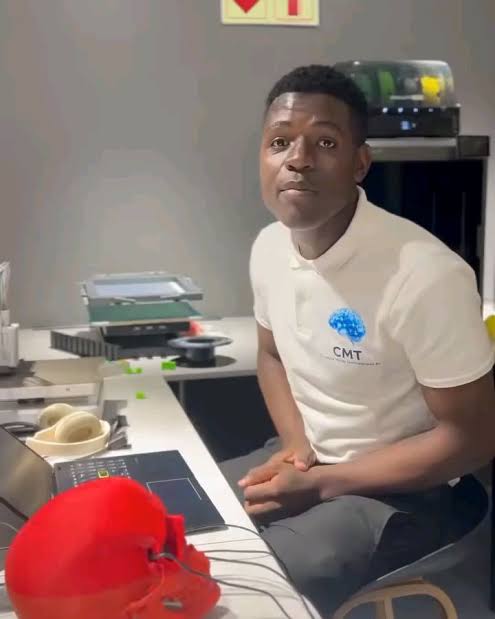
Most voice assistants in South Africa still default to English the moment you open your mouth, no matter which of the country’s eleven official languages you actually grew up speaking. Innovator Mzwandile Zulu is working against that default. He has built a humanoid robot designed to understand and respond in all eleven, isiZulu, isiXhosa, Sepedi, Xitsonga, Afrikaans, English, Setswana, siSwati, Sesotho, isiNdebele and Tshivenda, rather than treating English as the starting point and everything else as an afterthought.
South Africa’s constitution recognises eleven official languages for a reason. No single one is spoken by a majority of the population, and thoughtful design here means an interface that actually reflects the country’s constitution, not just its capital cities. Most consumer AI products, robotics included, are still built English first and then patched with translation layers for everything else, an approach that tends to work reasonably well for widely resourced languages and poorly for the rest. Building understanding and response across all eleven from the ground up is a materially harder engineering problem, since languages like isiZulu and isiXhosa carry click consonants and grammatical structures with little in common with English, and good machine understanding of them still lags far behind what exists for global languages.
According to Zulu, the project is about more than a technical demonstration. He has described the aim as making technology more accessible while showing that African languages have a real place in AI and robotics, not just as an add on feature but as a starting design principle. That framing matters in a region where a lot of consumer technology still arrives built for other markets first and localised for Africa second, if it’s localised at all.
Zulu’s robot fits into a broader movement of African builders choosing to design AI and robotics around the continent’s own languages, cultures and communities, rather than importing tools built elsewhere and hoping they translate. South Africa itself has already produced at least one other notable example of this: Iris, an AI powered educational robot that also communicates in all eleven official languages, built by innovator Thando Gumede and unveiled in Durban in 2025 with backing from the country’s Department of Science, Technology and Innovation. Whether Zulu’s project and Iris turn out to be entirely separate efforts or connected in some way isn’t fully clear from what’s publicly available, but either way the pattern is the same: South African innovators independently arriving at the conclusion that eleven languages, not one, should be the baseline for AI built in and for the country.
Robots and AI systems that only work well in English or French don’t just inconvenience non English speakers, they quietly decide whose voice counts as the default and whose is treated as an exception. Projects like this one are a small but pointed correction to that pattern, and a reminder that some of the most interesting AI work happening on the continent right now isn’t about matching what’s been built elsewhere. It’s about building something that couldn’t have come from anywhere else.