While global climate finance disproportionately targets carbon mitigation and industrial emissions reduction, a structural transformation is unfolding across the African continent. African economies produce less than 4% of global carbon emissions, yet they experience the most immediate, volatile shocks of global warming—from severe droughts disrupting agricultural supply chains to rapid flooding straining infrastructure.
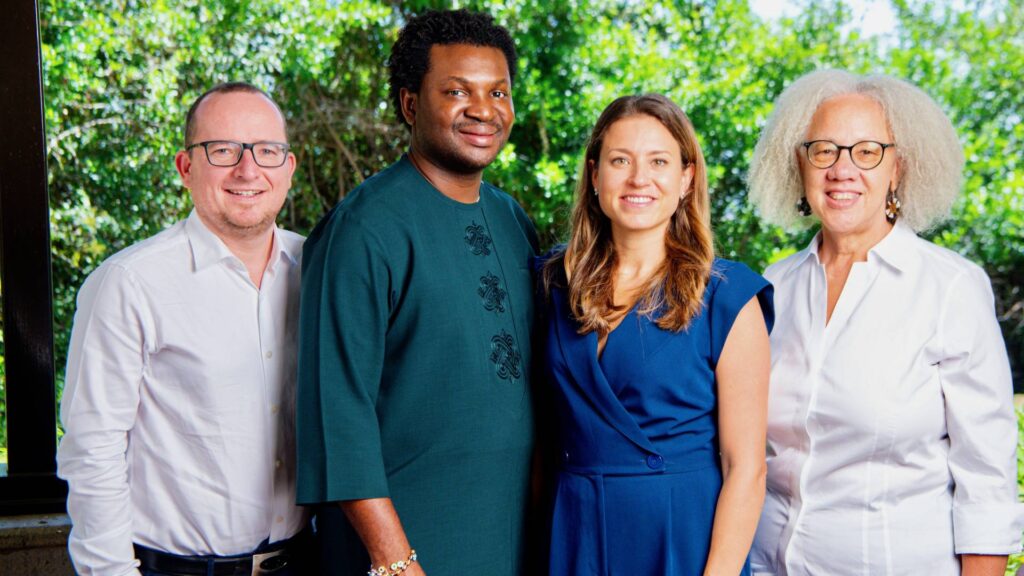
In this landscape, climate technology is not an ESG footnote; it is the core addressable market. The successful $30 million second close of Catalyst Fund’s debut equity vehicle—moving closer to its $40 million target—proves that international capital is waking up to this reality. Led by Managing Partner Maelis Carraro alongside General Partners Maxime Bayen, Olúwatóyìn Emmanuel-Olubake, and Amolo Ng’weno, the fund is shifting the investment paradigm from avoiding emissions to building structural resilience.
The Core Framework: Capital & Focus
By stepping in at the pre-seed stage, Catalyst Fund addresses a critical equity funding gap in the African ecosystem. They write initial checks to de-risk companies before traditional, late-stage venture capital enters the picture.
| Parameter | Specification |
| Fund Stage | Second Close ($30 Million secured toward a $40 Million final target) |
| Investment Stage | Pre-seed through Series A (Entry at pre-seed) |
| Initial Check Size | ~$200,000 equity investment, with reserves allocated for follow-on rounds |
| Target Scale | ~40 startups across the continent (28 already backed across 10 markets) |
| Geographic Focus | Pan-African (Key operational hubs include Nigeria, Kenya, Egypt, and Tanzania) |
| Core Verticals | Agritech, food systems, clean energy, water management, cold chains, circular economy/waste, and climate fintech |
The Blended Finance Innovation: A significant structural driver of this second close is a $5 million junior equity commitment from Financing for Agricultural SMEs in Africa (FASA). Operating as a “first-loss” mechanism, this structure absorbs early execution risks to attract risk-averse commercial limited partners (LPs) like Speedinvest and corporate foundations into the stack.
Mitigation vs. Adaptation: The Strategic Pivot
To understand why this fund model matters, it helps to isolate how the investment thesis differs from standard Western climate venture capital:
-
Western ClimateTech Focus (Mitigation): Capturing carbon, improving EV battery chemistry, reducing factory emissions. It solves for tomorrow’s atmosphere.
-
African ClimateTech Focus (Adaptation): Deploying decentralized solar cold storage, constructing transparent waste supply chains, engineering predictive agritech systems. It solves for today’s survival and economic continuity.
Startups solving these localized infrastructure deficits are building highly defensible, high-margin commercial enterprises because they address immediate, non-discretionary operational friction for businesses and consumers.
De-Risking via Embedded Venture Building
Early-stage execution in frontier markets is notoriously tricky. Thin localized talent pools and complex supply chain logistics mean that capital alone is rarely enough to scale a pre-seed venture. To address this, Catalyst Fund partners with BFA Global to deliver an intensive, hands-on operational framework.
Inside the Portfolio: Real-World Resilience
The fund’s investment thesis isn’t theoretical—it is actively functioning across 28 current investments. Three clear operational archetypes show what this looks like on the ground:
1. Keep It Cool (Kenya)
-
The Problem: Up to 40% of smallholder catch and poultry spoils before reaching urban markets due to broken cold chains.
-
The Solution: A solar-powered cold-chain infrastructure network that enables regional fishers and poultry farmers to store, preserve, and transport inventory predictably, drastically increasing household income stability.
2. MazaoHub (Tanzania)
-
The Problem: Volatile rainfall patterns and unpredictable soil degradation reduce crop yields for smallholders who lack precision data.
-
The Solution: An end-to-end platform combining artificial intelligence-powered soil analysis with agronomic insights and direct digital market access, transforming unpredictable farming into data-driven operations.
3. Bekia (Egypt)
-
The Problem: Fragmented municipal waste collections lead to massive environmental degradation and lost material value within the informal economy.
-
The Solution: A digital marketplace that enables household consumers and small enterprises to trade sorted waste directly with commercial recycling partners, injecting liquidity into the circular economy.
Looking Ahead to the Final Close
With the market recovering from the venture contraction of recent years—African climate tech sector funding rebounded to over $1.1 billion—this $30 million milestone proves that adaptation infrastructure is highly investable. As the team moves toward its final close later this year, the focus shifts to scaling these 28 portfolio companies into sustainable market leaders, showing that solving climate vulnerability is one of the most lucrative structural arbitrage opportunities of the decade.