For decades, the African tech narrative has been built on a persistent, almost noble lie: that software alone can solve structural problems. We built mobile money on top of failing telecom infrastructure, and we built digital banks on top of unreliable payment switches. But as we move into 2026, we have hit a wall that code cannot climb. We have hit the Compute Wall.
Artificial Intelligence (AI), the definitive technology of this era, is not a “software layer.” AI is a power layer. High-performance computing (HPC) for training foundation models requires immense, consistent, reliable energy. It is an industrial-grade process disguised as a digital service.
Yet, most data center operators in Nigeria have continued to build using the 2015 “Real Estate” model: construct a secure building, get a partial grid connection, and buy large generators. This model, in 2026, is no longer just high-cost; it is a failure vector. It is leading Nigeria directly into the Energy-Latency Trap.
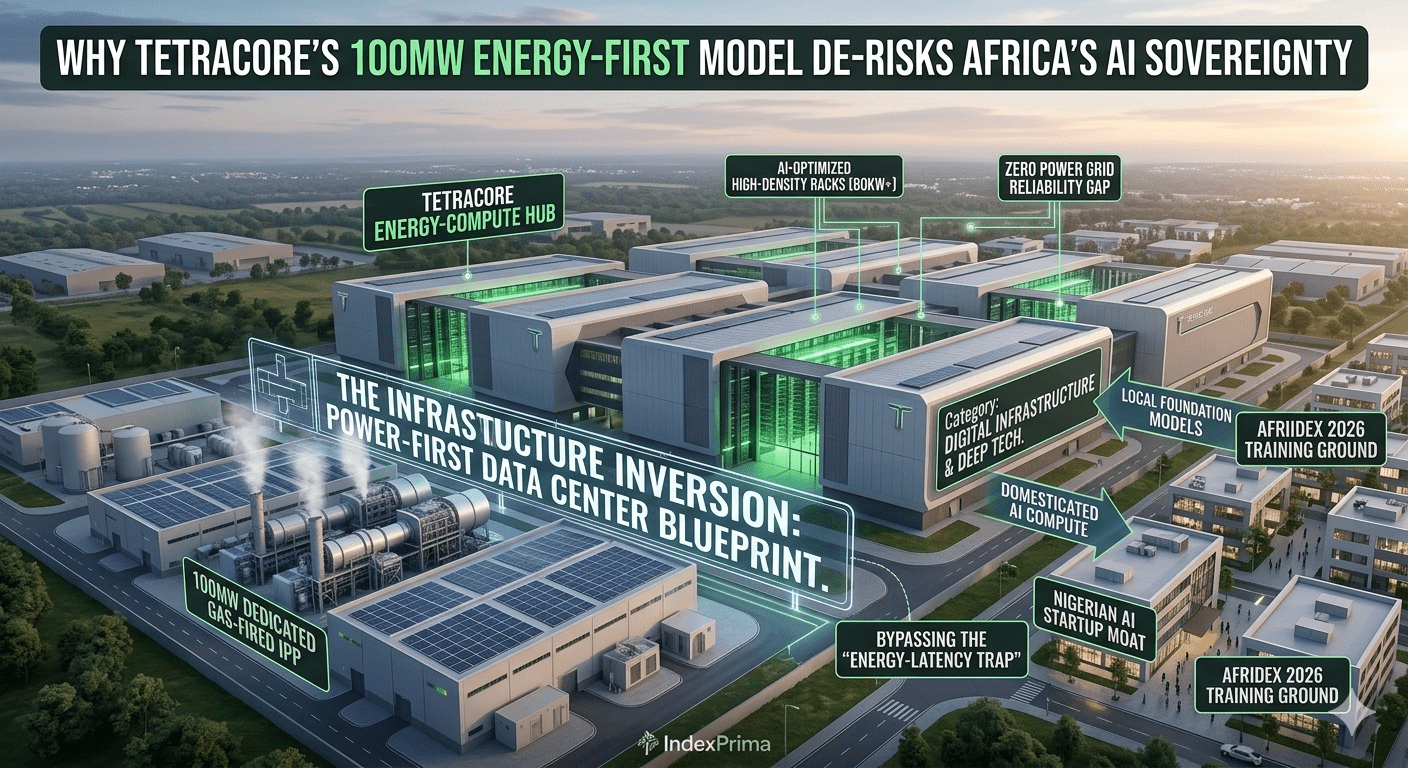
The inversion is necessary. We must move from Data Centers that buy power to Power Plants that sell data. The March 2026 announcement of Tetracore Energy Group’s partnership with Huawei for a $400 million Tier III Data Centre in Ogun State, powered by an integrated 100MW Independent Power Plant (IPP), is not just a landmark deal; it is the Blueprint. It is the first critical asset of true African AI Sovereignty.
1. The Real Estate Trap vs. The Compute Wall
Traditional data centers are essentially secure real estate operations. They prioritize uptime for web hosting, cloud storage, and generic enterprise applications (databases, mail servers). A traditional data center rack might consume 2–5kW of power.
AI is different. Training a Large Language Model (LLM) or running complex video analytics requires high-density computing (using GPUs and specialized accelerators). An AI rack can consume 80–120kW+. The sheer density of energy required is magnitudes higher than the legacy grid was ever designed to provide.
The Nigerian Failure Vector (Pre-Inversion)
In Nigeria, a operator relying on the 2015 model faces three compounding failures:
-
Grid Impossibility: The national grid (on-grid generation of ~4,000–6,000MW) cannot physically deliver 10MW—let alone 100MW—of stable, 99.99% reliable power to a single point for AI-grade HPC. Any attempt to rely on it introduces severe volatility.
-
The Diesel Lag: Relying on generators means a data center must maintain massive, expensive diesel reserves (a major environmental and logistics liability). Furthermore, the gap (no matter how small) between a grid outage and the generators taking over (measured in milliseconds) introduces severe stress on highly sensitive (and expensive) AI hardware, often causing computational failures that necessitate a complete “re-training” of models.
-
The Involuntary Cap: If a operator cannot guarantee stable energy, they cannot allow local startups to use their HPC racks. They are forced to cap high-density usage to preserve the stability of their overall (low-density) facility. This means local founders are locked out of local compute.
The Infrastructure Inversion Defined
Tetracore has realized the fundamental flaw. A data center, fundamentally, is an energy utilization machine. Therefore, the Power Layer must be domesticated FIRST. Tetracore isn’t building a data center and looking for power; they are building a Power Plant and packaging its output as compute. This is the inversion. The energy-source reliability is guaranteed BEFORE the first server rack is installed.
2. Analyzing the Energy-Latency Trap
The “Energy-Latency Trap” is the systemic penalty a region pays when its core digital infrastructure (compute) is divorced from its core utility infrastructure (reliable power).
In 2026, this trap manifests in two ways for African startups:
A. The Geographic Penalty
Startups are forced to build their models in “foreign clouds” (AWS, Google, or Microsoft servers in the EU/US) because local data centers have no HPC capacity. This introduces HPC-Grade Latency.
-
The Problem: The speed of an AI training cluster is often limited by data transfer speeds between the computational nodes. If your data is in Nigeria and your HPC training cluster is in Dublin, the constant “pings” back and forth introduce an unacceptable, non-sovereign delay.
-
The Implication: You can’t train “real-time” Nigerian AI (e.g., local-dialect speech recognition for finance or automated logistics) on a remote cloud because the latency is too high. The data is geographically penalizing the compute.
B. The Performance Penalty (Local)
When local data centers do manage to get limited HPC racks online, they cannot guarantee power stability. This is fatal for AI.
-
The HPC Stress: High-density GPU racks put immense strain on energy systems. If a data center has volatility, it cannot guarantee the peak load needed by the GPU cluster for a complex calculation. The training job fails or “hangs.”
-
The “Diesel-Flicker” Vector: Even a millisecond switch from grid to generator is enough to crash a running training cluster. This is the Diesel Flicker Penalty. It doesn’t affect traditional websites, but it destroys AI training jobs.
3. How Tetracore De-Risks the “Compute Moat” for Local Startups
For Nigerian AI startups (the ones we are tracking for AFRIDEX 2026), access to high-performance computing is not a convenience; it is a structural necessity. Access to compute is the absolute “moat” that separates a toy from an enterprise-grade product.
The Tetracore 100MW solution completely transforms the unit economics of AI for local founders.
A. De-Risking the Performance Variable (Performance-Grade Reliability)
By building a dedicates gas-fired 100MW Independent Power Plant (IPP) on-site, Tetracore is guaranteeing:
-
“Zero Lag” Reliability: Power flows directly from the turbines to the racks. There is no grid volatility to manage, and zero need for diesel-generator “switch” procedures. The 100MW of domesticated, peak-load capacity is dedicated exclusively to the data center’s computational requirements.
-
HPC Guarantee: This reliability means Tetracore can offer HPC-Specific SLAs (Service Level Agreements). A local startup can begin a 60-day LLM training process knowing the power will be stable, at peak load, for the duration. The Performance Variable is de-risked.
B. Unit Economic Transformation (HPC “Moat” Democratization)
Because Tetracore is integrated, they control the Unit Cost of Energy-Compute. They are not buying power from a Distribution Company (DisCo) and marking it up. They are selling the output of their own plant as compute.
-
Cost Disruption: This allows Tetracore to dramatically lower the cost per compute hour compared to foreign clouds (which include the built-in cost of high EU/US energy and logistics).
-
The Startup Moat: Local AI startups can finally domesticate their compute. They no longer need millions of dollars in VC funding just to pay the Dublin or Virginia server bills. They can train complex, localized models on Nigerian-priced, performance-grade compute. The moat is no longer exclusive to Silicon Valley.
4. Why 100MW (at Peak) is the Marker of True AI Sovereignty
True digital sovereignty is the ability of a nation to control, process, and retain its own data, on its own infrastructure, using its own computational power. In the age of AI, this means Compute Sovereignty.
Tetracore’s 100MW (at Peak) marker is significant because:
-
Domesticated Foundation Models: For the first time, Nigerian institutions (universities, corporations, defense) can build Domesticated Large Foundation Models. We can train models on local language (Yoruba, Hausa, Igbo dialects), local trade data, and local biometric data without that data ever leaving the country.
-
Sovereign Resilience: By domesticating the power-and-compute layer, Nigeria removes the risk of “data blockade.” In a future where computational power is a weapon, Nigeria will not be reliant on a foreign government or corporation to provide the servers needed for national security or critical infrastructure management.
The “Sovereign Shield” of March 2026
TheTetracore Energy Group $400M investment is more than infrastructure; it is a declaration that the era of Nigerian energy-compute dependence is ending. It is the beginning of the Sovereign Shield where energy stability is digital sovereignty.
| Variable | The Real Estate (Pre-Inversion) Model | The Energy-First (Tetracore Blueprint) Model |
| Power Source | Grid (unreliable) + Diesel Gen (high lag) | Dedicated 100MW IPP (Sovereign/Persistent) |
| Energy Density | Low (2–5kW/rack) | High/AI-Optimized (80–120kW+/rack) |
| Reliability Vector | Major Gap (Grid failure to Diesel start) | ZERO Gap ( turbines to racks) |
| Latency Vector | Foreign Cloud (EU/US) – High Latency | Local Cloud (Ogun) – Near-Zero Latency |
| HPC Moat | Startups restricted / capped | Startups empowered (local compute democratization) |
The inverters have arrived. Nigeria is not just coding the future; we are now powering the compute that trains it.
Sources & References
-
Corporate Announcement (Tetracore/Huawei deal): Tetracore Partners Huawei for $400M AI-Ready Data Center (The Guardian Nigeria/Leadership Newspaper, March 24, 2026).
-
AI Surveillance Spend Report (Nigerian leading spend): Nigeria Leading Africa’s Surge into AI-Powered Surveillance and Defence Spending (IndexPrima Intelligence Unit, March 24, 2026).
-
HPC Energy Density Data: The Challenge of High-Density HPC in a Transitioning Energy Grid (DatacenterDynamics, 2025).
-
Nigerian Grid Stability analysis: Transmission Co of Nigeria (TCN) Grid Performance Q1 2026 (Nerc.gov.ng).
-
Latency Penalty for Remote HPC: Analyzing Latency Penalties for Remote Cloud HPC Training Clusters (Association for Computing Machinery, 2025).
The Tetracore 100MW Data Center isn’t just a high-alpha investment; it is the fundamental building block of Nigeria’s 2026 industrial strategy. Tetracore’s energy-compute inversion has successfully domesticated Africa’s first truly Sovereign Compute Moat.