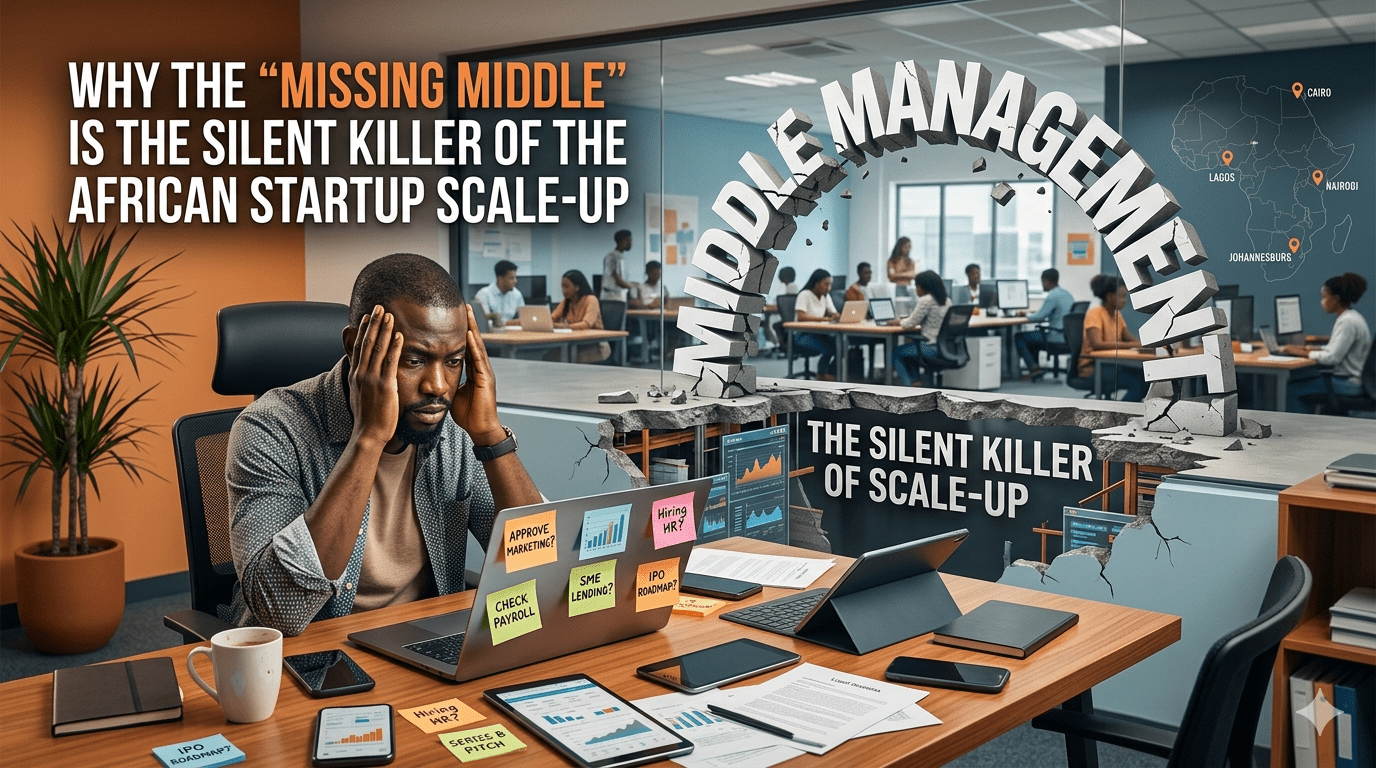
There is a specific, quiet moment in the life of a founder that no pitch deck prepares you for. It usually happens around Year Three. You have the seed funding, the product-market fit is humming, and the team has grown from five friends in a living room to fifty people in a glass office.
But suddenly, you realize you are still the only one making decisions.
You are still approving the social media copy. You are still sitting in on the junior dev’s sprint. You are the CEO, but you are also the Chief Operating Officer, the Head of HR, and the person who decides which coffee beans to buy. You are exhausted, and more importantly, your company has stopped breathing.
This is the Mid-Level Crisis, and it is the primary reason African startups hit a “Scale Ceiling” long before they ever reach the heights of an IPO.
The Myth of the Hero Founder
For a long time, we have romanticized the “Founder who does it all.” We celebrate the grit of the entrepreneur who stays up until 3:00 AM fixing bugs. But in the 2026 economy, Grit is not a scalable resource. The transition from a “Startup” to a “Company” requires a structural layer that most founders are afraid to build: Middle Management. These are the people who translate high-level vision into Monday-morning reality. They are the shock absorbers. Without them, the founder is directly connected to every tiny spark in the office, and eventually, the founder burns out.
We are losing our middle managers to a “Talent Drain” that isn’t just about moving to Europe or the US—it’s about a lack of internal investment. We hire for “Hustle” at the bottom and “Venture Experience” at the top, but we forget to train the “Bridge” in between.
The Cost of the Hollow Center
When you have a hollow center, your startup develops “Decision Constipation.” Information flows up, but nothing flows back down because the founder is a bottleneck.
Junior staff feel invisible because their only “boss” is a founder who is too busy chasing a Series B to give them feedback. Strategic errors go unnoticed because there is no one with enough seniority to say “No” to the CEO, but enough proximity to the ground to know when a project is failing.
This gap is killing scalability. You cannot manage 200 people with a “Founder-to-All” reporting line. You might survive the growth, but you won’t survive the complexity. The “Missing Middle” is why brilliant ideas in Lagos, Nairobi, and Cairo often fail to become continental institutions. They simply lack the Institutional Tissue to hold the weight of their own ambition.
The Cultural Pivot: From “Doing” to “Enabling”
Solving the Mid-Level Crisis requires a painful psychological shift for the African founder. You have to stop being the “Star Player” and start being the “Coach.”
It means hiring people who are better than you at the “boring” stuff—operations, people management, and process optimization. It means trusting a Mid-Level Manager to own a department’s P&L and, more importantly, trusting them to make a mistake.
The talent gap isn’t just about a lack of skilled people in the market; it’s about a lack of permission. We have plenty of brilliant operators across the continent, but we often trap them in “Execution Roles” where they have no autonomy. To scale, you must build a layer of “Owners,” not just “Doers.”
As we navigate this high-interest, high-complexity year, the startups that will win are not the ones with the most funding, but the ones with the most Structural Resilience. If you want to go from a founder with a great idea to a CEO of a lasting legacy, you have to stop trying to be the hero of every story. You have to build the bridge. You have to hire, train, and empower the middle.
Because at the end of the day, a company is not a product—it is a System. And a system without a center is just a collapse waiting to happen.
The Bottom Line: Don’t build a monument to your own hustle. Build an organization that can breathe without you. The “Missing Middle” is the only path to the IPO.
Founder’s Checklist: Is Your Center Hollow?
-
Are you still involved in more than three internal meetings a day that aren’t about strategy?
-
Does work stop when you go on a 48-hour flight?
-
Can your junior staff name their direct supervisor without naming a founder?
-
Have you promoted someone into a management role and actually given them a budget to manage?