In the 2026 venture landscape, entering the Nigerian food delivery market is widely considered the ultimate “Stress Test” for logistics startups. While the market offers a massive TPV (Total Payment Volume) potential, it is also defined by high operational friction: fuel price volatility, “last-mile” infrastructure deficits, and a fragmented merchant base.
Swoop, the Eswatini-born startup, is not entering blindly. On April 24, 2026, the company announced a $7.3M Seed round specifically earmarked for its Nigerian “Blitzscale” phase. This isn’t just another delivery play; it is an attempt to export a proven, low-cost operational model from a peripheral market into the continent’s most lucrative—and lethal—operational theater.
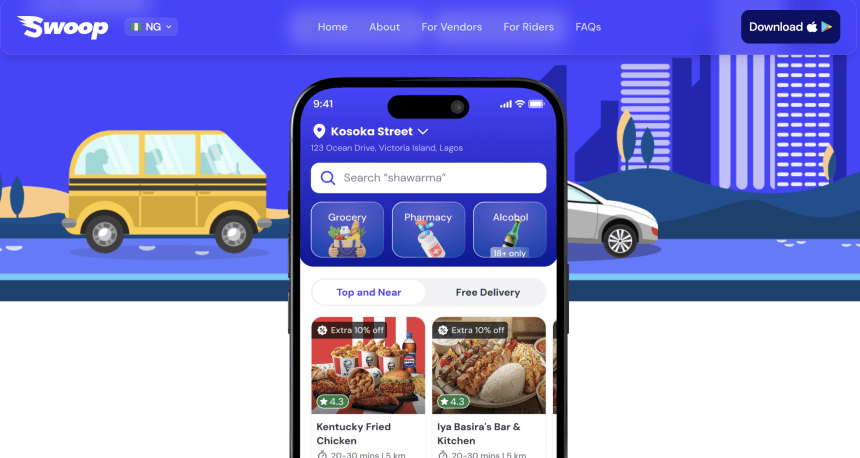
Unlike legacy players who focused purely on food delivery, Swoop’s architecture is built on the “Multi-Vertical Utility” model. The startup operates as a super-app, integrating food delivery, grocery logistics, and a fintech layer.
-
The Margin Hedge: By bundling multiple services, Swoop aims to increase its “Customer Lifetime Value” (CLV) while keeping acquisition costs (CAC) low. If food delivery margins are squeezed by inflation, the fintech or grocery verticals act as a Liquidity Buffer.
-
Algorithmic Routing: Swoop has hinted at a proprietary routing engine designed for “High-Chaos Environments.” In the context of Lagos and Abuja, this is a mechanical necessity. The engine optimizes for fuel efficiency and driver uptime, addressing the primary cost-drivers in the Nigerian market.
-
The “Asset-Light” Strategy: Swoop’s entry involves heavy partnerships with existing local fulfillment centers, avoiding the capital-heavy trap of building proprietary warehouses from Day 1.
The utility of Swoop’s expansion is found in its ability to offer “Institutional-Grade Reliability” in a market where “Best Effort” service is the norm.
-
Merchant Integration: Swoop is prioritizing the “Middle-Market” restaurants—businesses that are too small for high-end boutique delivery apps but too busy to manage their own riders.
-
The Fintech Pivot: Reports suggest that a significant portion of the $7.3M will fund the development of SwoopPay, a merchant-facing wallet designed to provide instant settlement. In Nigeria’s high-velocity trade environment, “Instant Liquidity” for vendors is a more powerful hook than just “delivery volume.”
The expansion from Mbabane to Lagos is a study in Regulatory Interoperability. * The Sovereign Signal: The fact that an Eswatini startup can raise $7.3M to enter Nigeria signals a maturing of the “Pan-African Venture Rail.” Investors are no longer looking for “Country Winners”; they are looking for “Operational Systems” that can be copy-pasted across borders.
-
The Competition: Swoop enters a field currently contested by local giants and revitalized global players. However, their “Seed Alpha” gives them the runway to experiment with pricing models that legacy players, hampered by older overhead structures, cannot match.
Swoop Strategic Scorecard (April 2026)
| Metric | Details |
| Funding Round | $7.3 Million (Seed) |
| Date | April 24, 2026 |
| Origin Market | Eswatini |
| Target Market | Nigeria (Food & Grocery Delivery) |
| Core Architecture | Super-App (Logistics + Fintech) |
| Key Competitive Advantage | Operational efficiency / Low-cost scaling |
Index Report: Key Stakeholders (2026)
-
The Innovator: Swoop (Led by Eswatini-based leadership).
-
The Target: Nigerian Urban Consumers (Lagos, Abuja, Port Harcourt).
-
The Enablers: Seed-stage VCs focused on Pan-African market expansion.
Sources & References
-
Primary News: Swoop raises $7.3 million seed for African super app, food delivery first — TechCabal 2026
-
Market Analysis: The State of Nigerian Logistics: Why Efficiency is the New Alpha — BusinessDay 2026
-
Strategic Diagnostic: How DPI and Digital Infrastructure are Changing African Commerce — IndexPrima Diagnostic
The “Index” Take: In 2026, the winner of the Nigerian delivery war won’t be the one with the most bikes, but the one with the most resilient “Unit Economics.” Swoop’s $7.3M raise is a bet on Operational Arbitrage. If they can prove that their Eswatini-tested efficiency can survive the friction of the Nigerian grid, they won’t just be a delivery app; they will be the primary rail for urban commerce in West Africa. This is the ultimate “Inverse Flip”: a small-market champion taking on the big-market giants.