The global transition to electric mobility has largely centered around passenger cars—a paradigm designed for Western infrastructure but completely mismatched to the industrial and logistical realities of sub-Saharan Africa. Across the continent, the primary economic and mass-transit engine operates on two wheels. With an estimated 25 million commercial motorcycles (known regionally as boda bodas or okadas) anchoring urban transit registries, motorcycle taxi operators cover 150 to 200 kilometers daily. These operators serve as the lifeblood of suburban commerce while remaining intensely exposed to highly volatile, imported fossil-fuel markets.
To capitalize on this structural reality and aggressively expand the physical energy grid required to support it, pan-African electric mobility leader Spiro has closed a landmark $215 million equity financing round. Co-led by Impact Fund Denmark (Denmark’s state development finance institution) and Equitane (the long-term investment platform founded by Spiro Chairman Gagan Gupta), this massive capital injection signals a decisive shift past early-stage proof-of-concepts into heavy, institutional asset scale.
1. De-Risking the Balance Sheet: The Anatomy of a $343M Capital Moat
Hardware-heavy mobility platforms are notoriously capital-intensive, frequently collapsing under the weight of early manufacturing overhead, unoptimized supply chains, and battery depreciation costs. Spiro’s financing strategy indicates a deliberate effort to counter this trend by building a fortress balance sheet composed of layered debt and equity instruments:
-
The Cumulative Capital Footprint: The latest $215 million equity round pushes Spiro’s total capital raised to over $343 million across seven funding intervals since its launch in 2022.
-
The Layered Funding Runway: This equity injection directly follows a $50 million debt facility secured in February 2026 from Afreximbank, Nithio, and the Africa Go Green Fund.
-
The Institutional Core: It builds seamlessly upon a historical $100 million equity round closed in October 2025, which was led by Afreximbank’s Fund for Export Development in Africa (FEDA).
-
Early Leverage Foundations: This cumulative structure also leverages a foundational $63 million debt package arranged by GuarantCo and Société Générale in 2023.
By securing pure equity from European pension-backed development capital and major trade finance institutions, Spiro insulates its expansion runway from the aggressive high-interest environments currently impacting domestic commercial bank debt across emerging markets.
2. The Unit Economics of Survival: Petrol vs. Swapping Architecture
The commercial validity of electric mobility in African urban corridors begins and ends with the daily cash-flow statement of the individual rider. Boda boda operators typically generate between $10 and $15 in daily gross revenues. Under legacy petrol architectures, fuel and basic mechanical maintenance exhaust an unsustainable 40% to 60% of that total income.
Spiro’s business model targets this operational drain through two distinct revenue vectors: upfront hardware affordability and sticky, recurring pay-as-you-go (PAYG) battery-swapping transactions.
            THE TWO-WHEELER MOBILITY UTILITY REVENUE ARCHITECTURE

  THE TRADITIONAL FUEL TRAP:
  [Petrol Bike Purchase] ➔ [40%-60% Income Lost to Fuel] ➔ [High Opex Burn] ➔ [Stagnant Cash Flow]

  THE VERTICALLY INTEGRATED EMOBILITY MATRIX:
  [Spiro Hardware Sale ($800)] ➔ [Sticky PAYG Battery Swapping] ➔ [40% Rider Opex Reduction] ➔ [Solar Grid Buffer]
By separating the cost of the vehicle from the cost of the energy storage unit (the battery), the platform fundamentally alters the rider’s margin structure.
The Unit Economics of Urban Mobility: Petrol vs. Spiro Ecosystem
| Financial & Operational Metric | Traditional Petrol Two-Wheeler | Spiro Electric Vehicle Ecosystem |
| Upfront Hardware Retail Cost | Standard commercial market baseline | ~$800 (Reported 40% less than petrol equivalents) |
| Daily Energy Operational Cost | 40% to 60% of daily rider earnings lost to petrol | Less than $2 per day via recurring energy subscription |
| Net Daily Operating Savings | $0 (Subject to fuel price spikes) | $2 to $3 saved per day per individual operator |
| Refueling Downtime Friction | 5–10 minutes at traditional retail stations | Under 3 minutes via automated smart-swap nodes |
| Lifespan Environmental Impact | Baseline urban particulate emissions | 72% lower lifecycle carbon emissions |
3. Vertical Integration: Overcoming the Supply Chain and Grid Trap
A common failure point for light EV assembly projects in emerging economies is an over-reliance on importing completely knocked-down (CKD) kits from East Asia, which leaves ventures vulnerable to currency fluctuations and shipping bottlenecks. Spiro is executing a deep vertical integration strategy to build defensive industrial walls:
-
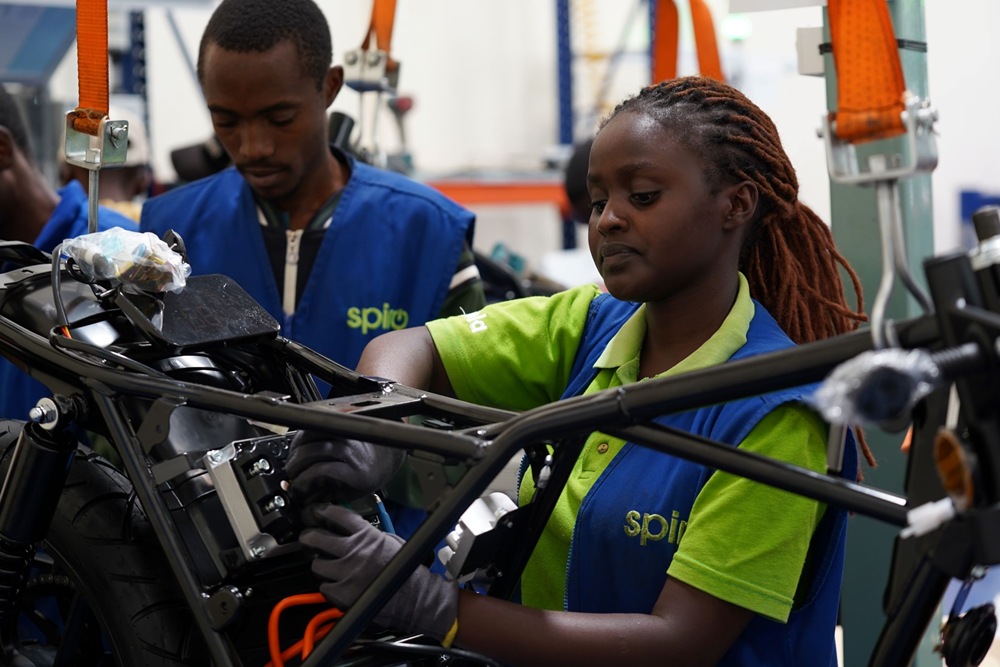
Localized Manufacturing Hubs: The company operates state-backed, active assembly and manufacturing facilities in Kenya, Rwanda, and Uganda.
-
Component Localization Targets: Spiro currently maintains a 30% local component sourcing rate, with a strict industrial target to scale domestic component manufacturing to 70% within the next 24 months.
-
Proprietary R&D Moats: Backed by an engineering core of over 150 specialists and holding more than 30 proprietary patents, the company designs its own custom Battery Management Systems (BMS) locally in Kenya.
-
Circular Infrastructure Operations: To mitigate electronic waste liabilities and extend battery asset life, the firm operates a dedicated, large-scale battery recycling and second-life assembly facility in Nigeria.
-
Insulating Against Unreliable Grids: To protect its 2,500 smart-swap stations from local municipal power outages, Spiro integrates localized solar generation arrays and secondary-life stationary battery storage systems directly into its charging nodes.
4. Cross-Border Footprints and the Sovereign Playbook
The fresh $215 million equity injection is explicitly mapped to drive geographical expansion and industrial duplication across diverse economic blocks. Spiro’s operational network currently spans seven sovereign markets: Kenya, Rwanda, Uganda, Togo, Benin, Nigeria, and Cameroon. Within this footprint, the company has deployed over 100,000 electric motorcycles, established 2,500 smart-swap stations, and processed more than 30 million individual battery swaps.
The next phase of growth targets deep entries into the Democratic Republic of Congo (DRC) and Ethiopia.
               SPIRO'S PAN-AFRICAN INFRASTRUCTURE EXPANSION CORRIDOR

  [CORE WEST & EAST BLOCK] ➔ ➔ ➔ [RESOURCE & POPULATION DEPTH]
  • Kenya, Rwanda, Uganda         • Democratic Republic of Congo (DRC)
  • Togo, Benin, Nigeria, Cameroon • Ethiopia
By moving into Ethiopia—which has enacted progressive bans on the import of non-electric passenger vehicles—and the DRC—the global epicenter of battery supply chain minerals—Spiro is positioning itself directly at the intersection of state-level industrial policy and clean infrastructure procurement.
The Index Take
Spiro’s $215 million capital raise highlights a fundamental principle of building technology in Africa: the most successful software plays are those wrapped inside heavy, inescapable physical infrastructure. For years, early-stage mobility startups attempted to win the market by building asset-light ride-hailing apps, attempting to aggregate existing petrol-powered drivers onto digital platforms. Those models frequently struggled due to razor-thin margins, high driver churn, and crushing fuel inflation.
Spiro’s success lies in its realization that the winning play is to become the energy utility provider for the continent’s transport layer. By owning the physical motorcycle, the proprietary battery hardware, the local assembly plants, and the solar-insulated swapping network, Spiro captures revenue at every step of the value chain.
An independent lifecycle assessment showing a 72% reduction in climate impact and 19 tonnes of avoided carbon emissions per vehicle is highly attractive to European pension capital. However, the true anchor for long-term survival is the immediate economic benefit to the rider: putting $2 to $3 back into a driver’s pocket every single day. In a macroeconomic climate focused on unit economics and operational resilience, the companies that build the physical tracks will always outlast the companies that merely build the apps.
Sources & References
-
[1] Launch Base Africa Industrial Desk: Spiro Lands $215M to Expand Its Battery-Swapping Network for Africa’s Motorcycle Taxis
-
[2] The Condia Capital Bureau: Spiro Raises $215M to Scale Africa’s Largest Battery-Swapping Network
-
[3] Ecofin Agency Energy Ledger: Electric Mobility Firm Spiro Raises $215 Million for Continental Expansion
-
[4] ThisDayLive Infrastructure Brief: Group Raises $215M in Equity to Scale Electric Mobility, Energy Infrastructure Across Africa
-
[5] IT News Africa Technology Review: Spiro Secures $215M to Accelerate Africa’s EV Revolution
-
[6] WeeTracker DealStreet Africa: Spiro Raises USD 215 M To Expand Electric Motorcycle Battery-Swapping Network In Africa
-
[7] Daba Finance Intelligence Hub: Spiro Raises $215M Equity to Expand EV Network in Africa
Founder to Watch: Spiro Team (Benin/Pan-Africa). The Electric Mobility Titans