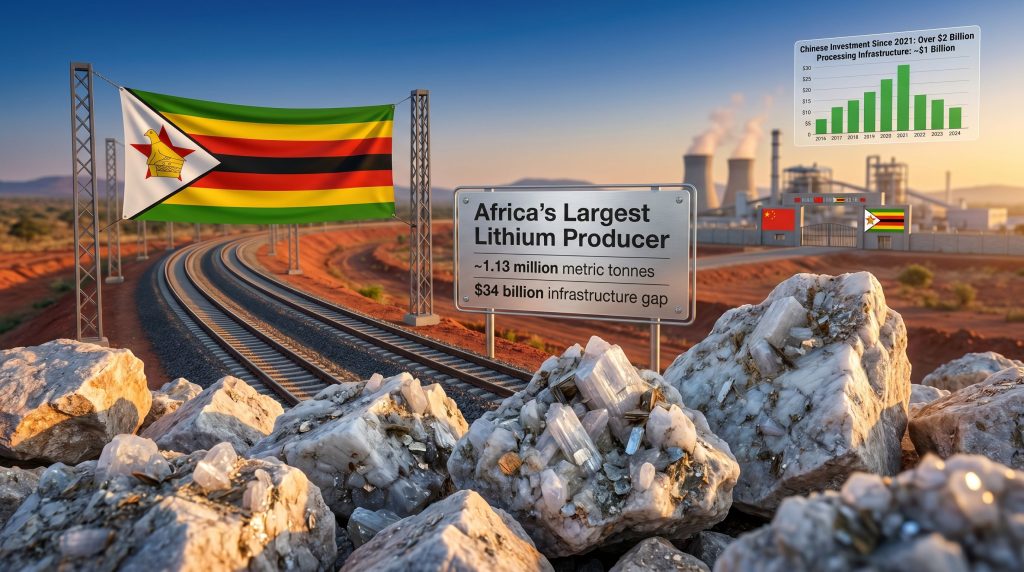
Zimbabwe is executing a major economic pivot on the global stage. At the World Economic Forum (WEF) in Dalian, China, Zimbabwean policymakers led by Finance Minister Mthuli Ncube launched an aggressive investment pitch anchored by an audited 8.2% GDP growth rate, a strict raw mineral export ban, and a newly unveiled National Artificial Intelligence Strategy.
The core thesis of Harare’s message to international markets is simple: Zimbabwe is no longer content to serve as a low-value, extractive pit for raw critical minerals. Instead, the state is leveraging its position as Africa’s largest holder of lithium reserves to force international mining conglomerates to build localized industrial processing networks, using alternative financing paths to close a massive $34 billion domestic logistics gap.
Industrial Blackmail or Value Capture? The Lithium Ultimatum
The absolute center of Zimbabwe’s new macroeconomic framework is its approach to mandatory mineral beneficiation (adding local value to raw commodities before export).
Historically, foreign extraction companies dug up raw lithium ores and unprocessed concentrates, shipping them directly to refineries in mainland China and Europe. This left Zimbabwe with minimal tax revenues, depleted natural wealth, and zero industrial job creation.
Harare is putting an absolute end to this practice. The government has confirmed a hard deadline: effective January 2027, a total ban on the export of raw lithium concentrates will be enforced.
               THE LITHIUM VALUE CAPTURE PIPELINE

  [Legacy Model]  ──► Dig Raw Ore ➔ Export Concentrates ➔ Foreign Refineries
                                      │
                         (2027 Absolute Export Ban)
                                      ▼
  [Enforced Shift] ──► Domestic Processing ➔ Battery-Grade Carbonate ➔ Global Export
                                      │
                             (Economic Carrots)
                                      ▼
  [Investor Perks] ➔ Special Economic Zones (SEZs) + Sweeping Tax Concessions
To soften the blow of this regulatory stick, Zimbabwe is offering significant carrots:
-
Special Economic Zone (SEZ) Status: Investors willing to build domestic chemical processing plants and refineries qualify for zero-rated corporate tax brackets for their early operational years.
-
Duty-Free Capital Imports: Equipment, processing machinery, and industrial components required to build localized plants cross borders completely free of import duties.
-
The Target Output: The state is forcing operators to scale up from basic crushing plants to advanced facilities capable of outputting battery-grade lithium carbonate or lithium hydroxide locally.
The Cross-Border Financial Swap: Collateralizing the Subsurface
While an 8.2% GDP expansion—driven by temporary spikes in agricultural output, mining, and localized ICT adoption—looks impressive on paper, Zimbabwe’s broader industrial expansion is bottlenecked by a decaying transport network. The African Development Bank (AfDB) estimates that the country faces a $34 billion infrastructure modernization shortfall.
Because prolonged inflation cycles and historical debt defaults lock Zimbabwe out of traditional Western capital channels like the IMF or World Bank, Harare is turning heavily to resource-linked debt instruments.
During the WEF sidelines, the government opened advanced negotiations with China Railway to finance critical road and rail networks. Under this framework, which closely mirrors the Democratic Republic of Congo’s $7 billion Sicomines model, Zimbabwe evaluates the cost of major transport logistics, pledges future revenues from localized lithium and gold operations as collateral, and allows Chinese state engineering firms to build the infrastructure directly.
Parallel Trajectories: The Commodity vs. Technology Matrix
To diversify its geopolitical risk profile away from singular bilateral dependence, Zimbabwe’s pitch layers critical mineral processing alongside alternative institutional membership and digital automation.
| Strategic Vector | Legacy Structural Bottleneck | 2026 Sovereign Intervention | Macro Economic Target |
| Industrial Mining | Pure extraction of raw, unrefined lithium concentrates. | Total export ban by Jan 2027; mandatory domestic refining facilities. | Retaining high-value chemical processing margins onshore. |
| Logistics & Transport | $34B deficit in rail and road networks, choking mineral export paths. | Resource-backed infrastructure financing negotiations with China Railway. | Upgrading heavy-freight links to maritime ports. |
| Technology & AI | Low tech adoption across public sector and manual supply chains. | Rollout of the National Artificial Intelligence Strategy. | Positioning as a regional tech hub for smart mining and predictive agritech. |
| Capital Integration | Isolation from traditional Western-dominated financial markets. | Active application for membership in the BRICS New Development Bank (NDB) and the AIIB. | Accessing alternative, non-Western development liquidity. |
The AI Overlay: Code Meets Commodities
The most unexpected element of Zimbabwe’s global pitch is its National Artificial Intelligence Strategy. For an economy structurally weighed down by cash liquidity challenges and energy access deficits, an aggressive push into AI appears ambitious.
However, the policy is intentionally narrow and utilitarian. Rather than trying to compete in building foundational large language models, Zimbabwe’s AI blueprint targets localized, heavy-industry applications:
-
Predictive Agritech: Utilizing computer vision and machine learning models to analyze satellite imagery, predict crop yields, and optimize automated irrigation across newly modernized agricultural belts.
-
Autonomous Mining Safety: Deploying sensor arrays and AI models within deep-level gold, platinum, and lithium mines to predict structural collapses, automate ore grading, and optimize energy distribution inside processing plants.
-
Digital Public Health: Integrating AI diagnostics to bridge the doctor-to-patient deficit in remote rural mining settlements.
The Index Take: The Friction of Execution
Zimbabwe’s pitch is structurally sound, but its success hinges entirely on the transparency and execution of its regulatory frameworks. Forcing global battery-component giants to process minerals locally works when local operating environments are stable. If the country cannot guarantee reliable baseload electricity to power these new, energy-intensive lithium refineries, the 2027 export ban will simply lead to a production freeze rather than industrialization.
Furthermore, relying heavily on mineral-backed infrastructure loans is a high-wire act. If commodity prices experience sharp down-cycles, the pledged natural resources consume a larger share of state revenues, potentially trapping future budgets. The coming 18 months will determine if Zimbabwe’s combination of lithium ultimatums and alternative capital alliances can successfully rebuild its industrial base, or if the country will remain vulnerable to global commodity volatility.
Sources & Reference Context
-
[1] Mining Weekly Regional Analysis: Zimbabwe mining investment rising steadily and extends beyond lithium
-
[2] NewZimbabwe Business Desk: Zimbabwe courts global investors at World Economic Forum
-
[3] Investment Monitor Global Insights: Zimbabwe explores resource-linked loans with China Railway on WEF sidelines
-
[4] Mining Digital Supply Chain Report: Zimbabwe Uses Lithium to Fund China Infrastructure Deal ahead of 2027 Ban
-
[5] Africa News Agency Macro Briefing: Harare explores $34 billion resource-backed financing with China