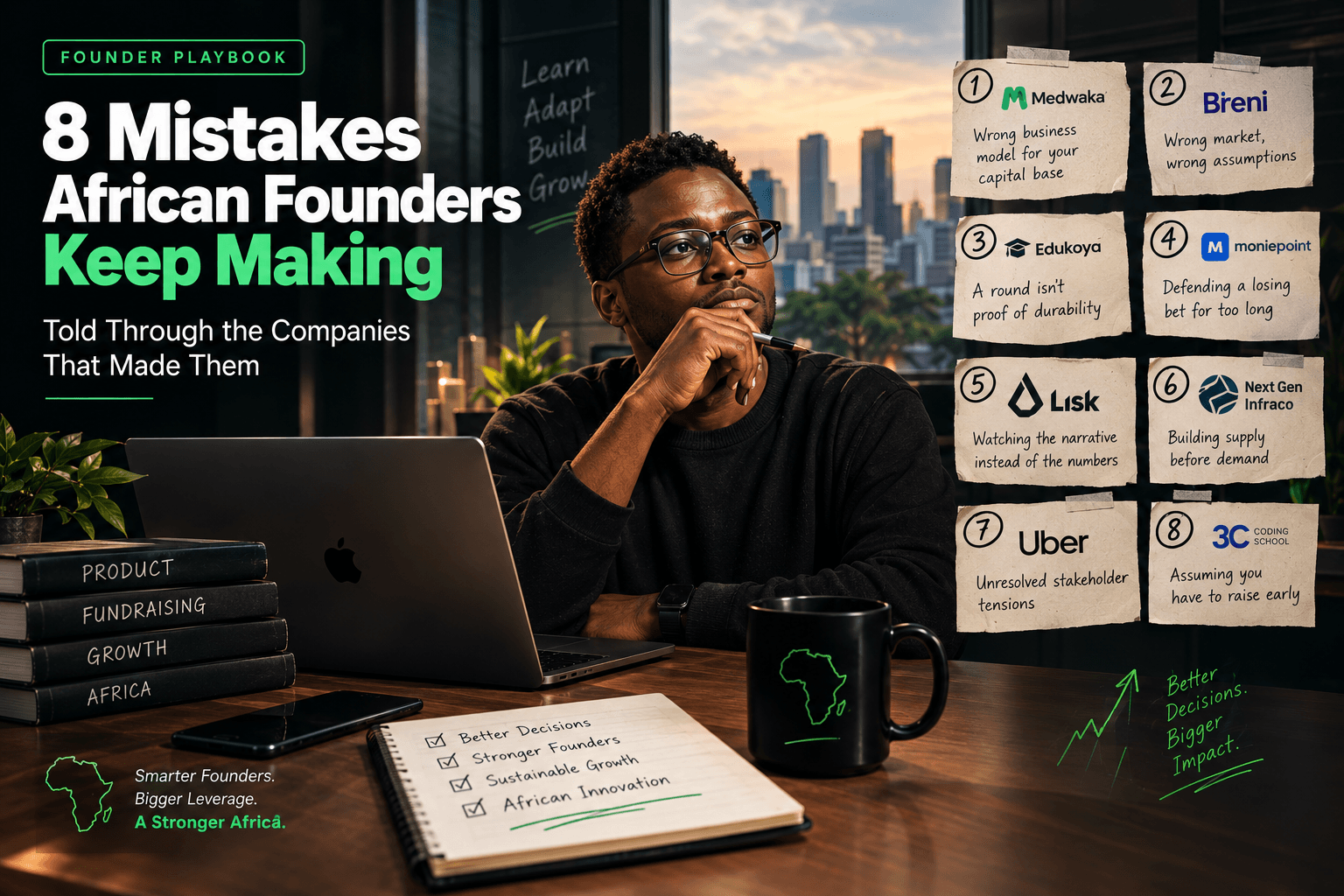
Most startup advice is written in the abstract, which is exactly what makes it easy to ignore. The version worth reading is the one attached to real companies that raised real money, made a specific call, and then had to live with it. What follows are eight mistakes that keep repeating across African startups, each one drawn from a company whose outcome is now a matter of public record. Several of these companies are still operating and doing well. That is part of the point. Most of these mistakes are survivable if caught early, and expensive if not.
1. Building a Business Model Your Capital Base Cannot Support
Nigerian health-tech startup Medwaka set out to build a 911-style emergency response system, an ambition that required an ambulance fleet. Ambulance fleets cost money that early-stage startups do not have, and the founders spent months trying to force the model to work, either purchasing vehicles outright or depending on hospitals’ existing ambulances with all the unpredictability that brought. The eventual fix was abandoning ownership entirely and repositioning as a layer that strengthens the emergency systems already operating. The lesson is not that ambition is bad. It is that a business model has to be fundable at the stage you are actually at, not the stage you hope to reach. Compare that with Egypt’s ChipMango, which deliberately avoided semiconductor fabrication, an industry requiring billions in capital, and focused on chip design and verification services instead, work that needs skilled engineers and software rather than a fabrication plant. Same industry, radically different capital requirement, chosen on purpose.
2. Assuming Your Intended Market Is Your Real Market
Two Kano-based founders built Breni, an AI learning platform, specifically around problems they had seen in Northern Nigerian classrooms. Roughly 90% of its users turned out to be outside Nigeria entirely, with Nepal alone accounting for more than 40% and Nigeria ranking third behind Russia. The founders did not plan that, and there is nothing wrong with the outcome, but it illustrates something founders regularly get wrong: the market you built for and the market that actually shows up are two different questions, and only one of them is answered by data. Watch where traction genuinely comes from rather than where your original thesis said it should come from.
3. Treating a Funding Milestone as Proof of Durability
Edukoya raised $3.5 million in what was at the time Africa’s largest edtech pre-seed round. It shut down entirely in February 2025. The size of a round tells you what investors believed at one moment in time, not whether a business works. The same pattern shows up in reverse at Afrikrea, which reported reaching breakeven with $4.1 million in revenue in 2024 under its renamed identity, then was sold out of financial distress the following year with all three original founders exiting. A single good quarter, a single large round, and a reported breakeven moment are all data points, not conclusions.
4. Defending a Struggling Bet Publicly Instead of Cutting It Early
Moniepoint launched MonieWorld, a UK remittance product, in April 2025. By October, company filings showed the UK subsidiary had generated zero revenue in its first year while running at a loss. Moniepoint publicly disputed the reported loss figures and framed the spending as deliberate expansion investment, pointing to strong transaction volume growth and further products on the roadmap. Less than a year after those reassurances, the business was wound down entirely and put up for sale. The company’s core Nigerian business remains enormously successful, which is precisely why this is instructive: even a well-run unicorn can spend a year defending a position it would have been better off exiting sooner. The instinct to defend publicly is understandable. It is also expensive.
5. Watching the Narrative Instead of the Usage Numbers
Swiss blockchain company Lisk spent years building an ecosystem presence, funding startups, and running accelerator programmes across Africa. By the time it announced its blockchain would shut down in October 2026, total value locked on the network had collapsed from $5.47 million at the start of the year to just over $139,000, with the entire chain generating roughly $3.88 in fees over a 24-hour period. Those numbers did not appear overnight. Usage metrics tend to decline quietly and well before anyone is willing to say out loud that a product is not working, which is exactly why they deserve more attention than the story being told around them.
6. Building Supply Before Demand Is Actually Locked In
Ghana appointed Next Gen Infraco as its exclusive 5G infrastructure provider, backed by serious financial weight. NGIC missed its June 2025 deadline to launch commercial service, and by early 2026 had built 49 live sites against a planned 4,400. Even when its network eventually went live across parts of Accra, Kumasi, and Tamale, no Ghanaian telecom operator had actually connected to it to offer commercial service. A network built with nobody using it is the infrastructure version of a mistake founders make at much smaller scale constantly: building capacity on the assumption that customers will arrive, rather than securing the commitments first and building against them.
7. Letting Unresolved Stakeholder Tension Compound
Uber operated in Nigeria for twelve years and faced driver protests over fares and commission rates in 2017, again in 2023, and again in 2025. Each round was addressed enough to end that specific protest without ever resolving the underlying disagreement about whether the platform’s economics worked for the people actually driving on it. When Uber exited Nigeria and Uganda in September 2026 as part of a global restructuring, those markets were the easier ones to leave partly because a decade of unresolved friction had never been fixed. Problems with the people your business depends on do not resolve themselves through time. They accumulate quietly and make you more fragile at exactly the moment a hard decision gets made elsewhere.
8. Assuming You Have to Raise Early
Egypt’s 3C Coding School operated for more than ten years without taking a single outside institutional investment. It raised its first round, $3 million, only in 2026, by which point it had already built a base of more than 120,000 students and posted 230% revenue growth. That timeline is unusual, and it produced a company that came to the table from a position of genuine strength rather than need. Not every business can bootstrap for a decade, and plenty genuinely need capital early to work at all. But the assumption that raising quickly is the default correct move deserves more scrutiny than founders usually give it, particularly in a market where equity terms have tightened considerably and debt has risen to account for roughly half of all capital raised on the continent.
What Actually Connects These
None of these mistakes came from founders who were lazy or unserious. They came from smart people making reasonable decisions with incomplete information, which is the only kind of decision anyone gets to make while building a company. What separates the companies that recovered from the ones that did not was usually speed: how quickly they were willing to look at evidence that contradicted their original plan and act on it. Medwaka pivoted and grew. Moniepoint defended a losing position for a year before cutting it. Both were run by capable people. The difference was how long each took to accept what the numbers were already saying