Every exit announcement sounds like a win. A startup is acquired, a founder is congratulated, a press release uses the word “milestone.” But an exit only matters to the people behind a company if it puts real money in their hands. That is the question this deep dive asks about 2026: across African tech’s acquisitions, secondary sales and listings, who actually got paid, who got paper, and who is still waiting?
The short answer is that the year has been busy but uneven. Exits are happening at a record pace, yet only a minority disclose a price, several large deals are paid in shares, and the biggest checks went to licensed lenders and payment firms more than to software startups. This is our analysis of public reports and the deals Index Prima has covered. It is not a complete census, and where numbers conflict we show both.
How many exits, really?
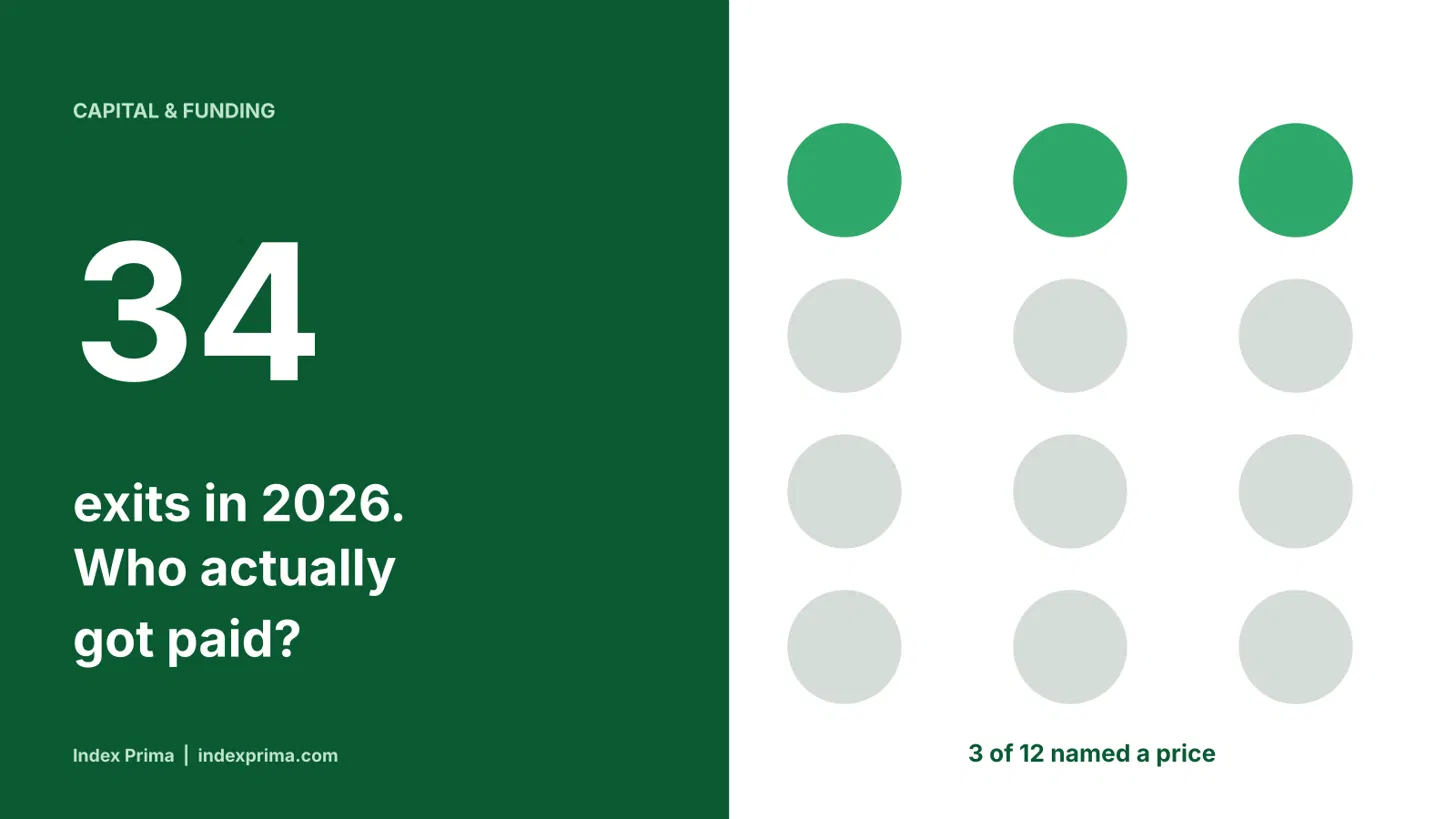
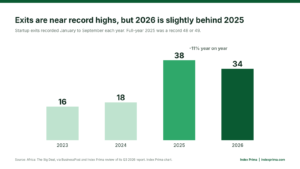
The count depends on who is counting. The tracker most often quoted is Africa: The Big Deal, which says there were 34 exits between January and September 2026, mostly acquisitions. That is down 11% from 38 in the same period of 2025, but nearly double the 18 recorded in 2024. Its reports describe 2025 as a record year with 48 or 49 exits, depending on the report. Nine of the 34 exits came in the third quarter.
Other counts are far larger because they measure something different.
| Source | Period | Count | What it appears to measure |
|---|---|---|---|
| Africa: The Big Deal, as reported by BusinessPost and BusinessDay | Jan to Sep 2026 | 34 exits (25 in H1) | Exits of venture-backed startups |
| Africa: The Big Deal | Full year 2025 | 48 or 49 exits | Same, a record year |
| TechCabal NextWave essay | Full year 2025 | 67 M&A deals, up 72% | Broader M&A count, mostly all-stock deals |
| TechCabal headline, 24 August 2026 | 2026 so far | 84 M&A deals, $11.4 billion disclosed value | Broader tech M&A. We could not open this article, so we rely on its headline |
| Technext | H1 2026 | 25 exits, “more than all of 2025” | Conflicts with the Big Deal’s 2025 total, so we treat the comparison as an error |
None of these is wrong on its own terms. A founder-focused tracker counts fewer, venture-backed exits. A deal tracker counts every transaction touching a tech company. When you read a headline number, ask what was counted. The 34 is the cleanest count of venture-backed exits, and it shows the pace slightly slowing, not accelerating.
The deal ledger: who was paid, and how
The table below lists the main 2026 deals we could verify. “Payment form” is what the sources say, and “not stated” means the sources we reviewed do not say.
| Deal | Type | Disclosed value | Payment form | Who was paid |
|---|---|---|---|---|
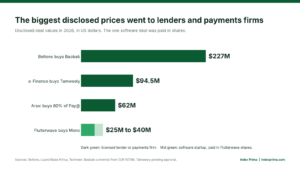
| Beltone buys Baobab (Egypt, buying a Pan-African lender) | Full acquisition | EUR 197.6 million, about $227 million | Not stated | Sellers not named in the sources we opened |
| e-Finance buys Tamweely (Egypt) | Full acquisition, pending regulator approval | About EGP 4.75 billion, about $94.5 million | Not stated | SPE Capital, EBRD, Tanmiya Capital Ventures, British International Investment |
| Araxi buys Pay@ (South Africa) | 80% stake | $62 million | Not stated | Not stated |
| Flutterwave buys Mono | Acquisition | $25 million to $40 million | All stock | Mono’s shareholders, in Flutterwave shares |
| Moniepoint buys Orda’s Nigerian business | Acquisition | Undisclosed | Not stated | Investors in a startup that raised $4.5 million |
| Moniepoint buys Sumac Microfinance Bank (Kenya) | 78% stake | Undisclosed | Not stated | Sellers not named |
| Kuunda secondary sale | Early investors sell shares to a group led by E4E Africa | $5 million | Not stated | Selling early investors, not the company |
| LekkeSlaap sold to a South African consortium | Sale by founders and long-term shareholders | Undisclosed | Not stated | Co-founders and long-standing shareholders are selling, terms unknown |
| Everlectric leaves Vumela Fund | Venture debt exit | Undisclosed | Not stated | Not stated, and it is unclear whether the loan was repaid or refinanced |
| OPay US listing | IPO, filed publicly in October 2026 | Not yet priced | Not applicable | Not yet known |
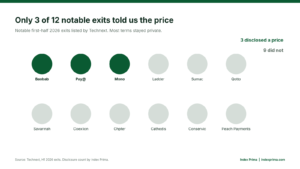
Notice how many cells say “not stated.” Of the 12 notable H1 exits Technext listed, only three disclosed a value: Baobab, Pay@ and Mono. That is a disclosure rate of 25%, by our count.
Pattern one: the big checks went to licences and loan books
Add up the four disclosed prices and you get roughly $409 million to $424 million, by our own arithmetic. That total is dominated by Baobab, Tamweely and Pay@. All three are licensed lenders or payment companies with customers, branches or regulatory permissions. Baobab served about 1.6 million customers at the end of the third quarter of 2025. Tamweely, founded in 2017, has more than 130,000 active clients and more than 250 branches.
The Tamweely story shows why. LaunchBase Africa reports that Egypt’s Financial Regulatory Authority froze new consumer finance licence applications for one year in late 2025 and revoked about 258 dormant microfinance licences. With new entry closed, buying a licensed operator becomes the main route into the market. Technext makes the same point about Paystack and Moniepoint’s deals. A licence, in other words, can be worth more than software.
The clearest software deal with a stated payment form, Mono, was paid in shares. It is a small sample, so treat this as a pattern to watch and not a rule.
Pattern two: paper is not cash
Mono raised $17.5 million, including a $15 million Series A led by Tiger Global in 2021. Flutterwave acquired it in January 2026 in an all-stock deal valued at $25 million to $40 million. TechCabal’s analysis points out the catch. Flutterwave’s last official valuation was $3 billion in 2022, but secondary sales in 2023 reportedly priced it at $1.5 billion to $1.6 billion. At that level, Mono’s investors hold a stake worth roughly $12.5 million to $20 million in a private company with no clear exit date. That is TechCabal’s estimate, not a disclosed figure.
Orda tells a similar story at a smaller scale. It raised $4.5 million, never reached a Series A and had 1,075 restaurants on its platform when Moniepoint bought its Nigerian business in March 2026. The price was not disclosed. TechCabal estimates that a $500,000 investor may have recovered the same amount or less after four years. That would be a negative return, but again it is an estimate.
The broader point from that analysis is structural. About 80% of venture funding in Africa comes from foreign investors, who answer to limited partners that judge them on cash returned. Stock deals defer that cash. They also stop investors from writing new checks, which weakens the pipeline of new startups.
Pattern three: early investors are getting paid through secondaries
Not every payout comes from a sale of the whole company. Kuunda’s $5 million secondary sale, announced on 13 October, let early investors sell shares to a group led by E4E Africa. Accion Ventures, Portugal Gateway Fund and Seedstars Africa Ventures increased their holdings. LaunchBase Africa reported that the sale cut Kuunda’s shareholder list from twelve to four, and that early angels who sold saw annualised returns above 70%. We could not verify those return figures. The money goes to the sellers, not into the company.
Launch Africa offers a rare look at what a fund actually returned. Its first fund, a $36 million vehicle, has made 11 exits and returned $2.5 million to investors, about 7% of paid-in capital, according to TechCabal. Five exits were full and six were partial. Eight were secondary sales to other investors, and only three were trade sales or management buyouts. Its largest realised multiple was 5 times, and no position returned less than 1 times. The managing partners say a strategy of not making follow-on investments made exits easier. So even a fund that is ahead of many global peers has returned only a small share of what its investors put in. That is the honest scale of the payout so far.
Pattern four: buyers are local, regional and increasingly Arab
TechCabal’s reporting says domestic buyers account for just over half of exits, and the intra-African share is higher. IPOs are a low single-digit share. The 2026 deals fit that pattern. Egyptian groups Beltone and e-Finance bought lenders. South Africa’s Araxi bought Pay@, and a South African consortium bought LekkeSlaap. Nigerian scale-ups Flutterwave, Paystack and Moniepoint bought smaller companies, often to gain licences, data or teams. Foreign buyers still appear, such as Commit of Israel and Glampings of the Netherlands, but the lead roles belong to regional players.
M-KOPA is a good example of a scale-up as buyer. It paid $8 million for KilpiTek, a Finnish device-locking software company, but only about $2.67 million of that was cash, with the rest described as deferred or equity-linked consideration. That deal brings software in-house rather than ending a startup’s story.
Where the listings stand
Two IPOs are the year’s biggest signals. OPay has publicly filed to list in New York. Its offering is not priced yet, so there are no proceeds to report, and about 88% of its 2025 revenue came from Nigeria according to its filing. In Egypt, MNT-Halan is offering 20% of its Egyptian arm on the Egyptian Exchange. Enterprise reported that the offering is described as fully secondary, with a separate capital increase of up to EGP 4 billion, though the article did not reconcile the two. The Big Deal says the offering was oversubscribed, while the Enterprise article, published earlier, said the order book had not closed. Treat both as still developing.
The warning behind the record
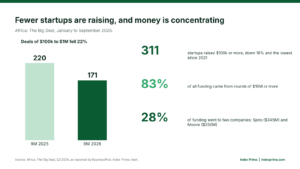
Strong exit numbers sit beside weak signs at the front of the pipeline. The Big Deal reports that 311 startups raised $100,000 or more in the first three quarters of 2026, down 18% and the lowest tally since 2021. Deals between $100,000 and $1 million fell to 171 from 220. And 83% of all funding came from rounds of $10 million or more. Spiro ($345 million) and Moove ($250 million) alone made up 28% of the money raised. Fewer early-stage companies today means fewer exits in five or six years. In the Big Deal’s words, “most exits return capital (and experience) to the ecosystem.” But the data suggests that capital is flowing back to fewer people than the headline exit count implies.
What to take from this
These are our conclusions, drawn from the evidence above.
For founders: Know what you are selling. A licence, a customer book or a distribution network can fetch a price that code alone may not. If a buyer offers shares, ask what they are worth, when you can sell them and who else can buy. Ask for a cash component. Keep your cap table clean, because exits stall on messy ownership.
For investors: The recycled-capital loop is the point. Secondary sales and partial exits can return cash earlier than waiting for a perfect sale. Launch Africa began returning capital in year five. Funds that plan for liquidity from day one will have an edge.
For policymakers: Licence rules shape exits. A freeze on new licences, as in Egypt, pushes buyers to acquire existing operators. That can reward incumbents and make it harder for new startups to enter.
What to watch next: OPay’s pricing, MNT-Halan’s final book, the regulators’ decision on Tamweely, and whether more buyers pay in cash. If those go well, 2026 will be remembered as the year African exits grew up. If they do not, it will be the year the headline count ran ahead of the money.
What we could not confirm
We could not open the full Big Deal reports, TechCabal’s 24 August article or its October piece on the class of 2016, so some figures come from outlets quoting them. Payment form and sellers were not stated for several deals. The $409 million to $424 million total adds four disclosed prices, mixes currencies using the rates reported by the sources, and includes Tamweely, which still needs regulatory approval.
Sources: Technext on H1 2026 exits; BusinessPost on 34 exits in nine months; Africa: The Big Deal, Q3 2026; BusinessDay on the H1 2026 exit market; TechCabal, More deals, less cash; TechCabal, Who will buy Africa’s startups; TechCabal, Launch Africa returns $2.5 million; LaunchBase Africa on Tamweely; Beltone on the Baobab acquisition; Enterprise on MNT-Halan’s IPO; Index Prima’s earlier reports on Kuunda, M-KOPA and KilpiTek, LekkeSlaap, Everlectric and OPay.
A note for startup founders: Don’t practice on investors. Practice on AI first. RaiseReady by Index Prima is an AI fundraising simulator for African founders: upload your pitch deck, get a readiness score and face a tough AI investor before the real meeting. Find this post, and every post we publish, at raiseready.indexprima.com.