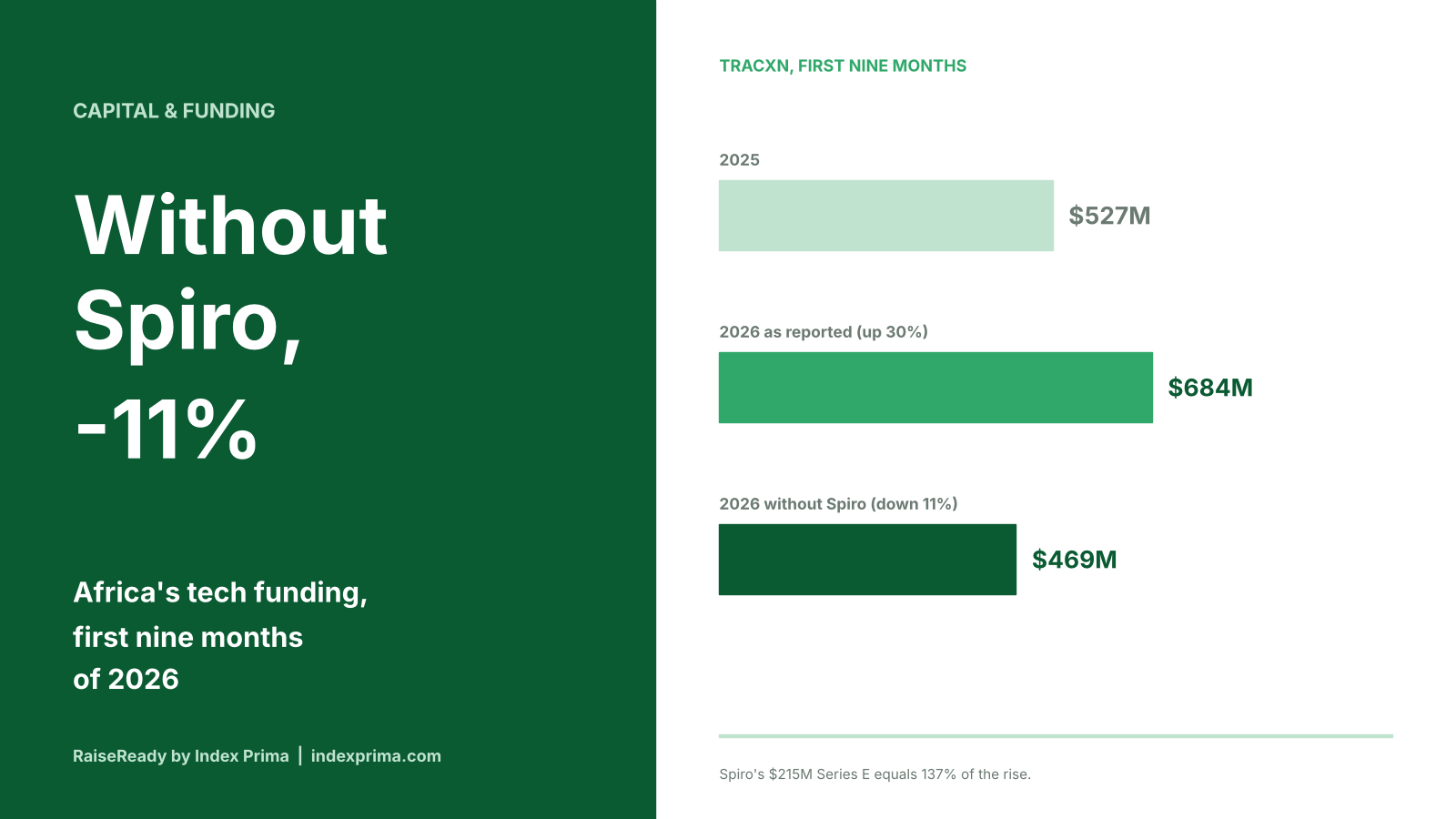
Africa’s tech funding is up 30% this year, and one company explains all of it. Strip out Spiro’s $215 million round, and the picture flips.
Tracxn says African tech firms raised $684 million in the first nine months of 2026, up from $527 million a year earlier. Nairobi took the largest share, mostly because of Spiro, and Abuja and Cairo followed. But other trackers count far more money and tell different stories about direction. The honest reading is that the continent’s capital is rising at the top and thinning at the bottom.
Start with the Tracxn numbers. The $684 million came from 100 rounds, three fewer than the 103 of last year. That is a gain of $157 million. Spiro, the electric-vehicle and battery-swapping company, raised $215 million in a Series E. That one round equals 137% of the whole increase. Without it, the total drops to $469 million. That is 11% below last year’s $527 million, and about 20% below the $587 million of 2024. These are our own sums, using Tracxn’s figures.
| Tracxn, first nine months | 2025 | 2026 | 2026 without Spiro |
|---|---|---|---|
| Funding raised. | $527M. | $684M. | $469M. |
| Change on 2025. | n/a. | Up 30%. | Down 11%. |
| Rounds. | 103. | 100. | 99. |
| Average round. | About $5.1M. | About $6.8M. | About $4.7M. |
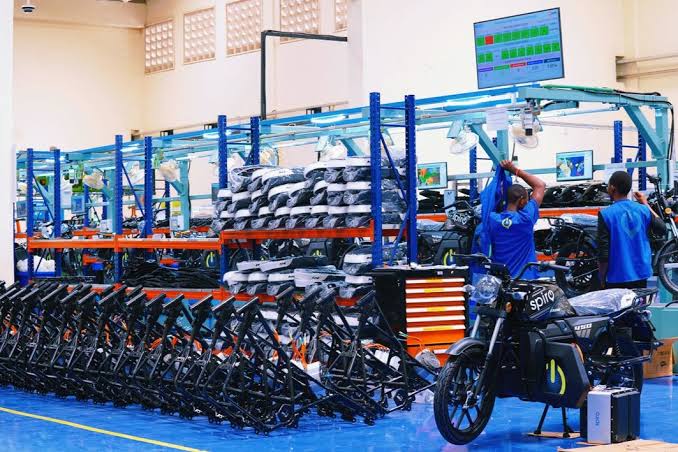
Spiro’s story is worth knowing. The company announced a $215 million equity investment on 3 June, with backing from Impact Fund Denmark and Equitane. A further $55 million from NewTrails Capital, a Chinese growth-stage firm with offices in Shanghai, Shenzhen and Nigeria, took the round to $270 million by late June. Spiro runs in seven markets: Uganda, Kenya, Rwanda, Nigeria, Cameroon, Benin and Togo. It says it has put more than 100,000 electric vehicles on the road and built more than 2,500 battery-swap stations. The new money is meant to grow that network, strengthen manufacturing and open the Democratic Republic of Congo and Ethiopia.
Here the Tracxn report has a wrinkle. Its headline counts Spiro at $215 million. But its city table credits Nairobi with $270 million from Spiro. Both cannot sit inside the same $684 million without a gap. If the larger figure is right, the total without Spiro would be even lower. Either way, the direction is the same.
Where a company is counted also shapes the map. Tracxn places Spiro in Nairobi. Africa: The Big Deal, another tracker, treats it as pan-African. That one choice moves Kenya up or down the league table.
| City, Tracxn | 2025 | 2026 | Share in 2026 |
|---|---|---|---|
| Nairobi. | $61M. | $277M. | 41%. |
| Cairo. | $131M. | $126M. | 18%. |
| Abuja. | $0. | $52M. | 8%. |
| All other cities. | n/a. | n/a. | 33%. |
Nairobi’s jump from $61 million to $277 million looks like a boom. It is not one. With Spiro’s $270 million removed, Nairobi is left with about $7 million. With Spiro at $215 million, it is left with about $62 million, which is flat on last year. Neither reading shows a surge in Kenyan startup funding.
Cairo is the steadier story. It raised $126 million, down just 4% from $131 million, even as its share fell from 25% to 18%.
Abuja is the surprise. It had no funding in the same period of 2025. This year it has $52 million, and all of it is Terra. The Nigerian firm, founded in 2024, builds autonomous security hardware, including drones, a drone interceptor and a solar-powered sentry tower. Tracxn counts three seed rounds. Another report describes one seed round closed in three parts. 8VC led $11.75 million in January, Lux Capital led $22 million in February, and $18 million followed in August. The sum is about $52 million. Terra has not said what it is worth. It has its main factory in Abuja, with a second planned in Ghana for the last quarter of this year. Together, Nairobi, Cairo and Abuja took 67% of all the money. The other 33% had to cover the rest of the continent.
Now the harder question. Is $684 million even the right number? Not by other counts.
| Tracker | Nine-month total | Direction |
|---|---|---|
| Tracxn. | $684M, 100 rounds. | Up 30%. |
| Africa: The Big Deal. | $2.16B. | Down 4% from $2.24B. |
| TechCabal Insights. | $2.49B, 315 deals. | Up 7.8%. |
Three trackers give three totals and two directions. They count different things. Some include debt, some do not, and each has its own rules on which deals qualify. Even so, the gap is large. The Big Deal says equity alone was $1.5 billion, more than double Tracxn’s whole figure. That tracker also says equity rose 23% while debt fell 33% to $669 million. So the idea that this year is about debt replacing equity does not hold in that data. It is better to read Tracxn as a narrow view of equity-style rounds, not the full market.
What do the trackers agree on? They agree that big deals rule. The Big Deal says rounds of $10 million or more made up 83% of all funding. The number of ventures raising at least $100,000 fell 18%, from 381 to 311. Seed funding came to about $100 million. The median seed round fell from $2.2 million to $1.2 million. Money is not leaving Africa. It is simply going to fewer, bigger companies, and early-stage founders get smaller cheques.
Sector data shows the same pull. The Big Deal puts logistics and transport at $780 million, or 36% of funding, with Spiro and Moove making up $595 million of it. Fintech took $760 million, or 35%. Yet fintech still had the most funded companies, at 80 ventures with at least $100,000 each. So fintech wins on numbers of firms. Mobility and energy win on size of cheques. Heavy assets such as vehicles, batteries and factories need big pools of capital, and the largest funds are now writing those cheques.
Nigeria’s story, in the same tracker, makes the point. It drew $635 million, up from $247 million in 2025, and the most funded ventures of any country at 77. But Moove, Flutterwave, Jumia and Yellow Card took about $440 million, or 69%, of that total. One of those, Flutterwave, is a tracker estimate of about $100 million, not a confirmed figure.
One more number needs care. African fund managers secured about $3.08 billion in commitments from limited partners over the period, says TechCabal. That money is pledged. It has not reached startups yet.
Why it matters: A 30% rise sounds like recovery. Without Spiro, the same data shows a year that is down 11%. For a seed-stage founder, the headline is the wrong guide. The median seed cheque is smaller, fewer ventures are getting funded and most of the money sits in rounds of $10 million or more. That does not mean it is a bad time to build. It means the bar is higher at the start. Investors want revenue, clear unit economics and assets or contracts that back a story. Founders should also read funding reports with care. Always ask who counted, what they counted and which single deal moves the total.
What to watch next: whether Tracxn clears up how it counts Spiro, since $215 million and $270 million cannot both be right. Also watch the fourth quarter. A few more big rounds could lift every tracker, while a quiet quarter would show how thin the base is. Another test is whether seed rounds recover from a median of $1.2 million, and whether cities beyond Nairobi, Cairo and Abuja can draw capital without a single mega-deal.
Sources: Tracxn Africa Tech 9M 2026 report, via Forbes Africa; African Leadership Magazine on asset-heavy funding and other trackers; Independent Uganda on Spiro’s $215M; ThisDay on Spiro’s $55M from NewTrails; TechArena on Spiro’s $270M; Tech-ish on Terra’s $52M seed; TechCabal Insights, via Africa.com.
A note for startup founders: Don’t practice on investors. Practice on AI first. RaiseReady by Index Prima is an AI fundraising simulator for African founders: upload your pitch deck, get a readiness score and face a tough AI investor before the real meeting. Find this post, and every post we publish, at raiseready.indexprima.com.