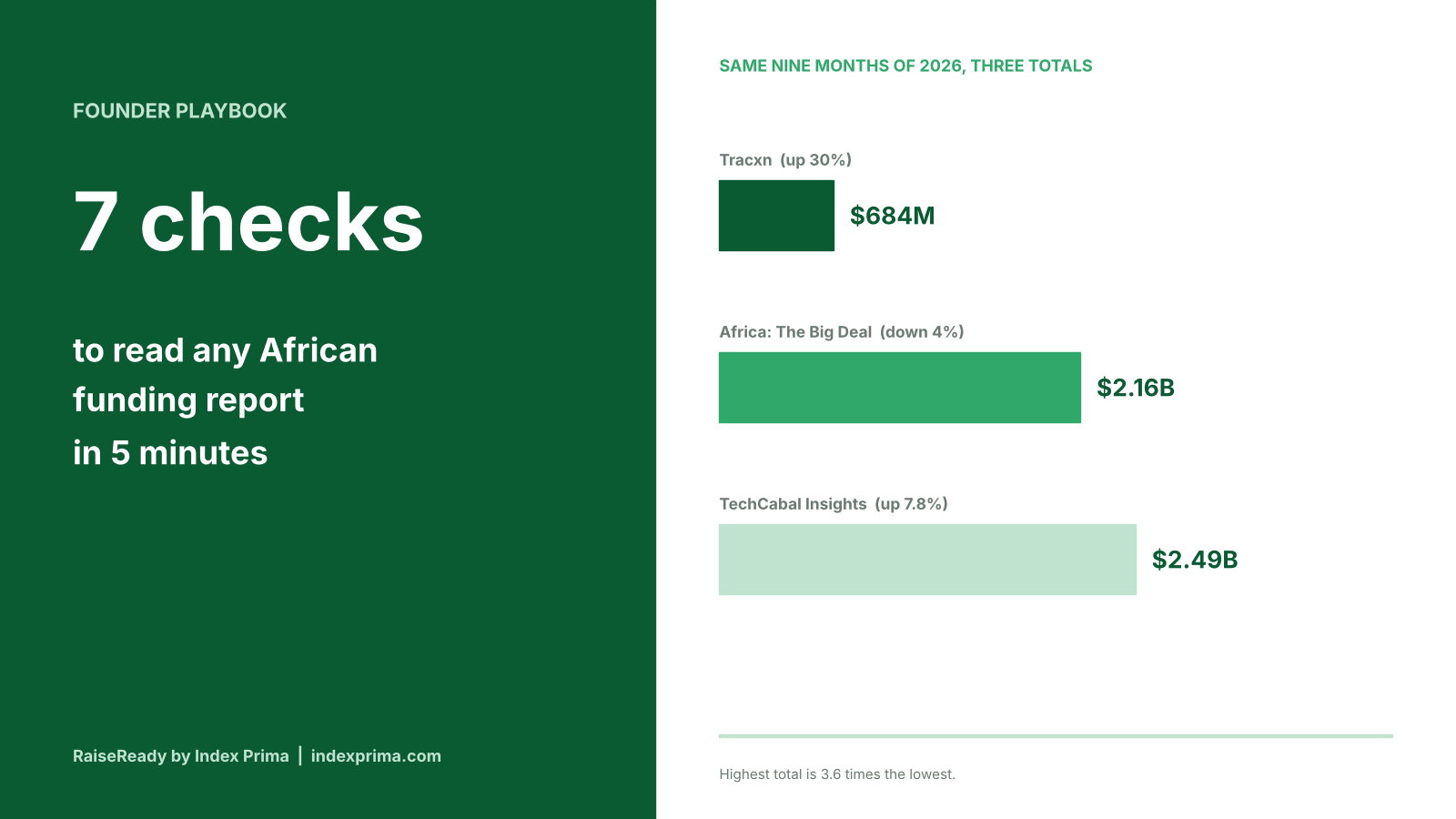
Three trackers looked at the same nine months of African startup funding. One said $684 million, one said $2.16 billion and one said $2.49 billion.
All three can be honest, and all three can mislead you if you only read the headline. This guide gives you seven quick checks, in the order to run them, so you can tell what a funding report really says in about five minutes. It uses this year’s numbers as the worked example, and it is written for founders, investors, journalists and anyone who will quote a funding figure in public.
Start with why the totals clash. Tracxn counted $684 million from 100 rounds in the first nine months of 2026, up 30% on last year. Africa: The Big Deal counted $2.16 billion, down 4%. TechCabal Insights counted $2.49 billion from 315 deals, up 7.8%. The highest total is 3.6 times the lowest, and the three disagree on whether the year is up or down. This is not new. For 2024, Disrupt Africa reported $1.12 billion, Daba Finance about $2.0 billion, The Big Deal $2.2 billion and Partech $3.2 billion. In the first quarter of 2023, four trackers gave $548 million, $649 million, $759 million and $1.3 billion. Trackers measure different things. The skill is knowing which.
Here is the whole method at a glance.
| Minute | Check | Question to ask |
|---|---|---|
| 1. | Who counted. | Which tracker, which period, and where is the methodology page? |
| 1. | What counts as funding. | Is debt, grant or M&A inside the total? |
| 2. | What counts as African. | Is it by headquarters, market or founders? |
| 3. | Same base. | Is the comparison period like for like? |
| 3. | The biggest deal. | What is the total without it? |
| 4. | Counts and medians. | How many companies raised, and how big is the typical round? |
| 5. | A second opinion. | Do other trackers agree on direction? |
First, find out who counted and look for the methodology. Many reports bury it in a footnote or a separate page. If you cannot find one, treat the figure as a rough guide. Check the date range too. A report that says “Q3” may mean three months or the first nine. A tracker may also revise old numbers as late deals surface, so last year’s base can change.
Second, find out what counts as funding. This is the biggest cause of gaps. Some trackers count equity only. Others add debt, grants, credit facilities and acquisitions. The BD Funding Tracker, run by Condia, counts equity and debt, leaves out grants and prizes, and uses only deals that were publicly announced. The Big Deal counts equity, debt and grants. Partech counts equity and debt. A single debt facility can move a yearly total by a lot. Debt was about 42.6% of the $1.44 billion that TechCabal Insights counted for the first half of 2026, and 41% of the $4.1 billion Partech counted for 2025. Divide by debt and you get a very different market. Thresholds matter as well. Partech has been described as counting deals above $200,000, and The Big Deal as counting ventures that raised $100,000 or more. A 2024 write-up described The Big Deal’s headline count as startups that raised $1 million or more. Same tracker, two cut-offs, so read the footnote.
Third, find out what “African” means. A company can be African because it is incorporated on the continent, because it sells mainly to African customers, or because its founders are African. These are not the same. The BD Funding Tracker asks that a company be Africa-founded with Africa as its main market, and says headquarters and incorporation do not count. Others use a headquarters rule. Spiro, the electric motorcycle maker, shows the effect. Tracxn files it under Nairobi, which gave Nairobi $277 million in nine months. The Big Deal treats it as pan-African. That one choice changes the Kenya league table, as our report on Nairobi’s funding showed. Some trackers cover North Africa fully, and others focus on Sub-Saharan Africa, so Egypt can swing a total as well.
Fourth, make sure the comparison is like for like. Compare the same months in each year. Ask whether a big deal fell just inside or outside the window. Spiro’s $100 million round came in October 2025, just after the nine-month cut-off. So Tracxn’s 2025 base had no Spiro, while its 2026 figure had a $215 million Spiro round. That one timing detail helps turn a flat market into a 30% rise.
Fifth, remove the biggest deal and see what is left. This is the single most useful check. Tracxn’s 2026 gain was $157 million, and Spiro’s $215 million round was 137% of it. Take Spiro out and the total falls to $469 million, which is 11% below last year’s $527 million. These sums are ours. A good habit is to do the same for the top five deals. In The Big Deal’s data, rounds of $10 million or more made up 83% of funding. Spiro and Moove alone were $595 million of the logistics and transport total. When a few deals carry the figure, the headline tells you about those firms, not about the market.
Sixth, look at counts and medians, not only dollars. The total can rise while the number of funded companies falls. The Big Deal says the number of ventures raising at least $100,000 fell 18% this year, from 381 to 311, and the median seed round dropped from $2.2 million to $1.2 million. That is a harder market for early-stage founders, even though the dollars look healthy. Averages can mislead too. By our sums, Tracxn’s average round was about $6.8 million and TechCabal’s about $7.9 million. A few giant rounds pull an average up. The median tells you what a typical company got.
Seventh, ask for a second opinion. Pull up at least one other tracker and look at direction, not at the dollar total. In 2024, the trackers differed hugely on size, yet broadly agreed on whether things went up or down. This year they do not agree, which is a signal to dig. Here the answer was in the mix. The Big Deal says equity rose 23% while debt fell 33% to $669 million, so an equity-only view and an all-in view can point different ways. If two trackers built differently land on the same direction, trust it more. That was the case for Kenya, where Tracxn’s data without Spiro and The Big Deal’s first-half figures both showed a flat to slightly lower year.
Now put the seven checks to work on a real sentence. Imagine a post that says “African tech funding is up 30% this year.” Check one: it is Tracxn, nine months, a tracker that counted $684 million. Check two: it appears to cover equity-style rounds, as other trackers count far more. Check five: remove Spiro and the figure is down 11%. Check seven: The Big Deal says down 4%, TechCabal says up 7.8%. The honest sentence becomes: “One tracker shows funding up 30%, but that rise comes from a single $215 million round, and other trackers show a flat year with more money going to fewer, larger companies.” It is longer, and it is correct.
Founders should also apply this to their own decks. Investors will check any market statistic you quote. Name the source, the year and what the figure includes. If you write “$2 billion raised in African fintech,” be ready to say whether that is equity, debt or both, and who counted it. A founder who can explain a number earns more trust than one who repeats it.
Why it matters: Funding reports shape real decisions. Founders use them to decide when to raise. Investors use them to size markets. Governments use them to claim progress or ask for support. If a single deal or a single definition can swing a headline by 30 points, those decisions can be wrong. Reading reports well is a cheap form of due diligence. It also protects the whole ecosystem from hype in good years and panic in bad ones. One analyst has argued for shared definitions of equity, debt, grants and “African,” open methodologies, and a public deal database, and has suggested that the African Private Equity and Venture Capital Association is well placed to lead that work. Until it happens, readers must do the work themselves.
What to watch next: whether trackers publish clearer methodology notes with each report, and whether Tracxn explains why Spiro appears as $215 million in one place and $270 million in another. Watch the full-year 2026 reports from Partech, The Big Deal and TechCabal Insights, and use the seven checks on each. And watch whether any group brings the major trackers together for a common standard, so that founders can finally quote one number.
Sources: Tech in Africa on why trackers disagreed for 2024; TechCabal on Africa’s funding trackers; Condia on the BD Funding Tracker methodology; Tech Funding News on debt’s share of African funding; Digest Africa on why funding figures confuse; Tracxn Africa Tech 9M 2026 report, via Forbes Africa; African Leadership Magazine on asset-heavy funding and other trackers; TechCabal on Spiro’s $100M in October 2025.
A note for startup founders: Don’t practice on investors. Practice on AI first. RaiseReady by Index Prima is an AI fundraising simulator for African founders: upload your pitch deck, get a readiness score and face a tough AI investor before the real meeting. Find this post, and every post we publish, at raiseready.indexprima.com.