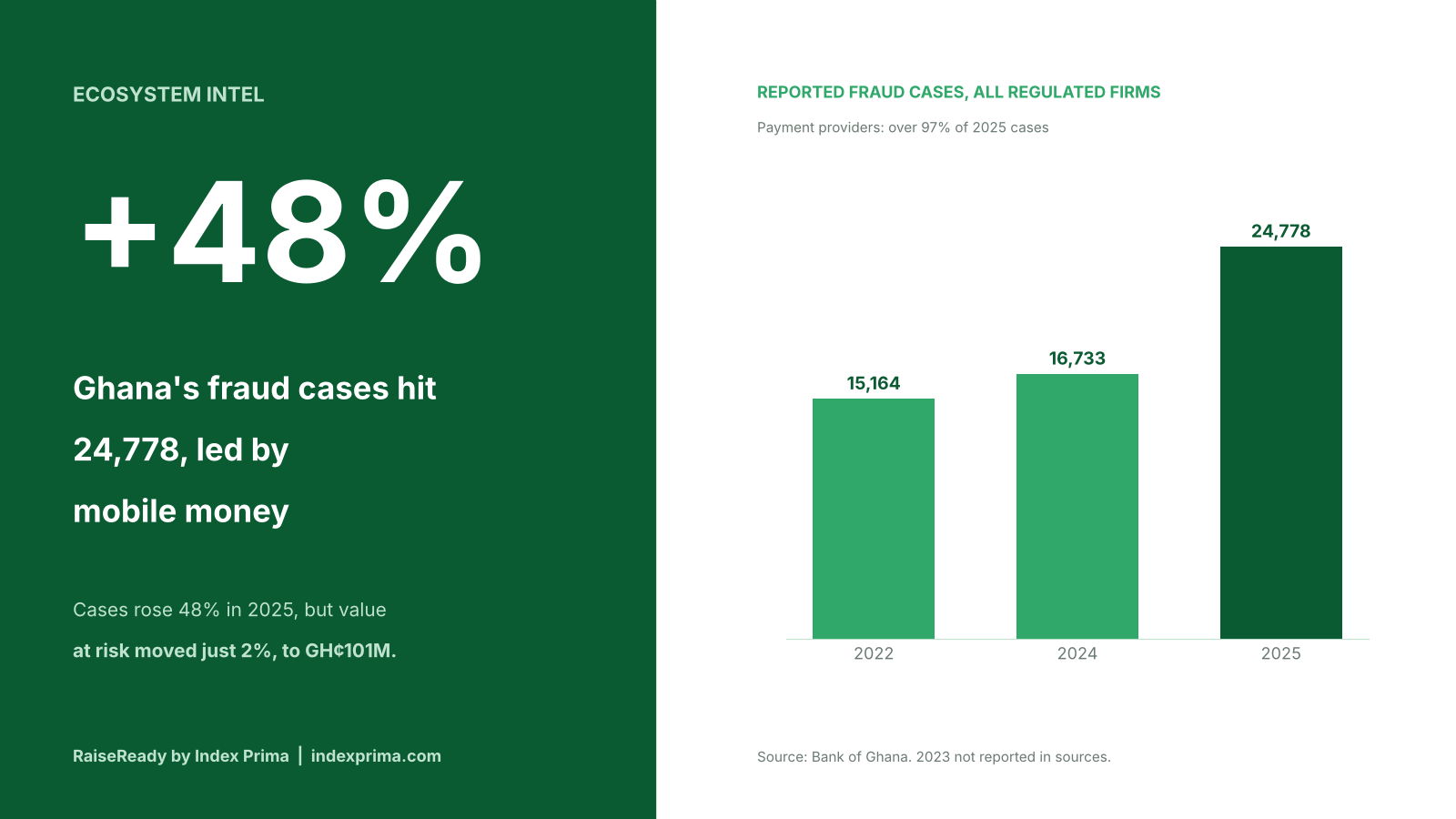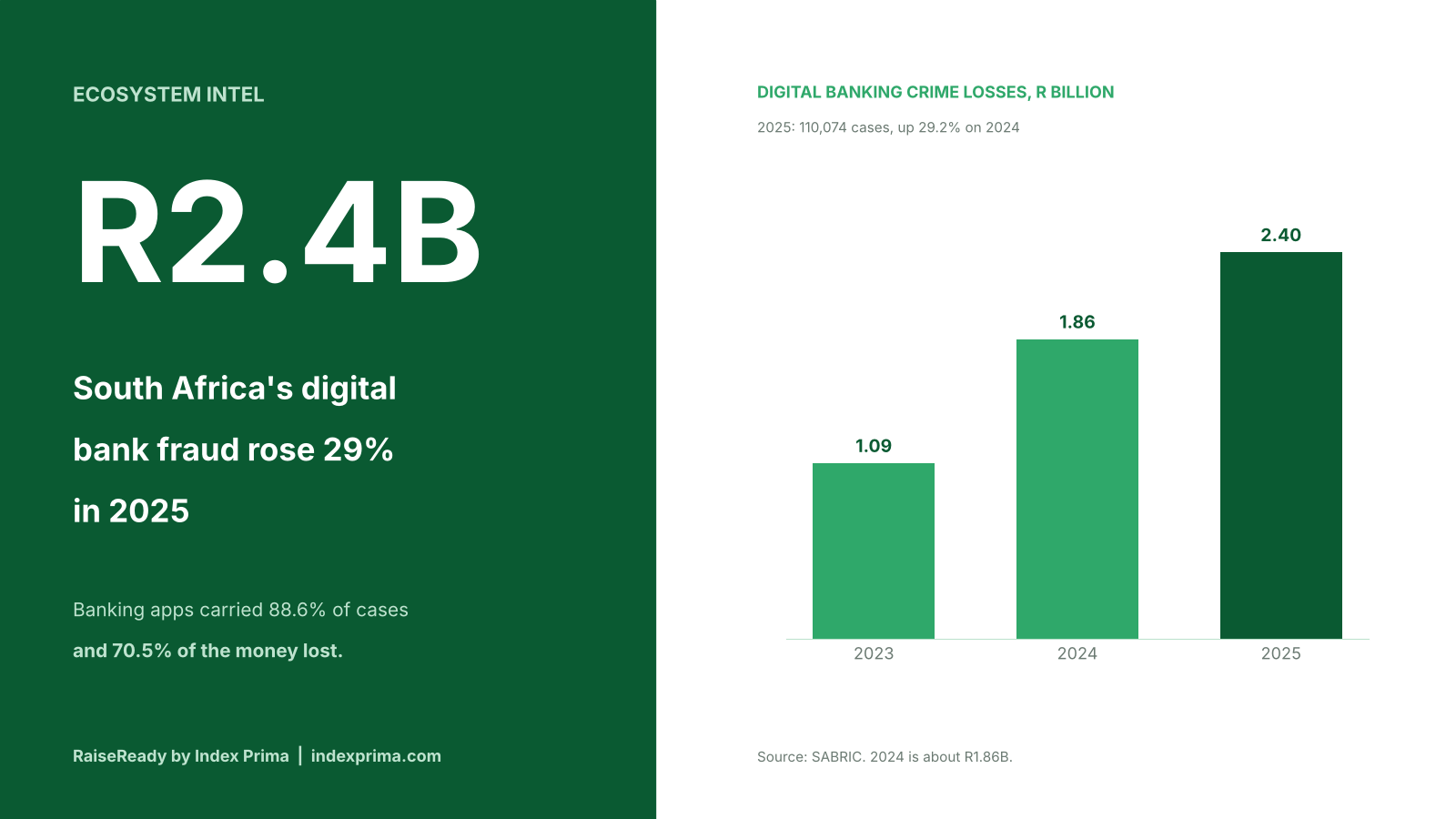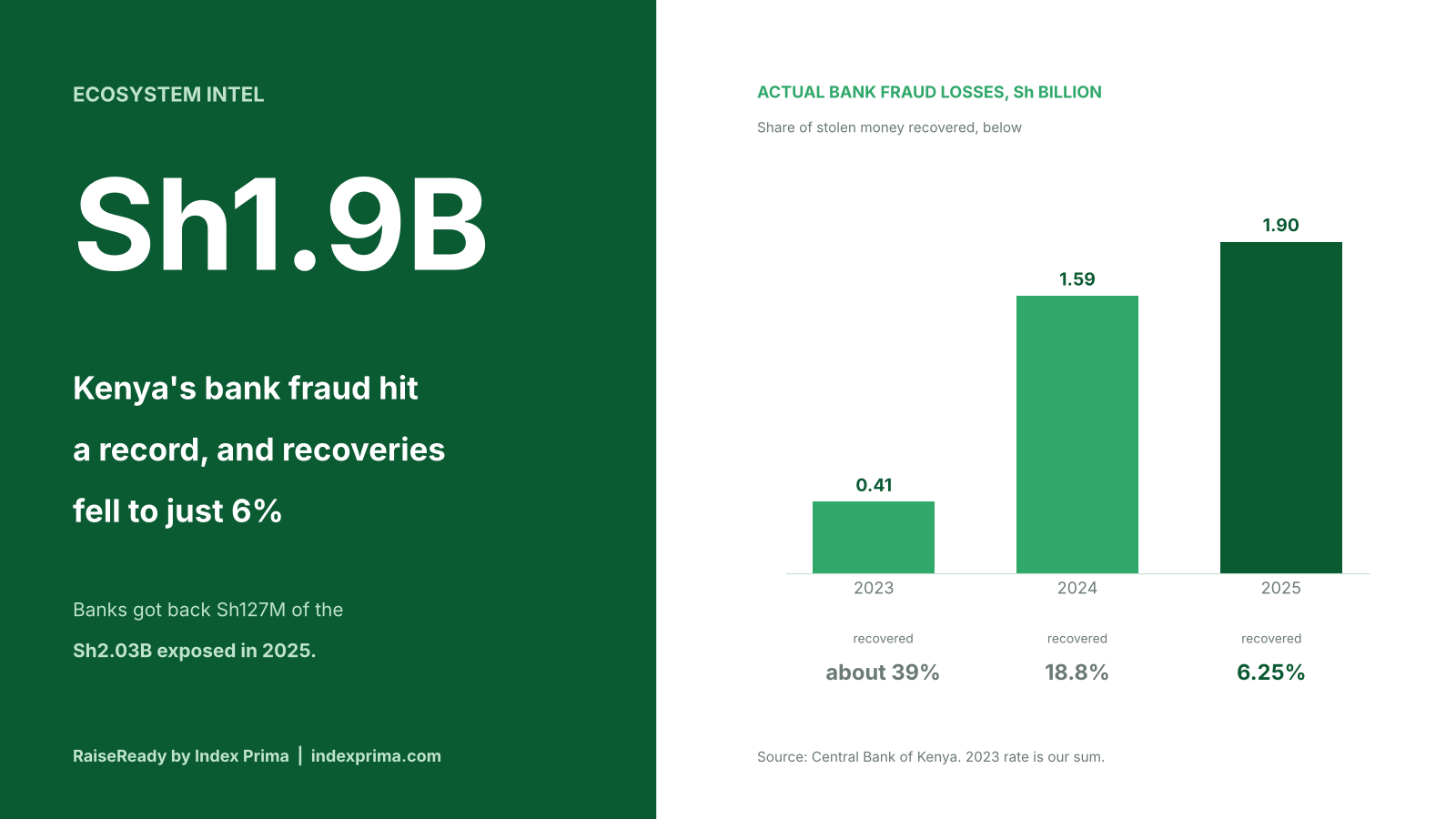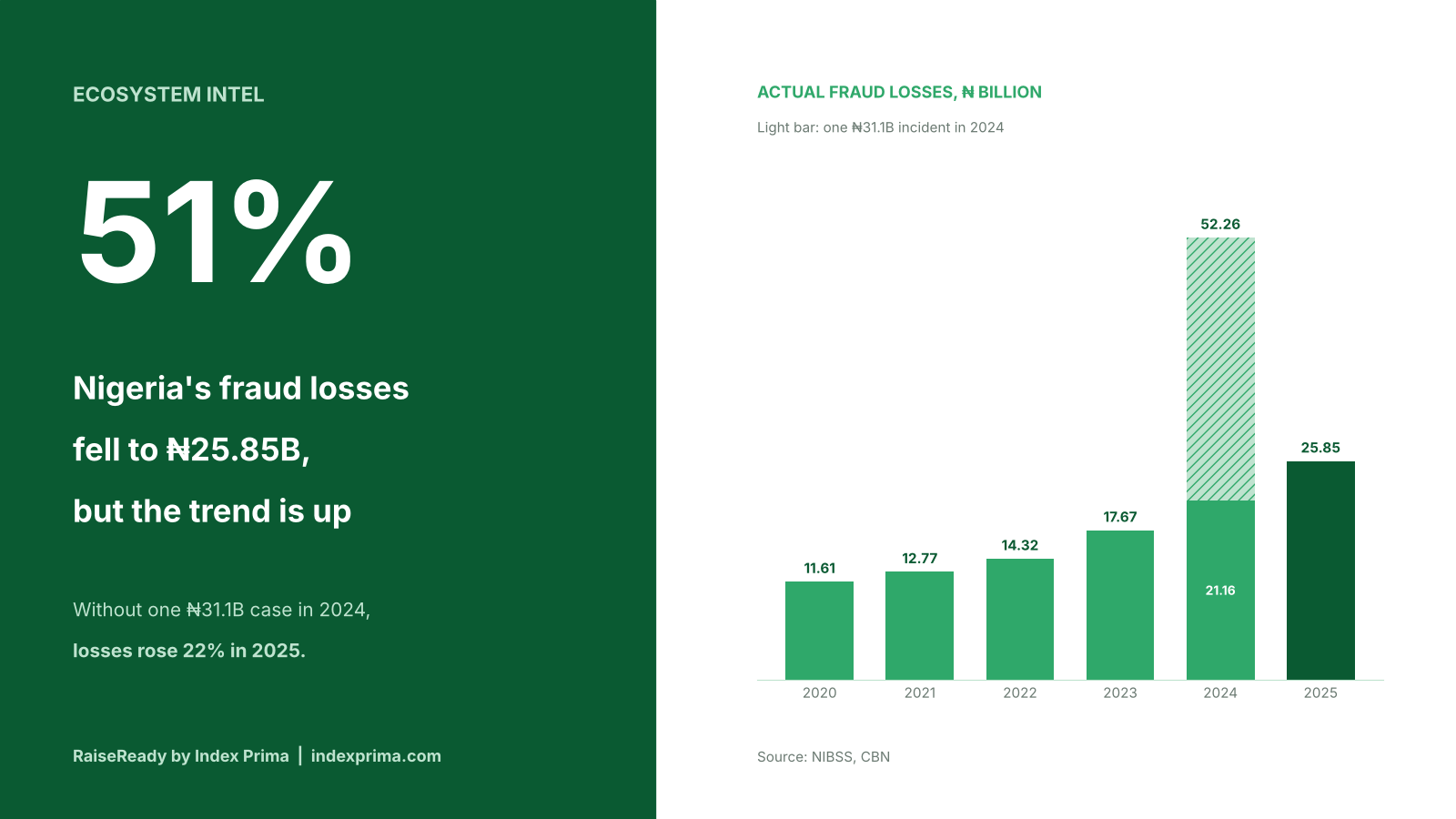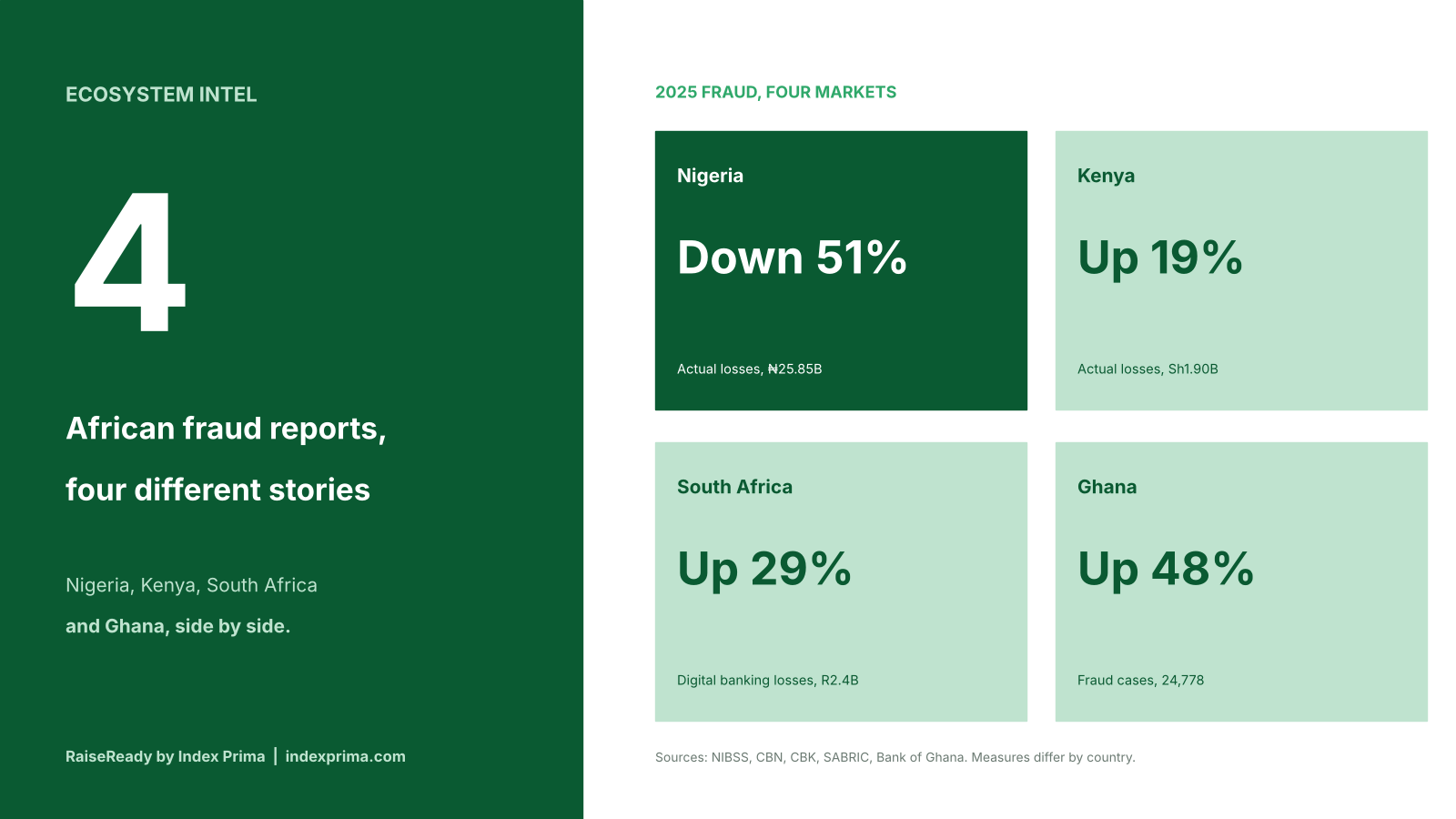
Four of Africa’s biggest digital money markets published fraud figures for 2025, and they point in four different directions. Nigeria’s losses fell 51%, Kenya’s rose 19%, South Africa’s rose 29%, and Ghana’s cases rose 48%.
Read one report and you get one story. Read all four and a clearer picture appears. This report sets the figures from Nigeria, Kenya, South Africa and Ghana side by side. Five patterns show up in every country. Criminals now trick people more than they break systems. A few very large cases can swing a whole year. The biggest losses come from a narrow set of channels. Little stolen money is ever recovered. And the data is thinner than it looks, because it comes only from banks and firms that choose to report. No country has solved the problem, and the one that looks best on paper is not clearly the safest.
Start with the headline numbers. Each country measures something slightly different, so the table shows what each source counts. We have not converted currencies, because the useful comparisons are trends and shares inside each country.
| Country | What the source counts | 2025 figure | Change on 2024 |
|---|---|---|---|
| Nigeria. | Actual losses, payments fraud. | ₦25.85B. | Down 51%. |
| Kenya. | Actual losses, bank-reported cyber fraud. | Sh1.90B. | Up 19.4%. |
| South Africa. | Client claims, digital banking crime. | R2.4B. | Up 29.2%. |
| Ghana. | Reported cases, value at risk. | 24,778 cases, GH¢101M. | Cases up 48%, value up 2%. |
On this first view, Nigeria looks like the winner. But the longer view tells a different story.
| Country | Earlier base | Then | 2025 | Rise since |
|---|---|---|---|---|
| Nigeria. | 2023 losses. | ₦17.67B. | ₦25.85B. | About 46%. |
| Kenya. | 2023 losses. | Sh412.47M. | Sh1.90B. | About 4.6 times. |
| South Africa. | 2023 losses. | R1.09B. | R2.4B. | About 120%. |
| Ghana. | 2022 cases. | 15,164. | 24,778. | About 63%. |
| Ghana. | 2022 value at risk. | GH¢82M. | GH¢101M. | About 23%. |
The last column is our own sums. Set against 2023, all three countries with data are up. By our sums, that is about 21% a year in Nigeria, about 48% a year in South Africa and more than double each year in Kenya. Ghana’s cases grew about 18% a year over three years, while its value at risk grew about 7% a year. Nigeria’s 51% fall is real on paper, but it follows a huge 2024. So the first lesson is that a single year’s change tells you little. The two-year view shows rising fraud in every market we can measure.
Why did Nigeria’s number fall, then? Because 2024 was inflated by one case. The payments body NIBSS says one incident of ₦31.1 billion at a single entity drove the 2024 spike, and CBN-based reporting calls it an internal case. Without it, 2024 was about ₦21.16 billion, and 2025 is up about 22%. This is the second pattern, and it repeats. Ghana had one bank cash suppression case of about GH¢36 million that explains most of the jump in its bank figures. Kenya’s card fraud tells a similar tale. Card losses hit Sh645.2 million from only 16 cases, about Sh40 million each by our sums. South Africa’s figures show no single giant case in the data we saw, so its 29% rise looks more like a trend than a blip. A fair rule for readers is simple. When a country reports a big move in one year, ask first if one case caused it.
Now look at who is being tricked. The third pattern is the strongest. In Nigeria, social engineering, which means tricking a person into handing over money or access, caused 47% of cases and about 69% of losses. In South Africa, SABRIC said every reported digital case in its 2024 report came from social engineering, and its 2025 data shows banking apps carrying 88.6% of cases. The typical scam there starts with a call from a fake bank or police officer. The victim is told to move money to a “safe account”, and then approves the transfer in the app. In Ghana, the Bank of Ghana’s Eric Cab-Beyuo said fraudsters “don’t usually use many hacking techniques. They just play on our minds.” In Kenya, Visa’s 2026 threats report says criminals are “increasingly targeting people rather than technology.” So four different regulators and firms describe one method. The bank’s systems see a real customer making a real payment. That is why stronger passwords and biometrics alone do not stop it.
The fourth pattern is about where the money goes. Each country has one or two channels that carry most of the pain.
| Country | Channel | Share of cases | Share of money |
|---|---|---|---|
| Nigeria. | Internet banking. | About 7%. | About 52% of losses. |
| Kenya. | Card fraud. | 16 of 385 cases. | About 34% of losses. |
| Kenya. | Mobile banking. | 136 of 385 cases. | About 33% of losses. |
| South Africa. | Banking apps. | 88.6%. | 70.5% of claim value. |
| South Africa. | Internet banking. | About 8.5%. | 28.6% of claim value. |
| Ghana. | Payment providers. | About 97%. | About 37% of value at risk. |
| Ghana. | Banks. | 472 of 24,778 cases. | About 56% of value at risk. |
The Kenya and Ghana shares are our sums. One thing stands out. In Nigeria and South Africa, internet banking cases are few but expensive. In Nigeria, an internet banking case costs about 7.7 times the average, and in South Africa about 4.2 times an app case. In Ghana, the opposite holds. Almost all cases are on mobile money, but they are small. By our sums, the average case at risk at a Ghanaian payment provider is about GH¢1,500, against about GH¢4,100 across the whole system. And in South Africa, mobile banking is under 1% of value. So Africa does not have one fraud problem. It has a high-value problem on computers and apps, and a high-volume problem on mobile wallets.
That split matters for the fix. A high-value problem calls for friction at the moment of payment: warnings, delays on new payees, and checks on large first transfers. A high-volume problem calls for fast reporting, wallet limits, and clear steps to freeze an account in minutes. A bank can solve the first with its own tools. A mobile money system needs telecom firms, regulators and police to work together.
The fifth pattern is the one that should worry readers most. Stolen money rarely comes back.
| Country | Recovery figure | Who it covers |
|---|---|---|
| Kenya. | 6.25% in 2025, from 18.8% in 2024. | Banks. |
| Ghana. | About 5% in 2025. | Banks and savings and loans firms. |
| Ghana. | About 7.2% in early 2026. | Member banks, January to March. |
| Nigeria. | Not given in the sources. | Not applicable. |
| South Africa. | Not given in the sources. | Not applicable. |
Kenya’s fall is the sharpest. In 2023, banks clawed back about 39% by our sums. By 2025, they got back about one shilling in 16. The Ghana figure is similar. One Ghanaian analyst, Jon Sarpong of the INNOVA Institute, argues that recoveries from mobile wallets and instant transfers are “near zero”. The Bank of Ghana has not published a rate for payment providers. Nigeria offers a different figure: joint industry action prevented about ₦20 billion in losses, and attempted fraud value fell 56%. Prevention data and recovery data are not the same thing, but they carry the same message. Once money leaves the account, it moves fast through mule accounts and mobile wallets. After that, there is little left to recover. The only real defence is to stop the payment, or to freeze it in the first hour.
Next, the inside question. In three of the four countries, insiders appear in the data, and in the fourth the data may not show them. In Nigeria, NIBSS Managing Director Premier Oiwoh calls insider abuse the greatest threat within social engineering. Wema Bank’s losses rose from ₦29.45 million to ₦847.6 million, and about 96% came from internal operations. In Ghana, 219 staff were involved in bank and SDI fraud, down 40%, and 139 of them were linked to cash theft or suppression. Staff dismissals fell 52% to 75. In Kenya, one lender’s loss of about Sh1.5 billion was first called a hack. Investigators later alleged that staff had colluded with outsiders. Those are allegations, not findings. South Africa’s SABRIC data does not break out insiders in the figures we saw. The lesson is that “cyber fraud” can hide an inside job. A bank that guards only its outer wall is not safe.
Now the data itself, which is the least comfortable pattern. Each country’s numbers come from a small group of reporters.
| Country | Where the data comes from | Gap to note |
|---|---|---|
| Nigeria. | Banks and firms reporting to NIBSS and the CBN. | Reporting institutions fell from 45 to 34. |
| Kenya. | Banks reporting cyber fraud to the CBK. | A survey found about Sh29.9B lost in one quarter. |
| South Africa. | Nine participating banks. | Not a national census. |
| Ghana. | Banks, SDIs and payment providers. | Banks reporting to the industry body fell from 20 to 14 of 23. |
Kenya shows the gap most clearly. The Central Bank counted Sh1.90 billion lost in the whole of 2025. A separate GeoPoll survey estimated that Kenyans lost Sh29.9 billion to cyber incidents in a single quarter, with 37% saying they lost money. These two numbers measure different things and cannot be set against each other directly. But the survey suggests the real cost is many times what bank figures show. In Nigeria, fraud reporting fell 34% in the last quarter of 2025, and some institutions reported zero incidents. NIBSS called non-reporting “unacceptable.” A falling number can mean less fraud, or it can mean less reporting. Readers should always ask which one they are looking at.
What are governments doing? The responses differ in speed more than in direction.
| Country | Main steps found in the sources |
|---|---|
| Nigeria. | A target of under 30 minutes for fraud response. Monthly fraud returns. Liveness checks and device binding for new accounts. Scorecards planned. |
| Kenya. | Rules on compensation for e-money and wallet fraud promised by end-2026, with no draft date. |
| South Africa. | Industry steps through SABRIC. No refund rule found in the sources. |
| Ghana. | Central bank calls for an industry-wide fraud system across banks, fintechs and mobile money. It also questions if penalties deter. |
Nigeria has gone furthest in setting rules and deadlines. Kenya has made the most direct promise on who pays the victim. Ghana’s central bank has asked whether penalties are strong enough, but we found no new rule. The open issue in every market is the same. When a customer is tricked into approving a payment, who bears the loss? In South Africa, a Personal Finance article cited industry figures on the National Financial Ombud Scheme. Its banking division received more than 15,000 complaints. Nearly 80% of cases were decided in favour of banks. The article did not say which year those figures cover. Still, it hints at the answer in practice. Today, the customer often pays.
So which country is doing best? That depends on the goal. On a pure fall in losses, Nigeria leads, but with a caveat that the underlying trend is up and reporting is slipping. On bank defences, Ghana shows banks holding the line, with bank cases down 34% and staff fraud down 40%, while the problem moves to mobile money. On rules, Nigeria and Kenya are ahead. On data, none of the four publishes recoveries for mobile money. And on pace of growth, Kenya and South Africa are the ones to watch, since both are rising fast from a low base.
Why it matters: Africa’s digital money markets are growing faster than the trust that holds them together. Mobile money, instant payments and banking apps bring millions into the system, and criminals have followed. The four reports show that fraud has changed shape. It no longer looks like a break-in. It looks like a phone call from someone who sounds like your bank. For ordinary people, the rules are the same in all four countries. Never share a PIN, one-time code or BVN. Hang up on any caller who asks you to move money, and call the number on your card or in your app. Treat any prize message as a trap. Report a loss at once, since every hour cuts the chance of getting money back. For banks and mobile money firms, the lesson is to add friction where it counts: new payees, large transfers and first-time devices. Guard the inside as well as the outside, since insiders appear in three of the four countries. Publish recovery rates. For regulators, it is to make reporting complete, to define terms the same way each year, and to settle who bears the loss when a customer is tricked. And for founders building in fintech, security and fraud tools, these four reports are a market map. Every pattern in this report is a problem someone will pay to solve.
What to watch next: whether Nigeria’s reporting recovers in 2026, and whether the underlying rise of about a fifth a year continues. Watch Kenya’s draft compensation rules, and whether other countries copy them. Watch whether South Africa’s next SABRIC report shows app-based losses keep growing at about 29%. Watch whether Ghana’s central bank publishes recovery rates and losses for payment providers, and whether its call for a shared fraud system turns into a rule. Watch for another very large insider case, which could distort the totals in any of these markets. And watch for AI-driven scams. SABRIC and Nigerian officials both warn about deepfakes and cloned voices, but none of the four countries has published a figure for them yet.
Sources: Guardian Nigeria on NIBSS’s 2025 fraud figures; Nairametrics on CBN data for 2020 to 2025; TechEconomy on NIBSS’s 2025 digital payment fraud report; TechTrends Kenya on the CBK’s 2025 fraud figures; Business Daily on the record Sh1.9bn in bank fraud; The Star on the GeoPoll cybercrime survey; SABRIC on the 2025 Annual Banking Crime Statistics Report; BusinessTech on R2.4 billion stolen from South Africans; Personal Finance on bank fraud dispute processes; MyJoyOnline on the Bank of Ghana’s 2025 Fraud Report; Graphic Online on 75 bank staff dismissed as fraud cases surge 48%; Citi Newsroom on Ghana’s banks and the new fraud fight; Ghana Association of Banks fraud report for January to March 2026.
A note for startup founders: Don’t practice on investors. Practice on AI first. RaiseReady by Index Prima is an AI fundraising simulator for African founders: upload your pitch deck, get a readiness score and face a tough AI investor before the real meeting. Find this post, and every post we publish, at raiseready.indexprima.com.