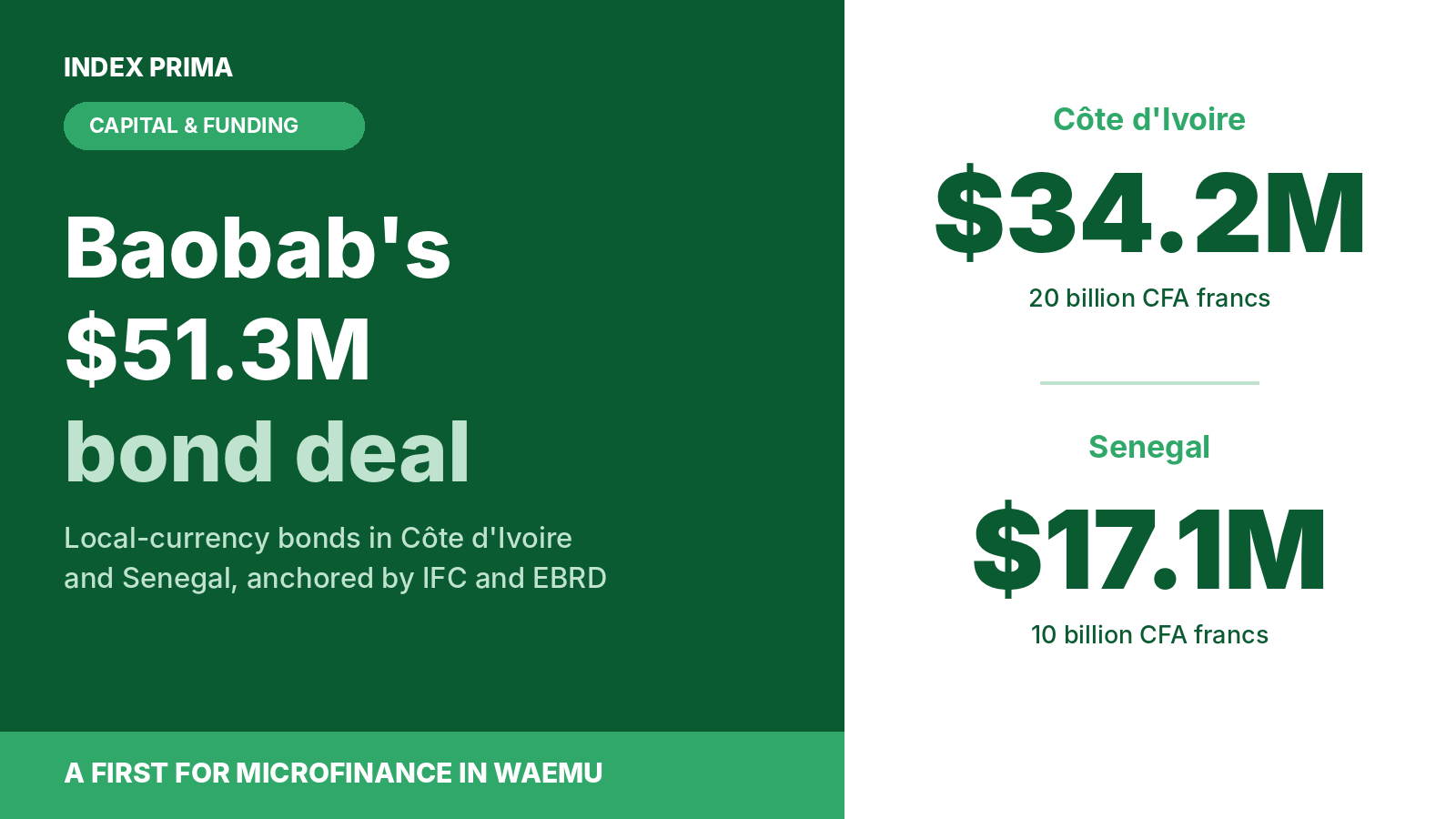
Baobab Group has raised about 30 billion CFA francs, or $51.3 million, from two local-currency bonds in Côte d’Ivoire and Senegal. The Ivorian bond is the first sustainability-linked bond by a microfinance institution on the West African regional market, the group says.
Both bonds run for five years, with a one-year pause on principal repayments. The International Finance Corporation (IFC) anchored both, and the European Bank for Reconstruction and Development (EBRD) invested in the Ivorian issue. The money is meant for small businesses, especially those led by women, for private schools and for green projects. By our sums, the deal matters less for its size than for what it tests. Will West Africa’s own savers and banks fund lenders to small firms, in the money those firms earn?
| Item | Côte d’Ivoire | Senegal |
|---|---|---|
| Amount. | 20 billion CFA francs, about $34.2 million. | 10 billion CFA francs, about $17.1 million. |
| Rate. | 6.80% a year, gross. | 6.80%, per Financial Afrik. |
| Term. | Five years, with a one-year grace period. | Five years, with a one-year grace period. |
| Subscription. | Opened in September, per the arranger’s notice. | Opened 22 September. Closed early after hitting its target. |
| Anchor. | IFC. | IFC. |
| Other named investor. | EBRD, 6 billion CFA francs. | None named. |
| Arranger. | CGF Bourse. | CGF Bourse. |
Baobab says the Ivorian bond is a first for a microfinance institution on the regional market that spans eight West African countries. A sustainability-linked bond ties the borrower’s terms to goals it must meet and report. Baobab has not published the targets, and neither has the EBRD. The arranger’s notice says an independent third party will verify progress. Until the targets are public, readers cannot judge how hard they are. Philip Sigwart, Baobab’s chief executive, calls the deals “an important milestone in diversifying Baobab’s funding sources.” Sherif Hassan of Beltone, Baobab’s parent group, says they show how regional debt markets can deliver “financial returns alongside sustainable impact.”
The numbers give a sense of scale. At the end of 2025, Baobab Côte d’Ivoire had over 320,000 clients, a balance sheet of 238.4 billion CFA francs and net income of 10.7 billion, according to the arranger’s notice. Its loans overdue by more than 30 days were 1.9% of the portfolio. By our sums, the 20 billion bond equals about 8% of that balance sheet and nearly twice its 2025 profit. At 6.80%, interest on both bonds would come to about 2 billion CFA francs a year, if the Senegal rate is as reported. Those are our figures, not Baobab’s.
The EBRD says it is taking 6 billion CFA francs, about €9.1 million, of an issue of up to 20 billion. By our sums, that is about 30% of the Ivorian bond. The EBRD calls the issue “one of the first thematic bond issuances by a private-sector company in Côte d’Ivoire.” It says the money will back women-led micro, small and medium businesses, as well as affordable education, early childhood development and green projects. The IFC’s share is not public. The notice says proceeds will reach women-led businesses, mainly in rural farming and trade.
Senegal is a repeat visit. In February 2025, Baobab Sénégal listed a 20 billion CFA franc bond at 6.80% on the regional exchange, due in 2029, according to a report from Dakar. This new 10 billion issue means the Senegal arm has now tapped local investors twice in under two years. That is our count from the two reports. Our reading is that a second trip suggests investors were happy with the first.
Local-currency debt is the real story here. Baobab lends in CFA francs, so borrowing in CFA francs removes the risk of a weak currency raising the cost of dollar debt. Many African lenders have been hurt by that mismatch. In June, the IFC also agreed to guarantee half of a loan portfolio of up to $100 million that Baobab will make to small businesses in five countries. That is a separate deal, and it shows the IFC leaning on Baobab for small business credit.
The wider market is still small. Financial Afrik reports that green, social and sustainable bonds make up under 2% of debt outstanding on the regional exchange. It says CGF Bourse’s three September and October deals, which include a 60 billion CFA franc issue by Shelter Afrique, would lift the count of such bonds from four to seven. The deals also show that the regional exchange can carry long-dated paper for lenders to small firms, not only government bonds.
Our reading is that debt has limits. Baobab must repay on time from its own loan repayments. Its borrowers run small businesses that can struggle in a downturn. The group has not said how much of the money goes to each use.
Why it matters: Small firms and women-led businesses are the backbone of West African economies, yet many cannot get a loan. A lender that can borrow for five years in local money can lend for longer too. If more savers, banks and pension funds buy such bonds, microfinance lenders will depend less on foreign money. For founders and small business owners, the test is whether longer loans reach them at fair prices.
What to watch next: the sustainability targets and who verifies them. Watch how much of the money reaches women-led firms, and how fast. Watch whether the IFC and EBRD amounts become public. Watch whether other microfinance lenders issue similar bonds. Watch the secondary market, where investors can trade the bonds on the regional exchange. And watch Baobab’s repayment record on its earlier Senegal bond.
Sources: Tolulope Bamiloye, “Baobab Group Secures $51.3M in Sustainability-Linked Debt Across Côte d’Ivoire and Senegal”, AU Startups, 23 November 2026; Arab Finance, “Beltone Holding: Baobab offers USD 51 million sustainability-linked bonds”, 18 November 2026; EBRD, “EBRD invests in Baobab bond issuance in Côte d’Ivoire”, 18 November 2026; Sika Finance, “Baobab Côte d’Ivoire lance le premier Sustainability-Linked Bond émis par une institution de microfinance sur le marché financier régional de l’UMOA”, 14 September 2026; Financial Afrik, “Finance durable : trois émissions majeures à 90 milliards FCFA”, 6 September 2026; AllAfrica, “BRVM: Baobab Sénégal fait coter son emprunt obligataire GSS Baobab 6,80% 2024-2029”, 26 February 2025; AllAfrica, “Sénégal: IFC et le groupe Baobab signent un accord d’assistance des PME et de partage des risques”, June 2026.
A note for startup founders: Don’t practice on investors. Practice on AI first. RaiseReady by Index Prima is an AI fundraising simulator for African founders: upload your pitch deck, get a readiness score and face a tough AI investor before the real meeting. Find this post, and every post we publish, at raiseready.indexprima.com.