African healthtech has no shortage of pilots. It has a shortage of companies that can pay their own bills. One Gates-backed network says it has found a way to close that gap, by tying every grant to a deal.
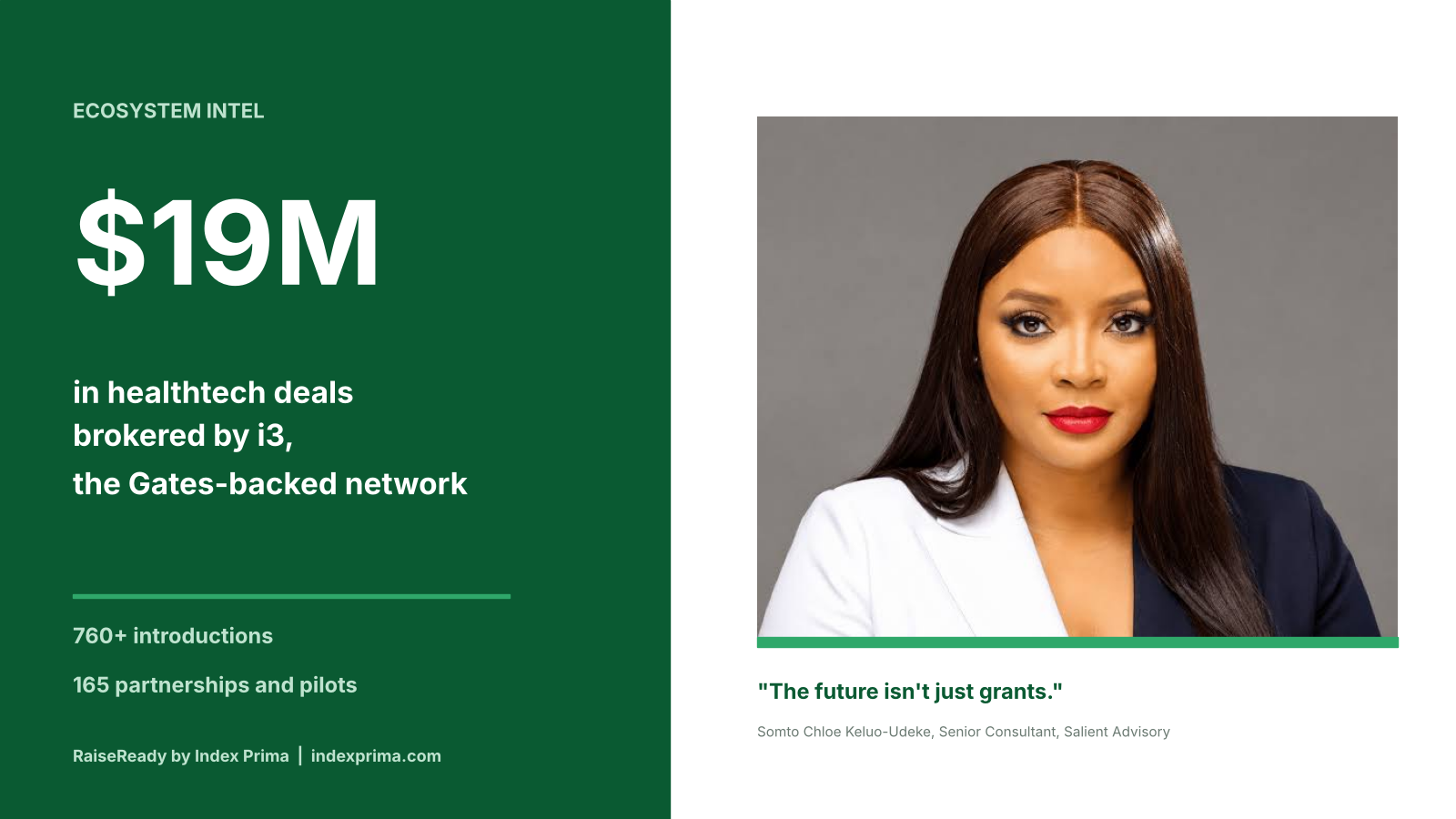
The network is i3, run by Salient Advisory. By its count, it has made more than 760 introductions and helped close 165 partnerships, pilots and agreements worth over $19 million. This deep dive checks those numbers, the deals behind them and the limits of the model. The picture is hopeful. But it comes in a year when healthtech funding is at its lowest point since at least 2019.
Somto Chloe Keluo-Udeke, a pharmacist and Senior Consultant at Salient, explained the thinking in an interview with Launch Base Africa. Her core point is simple. Grants should buy a company room to prove itself, then step aside so a commercial partner can take over. “The future isn’t just grants,” she said.
Start with what i3 is. It is a Gates Foundation programme, begun in the early 2020s, to support African health innovators. Salient Advisory runs it with the Solina Centre for International Development and Research. Its sponsors include MSD, Sanofi, Boehringer Ingelheim, Cencora, Endless Health and the Kühne Foundation. Leaders from those sponsors sit on a steering committee that helps shape each company’s plan.
The first phase was wide. It gave $50,000 grants to 60 early and growth-stage companies, 30 a year over two years. The current phase is narrow. Seven larger, growth-stage companies get up to $220,000 each. Some reports put the cap at $225,000. The phase runs through 2027. Keluo-Udeke said it was designed so that each grant is tied to a blocker that stops a company from signing a partner.
| i3, by its own figures | Number |
|---|---|
| Introductions made. | 760 plus. |
| Introductions this year. | 400 plus. |
| Partnerships, pilots and MoUs. | 165. |
| Stated value. | $19M plus. |
| Patients reached. | 6.85M. |
| Health products tracked or supplied. | 209M plus. |
| Companies supported. | 63 (per interview). |
| Countries. | 20 plus. |
Here is a closer look at the money. These sums are ours, using i3’s public figures. Phase 1 granted about $3 million. Phase 2 can grant up to about $1.5 million. That is roughly $4.5 million in total. Set against $19 million in partnership value, that is about $4 for every $1 of grant. About 22% of introductions, or 165 of 760, became a partnership. The average deal is worth about $115,000. That points to many small pilots and memorandums of understanding, not a few big cheques.
Two cautions apply. Value in a pilot or an MoU is not cash in a bank. And i3 itself says some of these deals might have happened anyway. Asked if MYDAWA and Endless Health would have met without i3, Keluo-Udeke said “probably they would have.” But she argued that i3 made it happen sooner. It validated the company and lent its goodwill.
The best proof is in the deals announced at the fourth Access to Markets event in Kigali, held beside the Africa HealthTech Summit. Twenty African innovators met 57 global and regional players, including Gavi, Pfizer, Johnson & Johnson and Amref.
| Innovator | Partner | Deal |
|---|---|---|
| Dawa Mkononi (Tanzania). | NMB Bank. | Interest-free credit line for pharmacies. |
| MYDAWA (Kenya, Uganda). | Endless Health. | Digital care model for hypertension and diabetes. |
| Meditect (francophone Africa). | Boehringer Ingelheim. | Debt financing, size not disclosed. |
| Sproxil (Nigeria). | Pharmacy Council of Nigeria. | Agreement on digital and AI pharmacy regulation. |
Dawa Mkononi is the clearest case. It gives inventory finance and stock tools to pharmacies and hospitals in Tanzania. It wanted banks to fund its lending, so it would stop lending from its own balance sheet. To get there it needed an in-house credit unit, better technology and strong credit analysts. i3’s grant paid for that build. Since then, Keluo-Udeke said, the company has signed at least two bank partnerships.
The headline number is a 0.3% rate of non-performing loans on more than $6 million lent. That is extremely low for unsecured lending to small pharmacies. If the rate held across all of it, bad loans would be about $18,000. Keluo-Udeke was candid, though. The figure comes from the Dawa Kwanza programme, a partnership with NMB Bank and Vodacom. That programme targets 20,000 pharmacies and clinics and has reached just over 3,000, or about 15%. As the loan book grows, she said, the rate will probably rise toward normal levels. She also said it is too early to tell how banks should lend to health. She noted that Access Bank in Nigeria and others are building specialist health teams.
Meditect shows how the pipeline works. It joined Phase 1 as an early-stage company with a $50,000 grant. It is now in Phase 2 with $220,000, and it has won debt from a drugmaker. i3 made the first introduction. Then it helped Meditect build a data room and model its impact in a way the lender would understand. That hands-on help, Keluo-Udeke said, is what the programme calls bespoke deal facilitation. Each company gets a relationship manager who meets it at least monthly.
Regulators are the second theme. Keluo-Udeke named three cases where a regulator worked with a startup instead of fighting it. Nigeria rewrote its online pharmacy rules in 2026, replacing the 2021 version. The new Electronic Pharmacy Regulations recognise pharmacy aggregators. They must register with the Pharmacy Council and name a superintendent pharmacist. A National Electronic Pharmacy Platform adds traceability for prescriptions. She said Ghana’s Pharmacy Council built an e-pharmacy platform with a healthtech firm, RX Health. She also said Rwanda’s medical supply agency built a data warehouse with Field Intelligence. Her view is that one successful partnership opens the door for others. She also said i3 matched Sproxil with a veteran government-relations adviser to help it survive changes of administration. And she said i3 has not faced a major clash with pharmacy associations.
Why does i3 focus on pharmacies? Because that is where care often starts. Keluo-Udeke said data from several African countries show pharmacies are the first stop for 40% to 60% of people. A Salient study covering 12 countries counted about 188,000 licensed private outlets. It found pharmacies are the first point of care for 41% to 60% of malaria patients and 42% to 74% of TB patients. In Kenya, a trial that paid pharmacies for test-then-treat cut per-patient costs by 50% to 80%. In South Africa, a pharmacy-based HIV drug pick-up scheme kept 97% of patients virally suppressed. Salient’s argument is that the building blocks exist already. The task is to make them work together.
Now the hard part. The funding backdrop is bleak.
| African healthtech funding | Amount |
|---|---|
| 2023. | $212M. |
| 2024. | $65M. |
| 2025. | $215M. |
| First half of 2026. | About $18M across 31 rounds. |
Healthtech took about 1.3% of disclosed African tech funding in the first half of 2026. Only four startups raised more than $1 million. Aid funding is also forecast to fall by up to 17% by year-end, says the OECD. Keluo-Udeke said donor money is shrinking and “funding cuts are here to stay.” She said i3 was not funded by USAID. Recent US aid cuts, she said, did not touch it. She would not discuss funding in the pipeline, but she said announcements on what follows 2027 are coming.
What does she want instead? Working capital. She said the most common request from founders is cheap, local-currency working capital. She pointed to SihAfya, a working-capital fund also backed by the Gates Foundation. Grants, she argued, should give risk room and evidence, then exit.
Some questions are still open. She did not say how many companies are profitable. She said only that it is harder for healthtech to reach profit. i3 judges success by reach and partnerships, not exits, though she says the ecosystem needs more acquisitions and a healthtech unicorn. She is not worried that banks setting up health units could squeeze out startups. And the model leans on a small group of sponsors who are also potential partners, so founders should ask who benefits from each introduction.
Why it matters: Africa’s health systems cannot be paid for by donors alone. The firms that survive will be those that sell to someone who keeps paying, whether a bank, a drugmaker, a government or a patient. i3’s record shows a practical path. Use a grant to fix the exact blocker, then let a partner carry the rest. It also shows the risk. A pilot or MoU is not revenue, and a low default rate on a young loan book will not stay that low. Founders should treat introductions as a start, and build the data, the credit track record and the paperwork a partner will ask for.
What to watch next: what comes after Phase 2 ends in 2027, and who pays for it. Also watch how many of the 165 partnerships turn into paying contracts. And watch whether Dawa Mkononi’s default rate holds as it grows past 3,000 pharmacies. The wider test is whether working-capital funds and banks fill the gap that grants leave, in a year when healthtech funding is the weakest since at least 2019.
Sources: Launch Base Africa interview with Somto Chloe Keluo-Udeke on i3; Techeconomy on i3’s four new deals at the 4th Access to Markets event; Launch Base Africa on i3 and corporate debt for African healthtechs; Launch Base Africa on African healthtech in 2026; Techeconomy on Salient’s report on private pharmacies; BusinessDay on Nigeria’s Electronic Pharmacy Regulations 2026; TechCabal on i3’s earlier cohorts.
A note for startup founders: Don’t practice on investors. Practice on AI first. RaiseReady by Index Prima is an AI fundraising simulator for African founders: upload your pitch deck, get a readiness score and face a tough AI investor before the real meeting. Find this post, and every post we publish, at raiseready.indexprima.com.