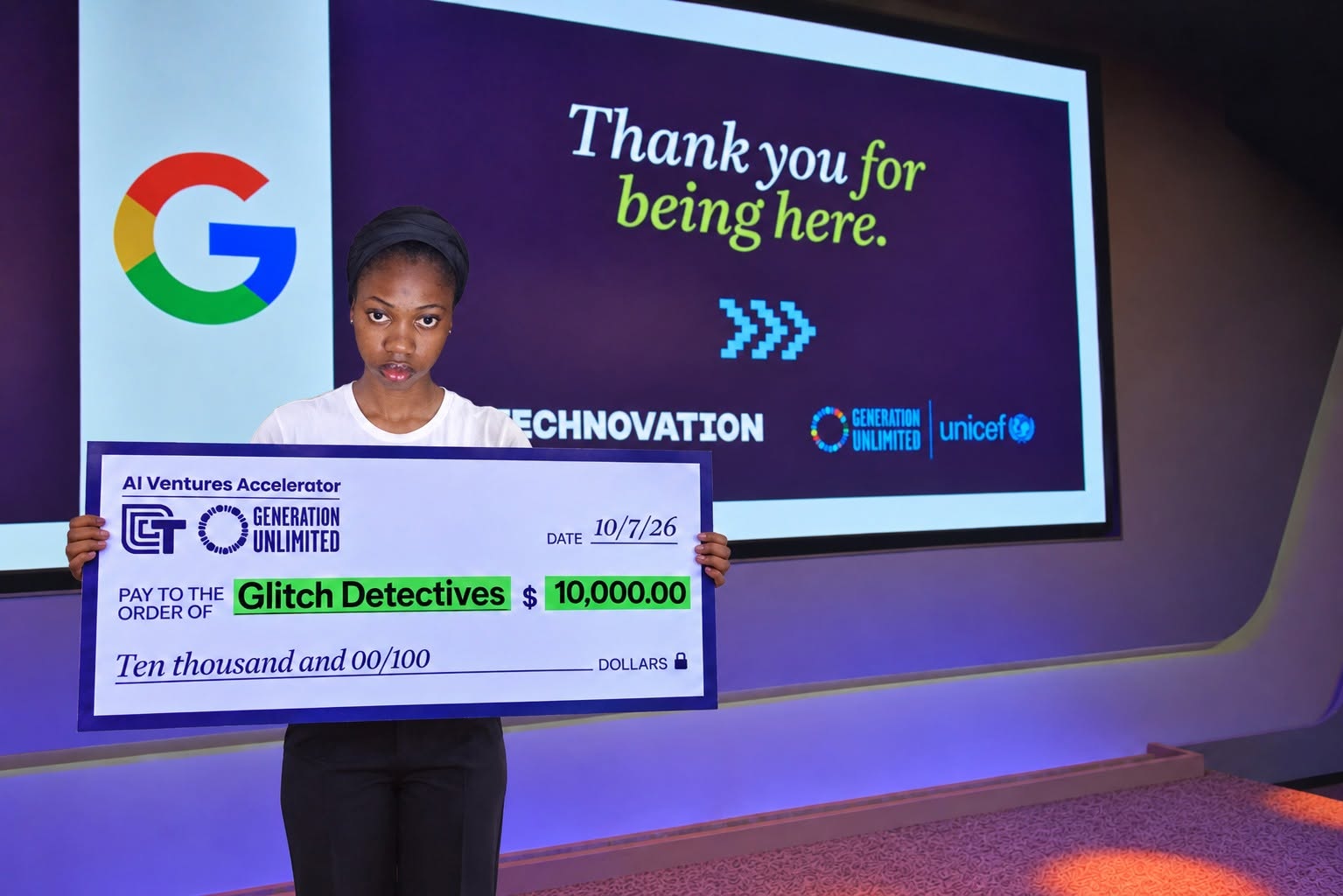
Glitch Detectives, a Nigerian maths learning startup, has been picked as one of 11 ventures in the AI Ventures Accelerator, run by Technovation with UNICEF’s Generation Unlimited. Its founder, Goodness, says the team won $10,000 in funding and pitched at the Demo Day in India.
The accelerator drew more than 1,000 young women from 60 countries, and over 200 finished with a working product, a demo video and a pitch. Glitch Detectives flips the usual maths lesson. Instead of solving a problem from a blank page, a child gets an AI-made answer with a hidden mistake, then finds the glitch, fixes it and explains why it was wrong. It is built for children in kindergarten to grade 6, and it is designed to be neuroinclusive.
| Item | Detail |
|---|---|
| Startup. | Glitch Detectives, a Nigerian maths learning startup for children in grades K to 6. |
| Founder. | Goodness, an educator turned numeracy learning designer, building alone. |
| Programme. | AI Ventures Accelerator, by Technovation and UNICEF Generation Unlimited. |
| Funding. | $10,000, equity-free seed funding, per the programme and the founder. |
| Field. | More than 1,000 applicants from 60 countries. Over 200 finished a product, video and pitch. |
| Demo Day. | October 2026, at Google’s Gurugram office, near Delhi. 11 ventures pitched. |
| Other wins. | First place at a hackathon, the founder says. |
| Not stated. | Hackathon name, app pricing, launch date for the workbook and the number of users. |
 The accelerator is a free 12-week online programme for young women aged 19 to 24. It runs on 10 to 15 hours a week and covers AI basics, entrepreneurship and human-centred design. Teams build working prototypes, get one-to-one mentoring and learn financial modelling and investor pitching. It was open to young women in India, Nigeria, Mexico and the United States, and to others in UNICEF programme countries. Technovation’s listing said the top 10 teams would each win $10,000 in equity-free seed funding. Glitch Detectives says it made the final 11 and received $10,000.
The idea came after a failure. Goodness says she began the programme with a different idea, and in Week 9 her survey validation failed. She was working alone and thought about quitting. She went back to the problem, built a new idea and tested it again, and this time it passed. That is a real lesson for founders. Survey validation, which means asking likely users whether they would use and pay for a product, can kill an idea early and save months. A failed test in Week 9 cost her a pivot, not a company.
Her product reflects a live worry in African classrooms. Children now meet AI answers everywhere, and wrong answers can look right. Glitch Detectives trains the skill of checking, not just solving. The company says its loop has four steps: investigate, detect, repair and explain. It starts with maths and says it wants to build reasoning and verification skills. Its site lists an app called Detective Worlds. One world, Fraction Factory, is live, and five more are marked as coming soon. It also offers printable, screen-free workbooks with worksheets, cut-and-glue activities and real-world challenges. The site says each page has a clear starting point, which it says reduces blank-page anxiety, the freezing some children feel when faced with an empty page. Goodness says she has felt it too.
The build path is lean and worth studying. She says she began with printables, shared them with families around the world and used the feedback to improve them. She then built a digital app, tested it with her own students and picked 25 families for a beta round. By our reading, that order is smart for a solo founder. Paper is cheap to change, families give honest feedback, and each round shapes the app before money is spent on code. A Fractions Workbook and Parent Guide are due to launch soon, she says, and families are already on a waitlist.
By our sums, the odds were steep. With more than 1,000 applicants and 11 on stage, about 1 in 90 got there, or about 5.5% of the 200 who finished a full pitch. The $10,000 is small by venture standards, but it is equity-free, so the founder keeps full ownership. For a one-person team in Nigeria, that can pay for app testing, printing and a first set of school pilots.
Neuroinclusive design is the other draw. Goodness describes her field as the meeting point of AI, learning and neurodiversity. Her site lists calm design, voice or text input, no timers and no sign-up for parents, and a report for teachers on reasoning patterns and misconceptions. Those are the company’s own claims. Schools and parents will want to see classroom results, and data protection rules for children’s information apply to any app that handles learner data.
Why it matters: Nigeria has many educators who see learning gaps up close, and few of them get global backing to build products. This win shows that a solo founder from Nigeria can compete with women from 60 countries on a world stage. It also points to a growing market for tools that teach children to question AI, not just use it. If Glitch Detectives can prove learning gains, it could serve families who want screen-free learning and schools that want AI literacy.
What to watch next: the launch of the Fractions Workbook and Parent Guide, and the size of its waitlist. Watch for learning results from classrooms and the beta families. Watch for pricing and school pilots in Nigeria. Watch whether more Nigerian founders enter the next Technovation round. And watch whether the startup raises a larger round after this seed funding.
Sources: Goodness, founder of Glitch Detectives, Facebook post on the AI Ventures Accelerator selection, November 2026; Luma, “AI Ventures Accelerator Demo Day”, October 2026; Daily Pioneer, “UNICEF, Google host AI for women founders”, 22 October 2026; VC4A, “Technovation/Generation Unlimited AI Ventures Accelerator”; Arbiterz, “Technovation AI Ventures Accelerator 2026 offers $10,000 equity-free seed funding”, February 2026; Glitch Detectives, “Products”; Signalbase, “Glitch Detectives raises $10K in seed funding”.
A note for startup founders: Don’t practice on investors. Practice on AI first. RaiseReady by Index Prima is an AI fundraising simulator for African founders: upload your pitch deck, get a readiness score and face a tough AI investor before the real meeting. Find this post, and every post we publish, at raiseready.indexprima.com.