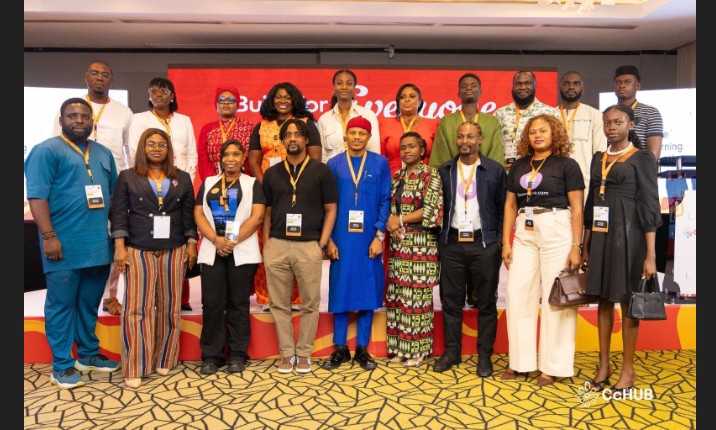
Co-Creation Hub (CcHUB), in partnership with the Mastercard Foundation, has named 12 early-stage Nigerian startups to Cohort 4 of the Mastercard Foundation EdTech Fellowship. Unlike a typical accelerator cohort selected mainly on product polish or growth metrics, this group was chosen as much for how well its founders understand the learners they’re building for as for the strength of the technology itself.
What the Fellowship Offers
Each of the 12 startups enters an 18-month programme carrying up to $100,000 in equity-free funding — capital that doesn’t dilute a founder’s cap table at the earliest, most fragile stage of building. Alongside the funding, CcHUB provides structured technical assistance across product development, communications, and business strategy, plus access to its wider network of sector partnerships. A dedicated pilot framework is also built into the programme, giving founders a structured way to test their solutions and generate the kind of evidence that funders and policymakers actually look for. The Fellowship rounds this out with media readiness training and stakeholder engagement support, aimed at making sure the work founders do over the next year and a half is visible to the people it matters most to.
Four Areas of Focus
Cohort 4 is organised around four thematic groups, each targeting a segment of learners that mainstream edtech tends to overlook.
For learners with disabilities, TrainDTrainer, Talktu, DAWN AI Study, and Efiwe are building tools focused on accessibility, teacher capacity, and more inclusive classroom experiences.
For underserved, rural, and displacement-affected communities — including internally displaced persons — Ileemore Technologies, Skillup Africa, and Lena are working on expanding access to quality education in low-resource settings.
For girls and young women, Heels and Tech, NursePadi, Skilladder AI, and Lalitah are focused on improving participation, skills development, and economic opportunity.
And in education and workforce data, Ribara Analytica is building data-driven platforms meant to support better decision-making and strengthen the pathway from education into employment.
Why the Inclusion Focus Is Deliberate
CcHUB Managing Partner Nissi Madu framed the cohort’s design around a simple premise: inclusion works best when it’s built into a startup from day one, not retrofitted once a product has scaled. The goal, in her telling, is to help these founders test and refine their solutions, build real evidence behind them, and grow into sustainable businesses in the process — with the broader aim of making sure no learner gets left behind as African education systems modernise.
Mastercard Foundation’s Wariko Waita, who directs the Centre for Innovative Teaching and Learning, has framed the philosophy behind the programme even more simply: good edtech shouldn’t just digitise education, it should redistribute opportunity.
A Track Record to Build On
This is the Fellowship’s fourth cohort, and the programme now has a body of results to point to. Since launching, it has supported 72 companies across Africa, reaching over 700,000 new learners — 89% of them children and youth, with a near-even gender split. The previous cohort alone, showcased at a Demo Day late last year, collectively reached more than 21,000 new learners, engaged 7,000 educators, and supported over 500 schools across Nigeria, including in rural and semi-urban communities.
The Bigger Picture
Nigeria’s edtech sector has no shortage of startups chasing scale, but relatively few are built specifically around learners with disabilities, displacement, or rural exclusion — segments that are harder to monetise and easy for a growth-first funding model to skip past. By pairing non-dilutive capital with a structured evidence framework, the Fellowship is betting that founders serving these groups can build real businesses, not just good intentions, and that the evidence they generate over the next 18 months could shape how funders and policymakers think about inclusive edtech well beyond this one cohort.