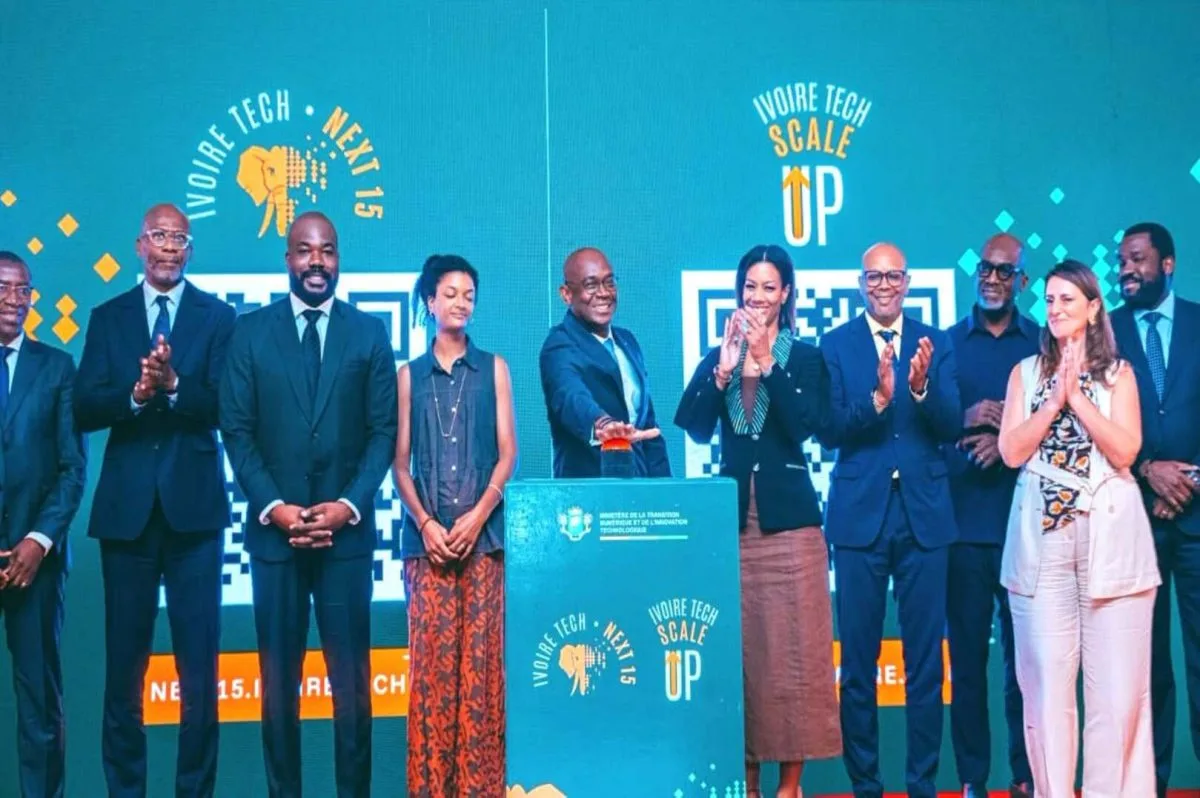
Côte d’Ivoire has opened applications for two new programmes that will support 30 digital companies over the next 24 months, unveiled alongside a ministry roadmap that elevates AI adoption to one of seven strategic pillars for the next three years. Minister of Digital Transition and Technological Innovation Djibril Ouattara launched both initiatives on 29 July at the Sofitel Abidjan Hôtel Ivoire. Applications, which are free to submit, close on 13 September, with shortlisted companies pitching to an independent international jury before winners are announced in Abidjan at the end of September.
Two Tracks, Two Very Different Bars
The programmes split the 30 slots evenly. Ivoire Tech Next 15 is built for earlier-stage startups: companies headquartered in Côte d’Ivoire, operating for at least a year, generating established and growing revenue from an innovative product or service, majority-owned by their founders, and current on their tax and social obligations.
Ivoire Tech Scale Up, aimed at more established digital SMEs, sets a considerably higher bar. Applicants need three to five completed financial statements, at least 75% Ivorian ownership of capital, average turnover of CFA 500 million (roughly $877,000) over three to five years with at least 65% of that coming from digital activities, a product already on the market, and a minimum of 10 employees.
That 75% local-ownership threshold, paired with the digital-revenue requirement, is doing real work: it screens out foreign-controlled entities and companies where digital work is a side hustle to some other business, narrowing the pool to Ivorian technology firms that can already prove they operate at scale. Neither track is built for pre-product founders pitching an idea off a slide deck — both assume the applicant already has a working, revenue-generating business.
The Real Prize Is a Route Into Government Contracts
Alongside the two support tracks, Ouattara announced a third initiative: Ivoire GovTech Lab, a platform that will publish government digital-transformation projects openly, letting startups and SMEs apply or propose solutions directly rather than competing through the usual channels reserved for established contractors. Of the three announcements, this may be the one with the most structural weight — public procurement is one of the few tools a government has to manufacture early demand for domestic technology companies, and opening that pipeline up changes who gets to compete for it.
Where AI Fits Into the Bigger Plan
The programme launch doubled as the unveiling of the ministry’s 2026–2028 roadmap: seven strategic pillars and 40 major projects, folded into the National Digital Development Strategy and aligned with the broader National Development Plan 2026–2030. The pillars span connectivity, public-administration digitisation, technological innovation, AI adoption, digital skills, e-commerce, and cybersecurity.
AI’s place on that list isn’t new — it continues a build-up that’s been underway for more than a year. Côte d’Ivoire secured a $95 million funding commitment from the UAE in late 2025 covering a modular data centre, a sovereign cloud, and an AI and innovation centre of excellence, alongside AI-powered upgrades to its civil service management system. The country has also signed memoranda with UAE-based G42 Presight on public-sector digitalisation, adopted a national AI strategy, and folded that strategy into a shared AI governance framework that six Francophone West African countries agreed to last month. Ouattara has separately floated an even bigger ambition: building what he’s described as Africa’s first multinational school dedicated to artificial intelligence, based in Côte d’Ivoire.
The Number That Matters Most
Beyond the pillars and the platforms, the ministry has attached one concrete target to all of it: doubling the digital sector’s contribution to national GDP within three years, from an estimated 6–8% today. Some reports also suggest the two new programmes are meant to help mobilise between CFA 5 billion and CFA 10 billion in financing from banks, investment funds, and development partners over their lifespan.
Whether It Actually Works Is a Different Question
Programme criteria are one thing; execution is another. But the combination on offer here — a supported cohort, a public-procurement channel through GovTech Lab, and an ownership requirement that keeps the benefits domestic — is a more coherent package than most startup-support announcements on the continent tend to offer. It’s also a deliberately narrow one: built for Ivorian companies that have already found a product and some revenue, not for founders still looking for their first one.