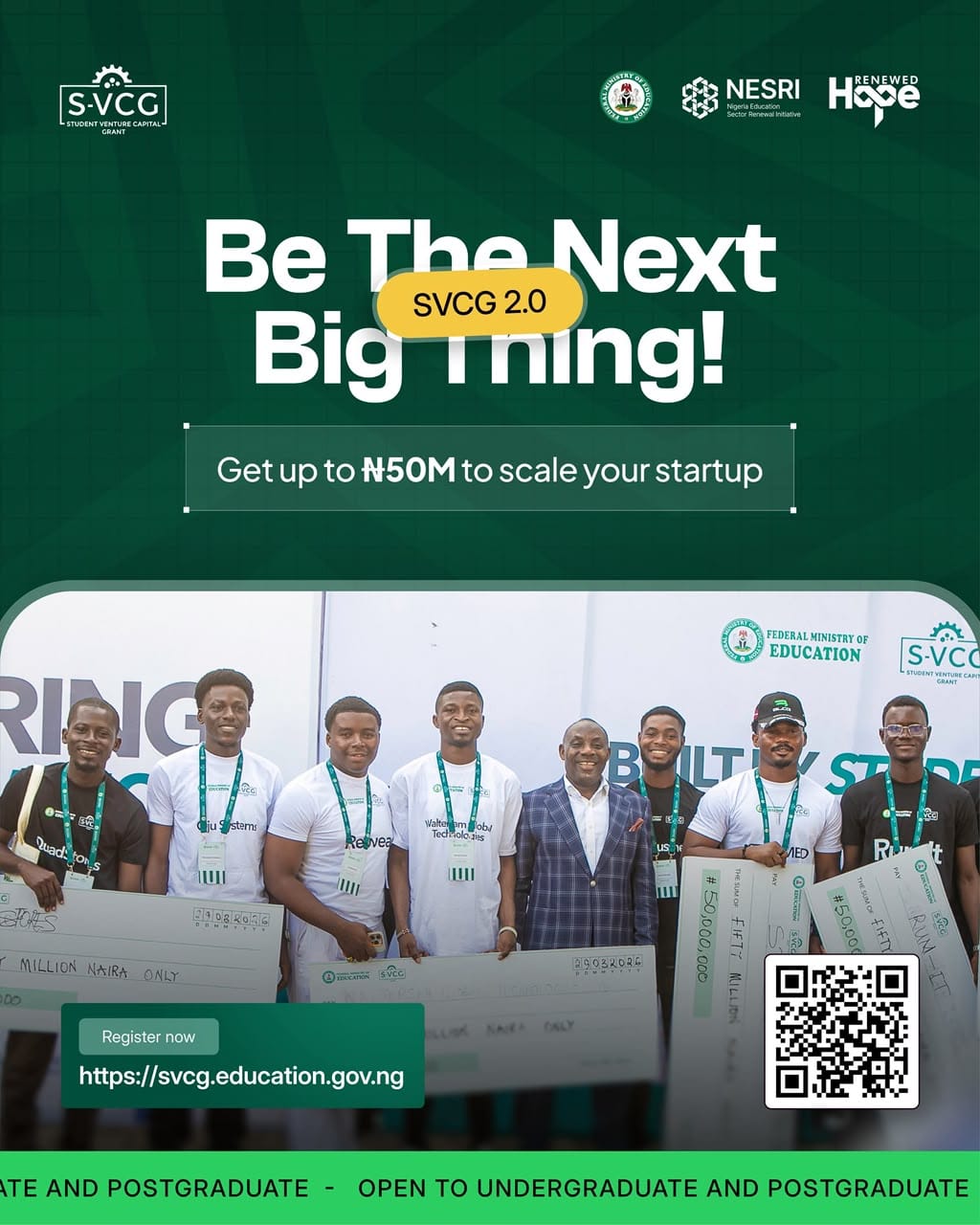
Nigeria’s Federal Ministry of Education has opened applications for the second cohort of the Student Venture Capital Grant (SVG), offering up to ₦50 million in equity-free funding to each of 50 student-led ventures, a ₦2.5 billion commitment in total. National Project Coordinator Adebayo Onigbanjo announced the new round at a press briefing in Abuja, with the application portal now open at svcg.education.gov.ng and closing September 30, 2026.
Who Can Actually Apply
Eligibility is specific rather than open to any student with an idea. Applicants must be currently enrolled in a Nigerian university, polytechnic, or college of education, and must be at least in 300 level or its equivalent, ruling out first and second year students regardless of how strong their idea might be. Within that pool, the programme is targeting ventures in science, technology, engineering, mathematics, and medicine, spanning health, agriculture, education, technology, energy, logistics, e-commerce, and other STEMM-related fields.
What’s Actually New This Round
The headline change from the first cohort is what happens after the money lands. Successful ventures in Cohort 2 will receive six months of structured mentorship on top of the funding itself, pairing young innovators with experienced entrepreneurs and organisations who can guide them through building, growing, and actually taking a product to market. That’s a meaningful shift in emphasis, treating the grant as the start of a supported runway rather than a one-time cash injection founders are left to figure out alone.
How the First Cohort Actually Performed
The scale of interest in Cohort 1 gives a real sense of demand for this kind of programme. The Ministry received 17,914 applications from 404 institutions across all 36 states and the Federal Capital Territory within just three weeks of opening, with 3,014 completed applications ultimately going through AI-assisted screening and human evaluation. That process narrowed the field to 65 finalists, who attended a three-day bootcamp from March 27 to 29, 2026, before 45 beneficiaries were eventually selected to receive funding. The gap between the original target of 50 and the 45 actually funded suggests the selection process held a genuine quality bar rather than filling every available slot regardless of readiness.
Taking the Programme Directly to Students
Rather than relying solely on students finding the opportunity online, the Ministry is running a nationwide mobilisation campaign from September 6 to 30, with its team visiting nine institutions across Nigeria’s six geopolitical zones directly: the University of Abuja, Nile University, Abubakar Tafawa Balewa University in Bauchi, Bayero University Kano, Kano University of Science and Technology in Wudil, Federal Polytechnic Nekede in Owerri, Ambrose Alli University in Ekpoma, the University of Lagos, and Covenant University in Ota. A Campus Ambassador Programme extends that reach further still, activating student ambassadors across 20 additional institutions to spread awareness beyond the campuses receiving a direct visit.
How the Money Actually Moves
According to the programme’s own site, S-VCG doesn’t disburse funding as a single lump sum handed over at selection. Grants are milestone-based, released as ventures hit defined progress markers, paired with structured validation support and tracked through what the Ministry describes as government-approved disbursement rails aimed at accountability. There’s also a detail worth knowing for students who don’t make the final cut: qualified projects that aren’t selected for funding still get logged in a national innovation repository, keeping them visible for future opportunities rather than simply disappearing after a single rejection.
Who’s Behind the Programme
The initiative sits under Nigeria’s Nigeria Education Sector Renewal Initiative, specifically its STEMM pillar focused on research, innovation, and entrepreneurship, and is described by the Ministry as a central component of President Bola Tinubu’s Renewed Hope Agenda. Minister of Education Dr. Maruf Tunji Alausa is leading the effort, with implementation support from the Tertiary Education Trust Fund, the Bank of Industry, and the Afara Initiative. Onigbanjo framed the underlying rationale plainly: Nigeria does not lack innovative young people, he said, what many lack is the opportunity and capital to take their ideas further, arguing that universities, polytechnics, and colleges of education need to become places where ideas are developed and businesses are actually born, not just where they’re first imagined.
Why It’s Worth Watching
A ₦2.5 billion programme reaching only 50 ventures out of a pool that drew nearly 18,000 applications in its first round is, by definition, extremely selective. But the addition of structured mentorship, a milestone-based funding model, and a visibility mechanism for students who don’t win funding on their first attempt suggests the Ministry is building this as a durable pipeline rather than a one-off grant cycle. Whether Cohort 2’s 50 ventures fare better than Cohort 1’s 45 will be the real measure of whether the added mentorship layer actually changes outcomes, not just optics.