Nigeria’s Fraud Losses Halved, but the Trend Is Still Up
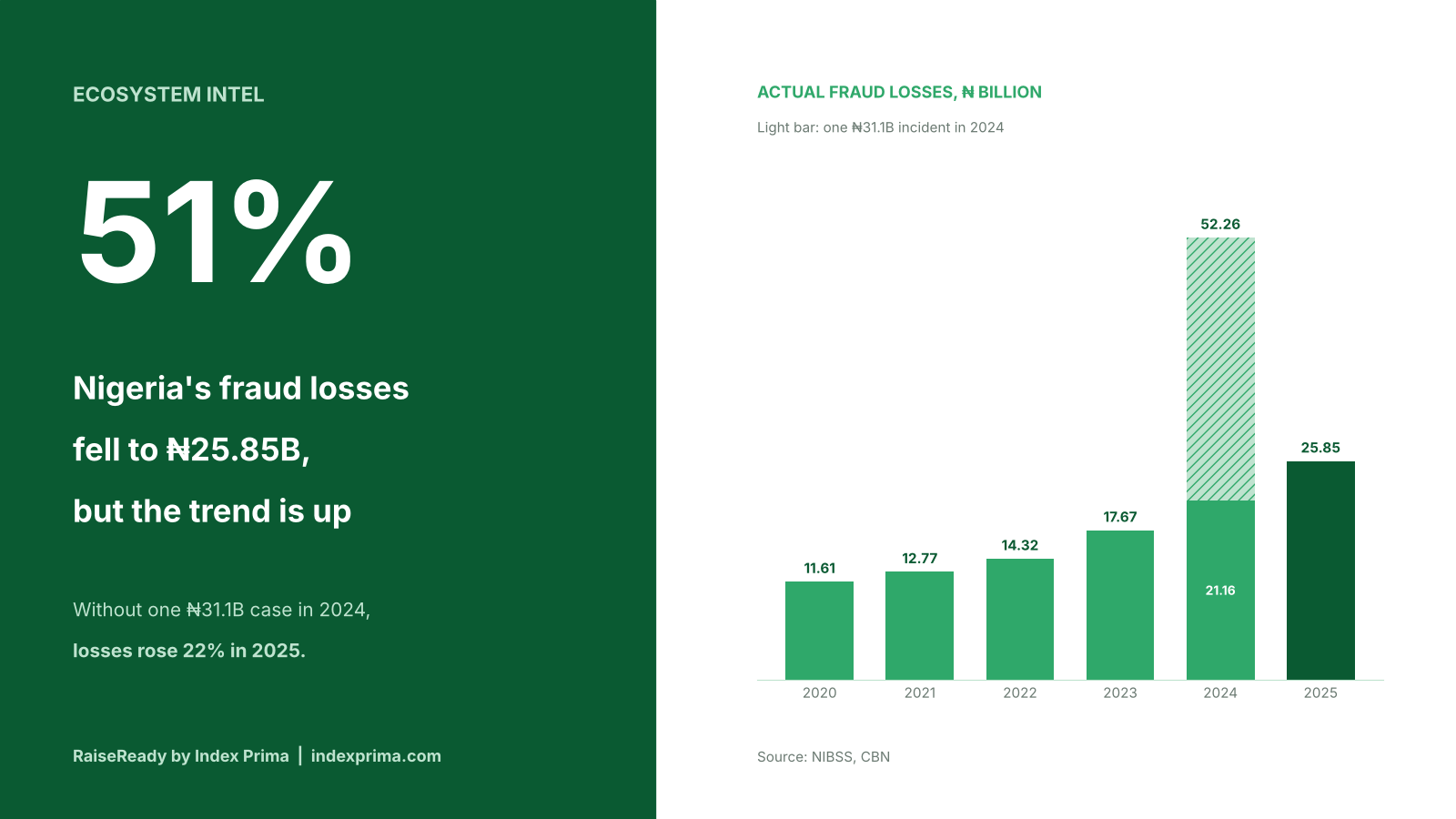
Nigeria’s digital payment fraud losses fell by half in 2025, from ₦52.26 billion to ₦25.85 billion. Look closer and the story changes: one huge case explains the whole drop, and fewer institutions are telling the regulator what they lose.
This report reads the 2025 figures from the Nigeria Inter-Bank Settlement System (NIBSS) in detail, alongside data from the Central Bank of Nigeria (CBN) and the banks. Four findings stand out. First, the fall is real on paper but rests on one event. A single ₦31.1 billion incident inflated 2024, and without it, losses rose about 22% in 2025. Second, criminals are hitting fewer people for more money. Cases fell 45% since 2021, while the average loss per case rose about 3.7 times. Third, social engineering drives the damage. It caused 47% of cases and, by our sums, about 69% of losses. It covers bank staff as well as customers. Fourth, the data is getting thinner. Fewer institutions report, and reporting fell 34% in the last quarter of 2025.
Start with the headline numbers. NIBSS presented the 2025 data at the 2026 Nigeria Electronic Fraud Forum. It shows a fall of 51% in actual losses. The CBN’s own series runs back to 2020 and puts the six-year total at ₦134.48 billion.
| Year | Actual fraud losses | Change on prior year |
|---|---|---|
| 2020. | ₦11.61B. | Not applicable. |
| 2021. | ₦12.77B. | Up 10%. |
| 2022. | ₦14.32B. | Up 12%. |
| 2023. | ₦17.67B. | Up 23%. |
| 2024. | ₦52.26B. | Up 196%. |
| 2025. | ₦25.85B. | Down 51%. |
Now the key question. Was 2024 a normal year? NIBSS says no. It says the 2024 rise came mainly from one incident worth ₦31.1 billion at a single entity, and CBN-based reporting calls it an internal case. Take that one event out, and 2024 comes to about ₦21.16 billion. On that basis, losses rose about 20% from 2023 to 2024, and about 22% from 2024 to 2025. Over the two years since 2023, that is a rise of about 21% a year. The rise of about 46% over 2023 holds: ₦25.85 billion against ₦17.67 billion. The drop from 2024 is best read as the end of a one-off event, not a turn in the trend.
The second finding is about shape. Fewer cases are causing more harm. Reported fraud cases fell from 123,918 in 2021 to 67,518 in 2025, a drop of 45%. Over the same time, the average loss per case rose from about ₦103,000 to about ₦383,000, using the CBN’s loss series and NIBSS’s case counts. That is about 3.7 times as much. The Financial Institutions Training Centre described the same shift in early 2025, as a move from frequent small hits to targeted, high impact attacks. Internet banking shows it best.
| 2025 measure | Internet banking | All fraud |
|---|---|---|
| Cases. | 4,507. | 67,518. |
| Losses. | ₦13.37B. | ₦25.85B. |
| Share of cases. | About 7%. | 100%. |
| Share of losses. | About 52%. | 100%. |
| Average loss per case. | About ₦2.97M. | About ₦383,000. |
On our sums, an internet banking case costs about 7.7 times the average. NIBSS says e-commerce and internet banking are the most affected channels, followed by point of sale, mobile and web. In 2023, the mix was different: mobile made up 50% of cases, web 23% and point of sale 18%. So the money has moved toward channels where one successful attack can empty an account.
The third finding is about people. The idea that criminals now target people more than systems holds up, with one important addition. NIBSS names social engineering, which means tricking a person into handing over money or access, as the most common technique. It caused 47% of cases and ₦17.84 billion in losses. Card theft came next at 17%, and robbery at 11%. In 2023, NIBSS put social engineering at 66% of cases, so its share has fallen, though the two reports may not label cases the same way.
| 2025 social engineering | Figure |
|---|---|
| Share of cases. | 47%, or about 31,700 cases. |
| Losses. | ₦17.84B. |
| Share of losses. | About 69%. |
| Average loss per case. | About ₦562,000. |
| Average loss in all other cases. | About ₦224,000. |
By our sums, a social engineering case costs about 2.5 times as much as any other kind. Who is being tricked? Not only customers. NIBSS Managing Director Premier Oiwoh calls insider abuse the greatest threat inside social engineering. “Insider involvement is high,” he said, “and recent investigations have confirmed this.” The ₦31.1 billion case is one example, and bank data supports the point. Wema Bank’s losses rose from ₦29.45 million in 2024 to ₦847.6 million in 2025. About 96% of that came from internal operations rather than digital channels. The bank blamed gaps in internal controls. Oiwoh’s advice to institutions reads like a staff-integrity checklist: profile staff, rotate jobs, make leave compulsory and watch for sudden changes in lifestyle. So “people” means both sides of the counter.
Where does the fraud happen? Lagos accounted for 63.43% of fraud activity in 2025. Abuja was second at 3.12%, and Ogun, Rivers and Delta each held between 2.09% and 2.51%. One report says Abuja has seen a notable rise. The pattern follows the volume of digital payments, but it also means a few cities carry most of the risk.
Now the fourth finding, and the one that clouds all the others. Reporting is slipping. Fraud reporting fell by about 34% in the last quarter of 2025. The number of institutions reporting fraud dropped from 45 in the second quarter of 2024 to 34 by the fourth quarter of 2025, a fall of 24%. Some institutions reported zero incidents. Oiwoh was blunt. “Non-reporting is unacceptable,” he said. He warned that offenders move to other institutions when incidents go unreported. Every number in this report is a reported number. If fewer institutions report, the true loss could be higher than ₦25.85 billion. A legislative paper from the National Institute for Legislative and Democratic Studies makes the same point. It calls the 2025 fall measurable progress that “does not constitute a definitive victory.”
So how much of the fall is real? The evidence points both ways.
| Signs of real progress | Signs for caution |
|---|---|
| Attempted fraud value fell from ₦86.36B to ₦37.57B, a fall of 56%. | Underlying losses rose about 22% once the one-off case is removed. |
| Cases are down 45% since 2021. | The number of reporting institutions fell from 45 to 34. |
| Joint industry action prevented about ₦20B in losses. | Fraud reporting fell 34% in the last quarter of 2025. |
| Access, GTCO and UBA spent about ₦280.9B on technology in 2025. | Average loss per case keeps rising. |
| In early 2025, banks blocked 85.2% of attempted fraud value, per the training centre. | GTCO’s fraud value rose 30% and its losses 69%, with fewer cases. |
One caution on the attempted figures. The CBN series does not say whether attempted value includes the amounts lost, so we do not divide one by the other.
The big banks show how uneven the defences are. Access Holdings, GTCO and UBA together faced ₦10.29 billion in fraud-linked incidents in 2025 and lost ₦2.13 billion, or about 21%. Wema Bank stopped about 88% of the ₦7.19 billion aimed at it. Within the big three, the gap is wide.
| Bank | Value targeted | Value lost | Share lost |
|---|---|---|---|
| Access Holdings. | ₦3.17B. | ₦1.24B. | 39.1%. |
| UBA. | ₦4.56B. | ₦621.57M. | 13.6%. |
| GTCO. | ₦2.58B. | ₦269.44M. | 10.4%. |
Access lost nearly four times the share that GTCO did. Customers of different banks face different odds, and few of them can see this table.
What are regulators doing? The CBN has set an industry target to cut fraud response times to under 30 minutes. It now requires monthly fraud returns, lets NIBSS debit institutions that receive the proceeds of fraud, and demands liveness checks and device binding when customers open accounts. It plans fraud-reduction targets and scorecards that publish bank performance. CBN Deputy Governor Philip Ikeazor framed the stakes. “Fraud is no longer merely an operational issue,” he said. “It is a financial stability concern.” NIBSS runs a Person of Interest Portal. It has held at least 13,417 names and photographs of suspects since 2019. Oiwoh says real-time identity checks through APIs could resolve up to 95% of customer verification problems if banks use them fully. Every instant payment on the new National Payment Stack is now risk-scored.
The legislative paper goes further. It calls for a public oversight hearing in 2026, quarterly fraud reports from the CBN and NIBSS, and stronger penalties for under-reporting. It also asks for a clear legal basis for sharing fraud data across the industry. And it wants consumer protection with set timelines for complaints and refunds, and clear rules on who bears the loss. At present, victims often absorb the pain while the rules on liability stay vague.
Why it matters: The danger is reading ₦25.85 billion as a finish line. It looks like a halving. But the underlying trend is up about a fifth a year, the average hit is growing, and the data is thinning just when it matters most. Fraud in Nigeria is now a story about trust: customers trusting a message, banks trusting their staff, and the regulator trusting the numbers. For ordinary people, the practical lessons are plain. Never share a PIN, one-time password or BVN, even with someone who sounds like your bank. Hang up and call the number on your card. Treat any urgent message as a warning sign, and report fraud at once, since the 30-minute response target depends on speed. For banks and fintechs, the lesson is to guard the inside as well as the outside: staff controls, device binding and liveness checks, and honest reporting. For lawmakers, it is to set rules on reporting and refunds before the next large case.
What to watch next: whether reporting recovers in the first half of 2026, and how many institutions send returns each month under the new rules. Watch whether the CBN publishes clear definitions of attempted and actual fraud, so that the numbers can be checked. Watch for the first quarterly fraud reports and a National Assembly hearing, as the legislative paper urges. Watch the six compliance deadlines running between March 2026 and March 2028. Watch whether another very large insider case appears and distorts the totals again. And watch the next wave. A senior police official lists artificial intelligence, ransomware and deepfakes among current threats. No figures have been published yet.
Sources: The Guardian Nigeria on NIBSS’s 2025 fraud figures; TechEconomy on NIBSS’s 2025 digital payment fraud report; Legit.ng on NIBSS’s biggest fraud technique; Nairametrics on CBN data for 2020 to 2025; allAfrica on CBN measures against fraud; allAfrica on the Person of Interest Portal; NILDS paper on electronic payment fraud trends; BusinessDay on four banks and the N14.5bn blocked; TechCabal on three banks’ fraud losses; BusinessDay on first quarter 2025 fraud losses; Intelpoint on 2023 fraud techniques and channels; Nairametrics on AI threats and the 2025 decline.
A note for startup founders: Don’t practice on investors. Practice on AI first. RaiseReady by Index Prima is an AI fundraising simulator for African founders: upload your pitch deck, get a readiness score and face a tough AI investor before the real meeting. Find this post, and every post we publish, at raiseready.indexprima.com.