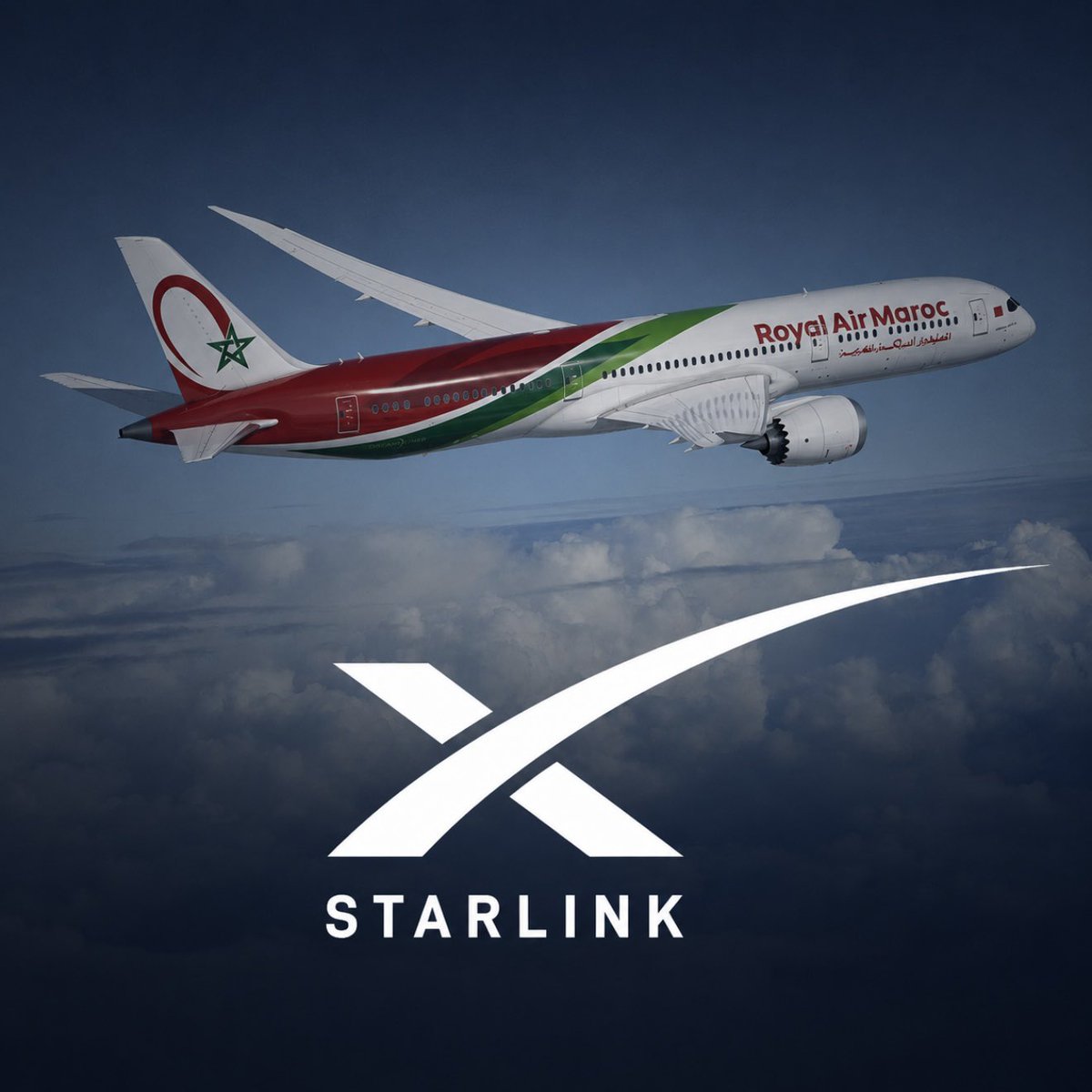
Royal Air Maroc has signed a deal with Starlink to equip its entire fleet with satellite Wi-Fi, making it the first airline in Africa to commit its full aircraft roster to Elon Musk’s satellite internet network. The Moroccan national carrier, chaired by CEO Abdelhamid Addou, concluded the agreement on August 4, closing out months of negotiations that had reportedly stalled over price and technical terms.
The delay wasn’t about interest, it was about cost. Royal Air Maroc had judged Starlink’s initial offer too expensive, and it took months of back and forth on financial and technical terms before both sides landed on an agreement both could live with. That kind of prolonged negotiation is common in aviation connectivity deals, where retrofitting an existing fleet involves real engineering constraints on top of the commercial terms, but it’s a useful reminder that even a company as aggressive about market expansion as Starlink doesn’t get to dictate pricing unilaterally to every partner it approaches.
Royal Air Maroc has already run a test phase on select aircraft in recent months. From here, the rollout moves in stages, extending gradually across the rest of the fleet, which is composed mostly of Boeing jets, with full coverage targeted for 2027. That’s notably faster than what was discussed back in 2025, when the airline’s timeline pointed to 2028, a date tied to the expected delivery of around 100 new Boeing aircraft. Moving the target up a year suggests both companies are treating this as more urgent than a routine amenities upgrade.
The timing lines up with Royal Air Maroc’s broader ambitions. Casablanca has been positioning itself as a connecting hub between Europe, Africa, and the Americas, and reliable in flight connectivity is increasingly one of the ways international carriers differentiate themselves on long haul and business travel routes. Royal Air Maroc competes directly with Air France across the Europe, Morocco, and West Africa corridor, and Air France has already been rolling out free, high speed Starlink Wi-Fi across its own cabins since 2025, with a target of covering its entire fleet by the end of this year. Signing with the same provider puts Royal Air Maroc on comparable technical footing with one of its most direct rivals on shared routes, rather than competing with a visibly inferior onboard experience.
Very few African carriers offer onboard Wi-Fi at all. Ethiopian Airlines is currently the only other African airline with the service, available on its A350 aircraft, but it runs on Ka-band satellite broadband rather than Starlink’s low earth orbit network, a technically different approach with its own tradeoffs on speed and latency. Royal Air Maroc’s move makes it the first carrier on the continent to commit to Starlink specifically, and the first to plan Starlink coverage across an entire fleet rather than a single aircraft type.
Royal Air Maroc’s signing fits inside a rapid expansion for Starlink’s aviation business. The company had just two airline partners at the end of 2025. It has added 23 more deals through 2026 alone, and contracts now cover more than 7,000 aircraft set to be equipped across roughly 48 airlines total, a list that includes American Airlines, United, and Emirates among its more recognizable names. Royal Air Maroc’s deal stands out within that broader wave simply for being the first to bring an African carrier’s complete fleet into the fold.
The Growth Story Behind the Deal
This lands during one of the more aggressive expansion periods in Royal Air Maroc’s history. For the 2026 summer season, the airline programmed close to 8.2 million seats, up 23 percent year over year, across 86 international destinations, with its fleet now standing at 67 aircraft. Leadership has also pointed to a renewal and expansion program that could bring the fleet up to 200 aircraft by 2037. Fast, reliable Wi-Fi is a relatively small piece of that larger growth story, but it’s the piece passengers will notice first, and the one most likely to shape whether Royal Air Maroc’s push for more international traffic actually converts into loyalty on routes where travelers have other options.