South Africa has raised more than twice as much AI money as Egypt this year. But the bigger story is how small the whole field is, who really profits, and why no African AI company has raised past Series A.
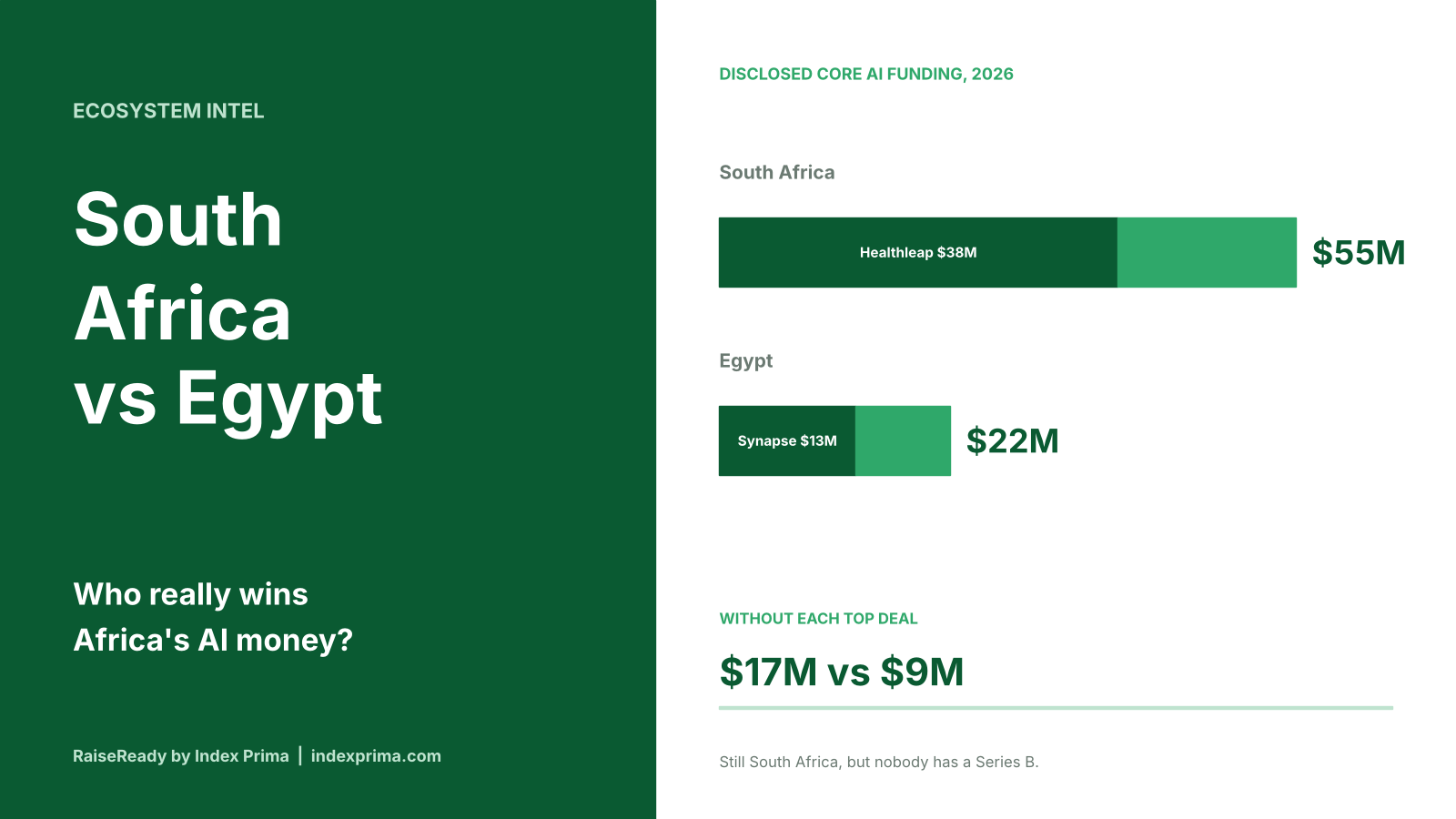
South Africa leads Africa’s 2026 AI funding race, with about $55 million in disclosed core AI rounds against Egypt’s $22 million, based on Launch Base Africa’s deal data. One round does most of the work: Healthleap’s $38 million. Take out each country’s biggest deal, though, and South Africa still leads, $17 million to $9 million. The deeper finding is that the whole continent has raised only about $93 million in AI across roughly 30 deals. That is a rounding error next to global AI money.
Start with the scoreboard. Launch Base Africa tracks more than 200 African funding deals this year. About 30 carry an explicit AI label, roughly one in seven. Their disclosed value adds up to about $93 million. South Africa holds about $55 million of it, or 59%. Egypt has about $22 million, or 24%. Kenya has about $11 million, and Nigeria about $2 million. Those four countries take about 97% of every AI dollar in the data.
| Market | Disclosed core AI funding | Share |
|---|---|---|
| South Africa. | About $55 million. | 59%. |
| Egypt. | About $22 million. | 24%. |
| Kenya. | About $11 million. | 12%. |
| Nigeria. | About $2 million. | 2%. |
A popular line says South Africa’s lead is an illusion. Without Healthleap, the argument goes, its total falls to $17 million, below Egypt’s $22 million. That is true, but it only tells half the story. Egypt also leans on one deal. Synapse Analytics raised $13 million, which is 59% of Egypt’s total. Healthleap is 69% of South Africa’s. Treat both countries the same way and remove each one’s top deal. South Africa keeps $17 million. Egypt keeps $9 million. South Africa still leads by nearly two to one.
| Test | South Africa | Egypt |
|---|---|---|
| All disclosed deals. | $55M. | $22M. |
| Top deal. | $38M. | $13M. |
| Top deal as share. | 69%. | 59%. |
| Total without top deal. | $17M. | $9M. |
So the honest picture is this. South Africa leads on dollars either way. Egypt leads on the number of small deals. Neither market looks balanced. Egypt is less top-heavy only because its other rounds are tiny.
Now look at who the two winners are. Healthleap was founded in 2022 by siblings Josiah Meyer, the chief executive, and Jemima Meyer, a clinical dietitian. Reports say it began in South Africa, when Jemima built a first tool to help colleagues find malnourished patients faster. It now describes itself as San Francisco based. Its $38 million came in October 2026. An $8 million seed was co-led by Sequoia Capital and First Round Capital. A $30 million Series A was led by Hummingbird Ventures.
The product reads each patient’s full electronic health record every morning. It flags people who may have undiagnosed conditions, starting with malnutrition, and passes the alert to doctors and nurses. It flags, it does not diagnose. Reports name US customers such as Penn Medicine. The company says it has gone from three hospital partners to over 50 in a year. In one health system, the company reports 39% more malnutrition cases found and treated, worth $11 million in added reimbursement. At one Penn Medicine hospital, it reports about $23.8 million a year from added reimbursement and shorter stays.
Pause on that. Healthleap is African by origin and talent, but its buyers are American hospitals, paid through US reimbursement. The money it earns does not circulate through African health systems. That does not make the round any less real. It does raise a question for anyone counting African AI: are we measuring AI built for Africa, or AI built by Africans?
Egypt’s winner raises the same question. Synapse Analytics started in Cairo in 2018, founded by Ahmed Abaza and Galal Elbeshbishy. It is now headquartered in Abu Dhabi. Its $13 million Series A was led by Partech, with Algebra Ventures and Silicon Badia, and brings total funding to $17 million. Synapse sells an AI decisioning platform to banks, other lenders, fintechs and telcos across the Middle East, Africa and Latin America. It says its tools have supported over $200 million in lending and helped clients cut bad loans by up to 40%. Those are company figures.
A third deal shows up in the analysis. Cerebrium, a South African-founded AI infrastructure firm, raised an $8.5 million seed led by Google’s Gradient fund. It was founded in 2021 by Michael Louis and Jonathan Irwin, and counts Tavus, Deepgram and Vapi as customers. But that round closed in July 2025, not this year, so it sits outside the 2026 numbers.
Below the two headline rounds, the lists look very different.
| South Africa | Round | Focus |
|---|---|---|
| Healthleap. | $38M. | Clinical AI. |
| Refiant AI. | $5M. | Smaller, greener models. |
| Cue. | $5M. | Customer service agents. |
| AI Diagnostics. | $4.75M. | Clinical diagnostics. |
| Verascient. | $1.2M. | AI infrastructure. |
| Egypt | Round | Focus |
|---|---|---|
| Synapse Analytics. | $13M. | Bank decisioning. |
| Fincart. | $2.8M. | Merchant operating system. |
| Nanovate. | $2M. | AI and automation. |
| INVIA. | $1.2M. | Business operating system. |
| SehaTech. | $1.1M. | Health insurance admin. |
| Tactful AI. | $1M. | Customer experience agents. |
| Knot Technologies. | $1M. | Ticketing and AI. |
Add up the Egyptian deals named in the analysis, plus 3C Coding School’s $3 million, and you get about $25 million. Leave out 3C and you get $22.1 million, which matches the dataset’s total. That suggests the dataset treats the coding school as education, not core AI. It is an inference, but it fits.
The lists also show a gap in typical deal size. Among the deals named, South Africa’s middle cheque is about $5 million. Egypt’s is about $1.2 million. Across the whole dataset, the median disclosed AI round is $1.9 million, and the average is $4.5 million. Without the two biggest, the typical round is closer to $1 million. Egypt has more deals, but each one is smaller.
Look wider, and AI is a small corner of African tech funding. Healthleap’s $38 million would not make the continent’s top ten deals this year. Spiro raised $270 million. Flutterwave raised $262 million, Moove $250 million and SolarAfrica $94 million. MNT-Halan, Odyssey Energy, d.light, GoCab and Yellow Card all raised more than Healthleap. Energy, mobility, fintech and asset financing still write the big cheques.
Money is also top-heavy inside AI. Healthleap alone is about 41% of all disclosed AI funding. The top three deals make up about 63%, and the top five about 74%. The picture is a long tail of cheques under $3 million, with two globally financed rounds on top.
The kind of AI being funded is practical, not frontier. About two-thirds of AI-labelled firms apply machine learning inside an existing industry. Examples include health records, bank decisions, merchant tools, customer service, legal workflows, construction and farming. Only about a third build infrastructure or models, such as AI cloud tools, hardware, voice data or edge computing. The dataset contains no foundation-model developer at all. The most African products tackle African problems: voice and local-language tools, AI that works on weak connections, and low-cost hardware.
The stage mix is early. Of 33 AI rounds recorded, about ten are pre-seed, pre-Series A or angel, and about seven are seed. Two are Series A. There is no pure-AI Series B or C anywhere. Only Healthleap and Synapse have raised at a scale that suggests growth-stage backing.
The way these firms are paid for explains part of it. No AI company in the dataset has raised debt. Unlike solar, mobility or equipment finance, AI startups have little to borrow against. So almost all money is equity, convertible notes, angel cash, strategic stakes or grants. Development finance lenders, who are big in African energy, are almost absent. Only one AI round, AI Diagnostics, shows clear impact or development finance backing, through the Global Innovation Fund and the Steele Foundation for Hope.
Investors split by stage. The largest cheques come with a US or European lead: Sequoia, First Round and Hummingbird for Healthleap, Partech for Synapse, and VoLo Earth for Refiant AI. Local and regional funds join the big rounds but rarely lead them. Examples are Knife Capital and FAM Investments in Cue, and Algebra Ventures and Silicon Badia in Synapse. At the start, accelerators and small funds act as gatekeepers. These include Y Combinator, Antler, Launch Africa, Ventures Platform, Norrsken22, Catalyst Fund and Madica.
Local growth capital is only starting to form. In November 2025, LLH Capital, led by former Vodacom executive Romeo Kumalo and investor Gil Oved, said it plans a $200 million fund for African AI companies. It follows the sale of part of their stake in Optasia during its Johannesburg listing. The fund is planned, not closed. In February 2026, Sygnia founder Magda Wierzycka announced a venture fund for South African AI startups, with no capital amount disclosed. In Egypt, Aria Ventures launched a $1 million fund (about EGP 50 million) for deep tech, including AI, in mid-2025. Wierzycka summed up the gap in one line. “We have the same intellectual capital,” she said, “but not the same access to capital.” LLH’s planned fund alone would be double the AI money raised across the continent this year.
Policy is where the two countries differ most.
| South Africa | Egypt | |
|---|---|---|
| Document. | Draft National AI Policy. | National AI Strategy 2025 to 2030. |
| Status. | Draft out for comment. | Launched in January 2025. |
| Style. | Rights-based, risk-tiered. | Industrial, target-driven. |
| Headline targets. | None for startups. | 250+ AI firms, 30,000 specialists. |
| Next step. | Final policy by end of 2026/27. | Delivery through 2030. |
South Africa’s Cabinet cleared its draft National AI Policy for public comment in April 2026. The Department of Communications and Digital Technologies published it on 10 April, and the comment window closed on 10 June. It builds on an August 2024 framework. It sets six pillars: talent, inclusive growth and jobs, responsible governance, ethical and inclusive AI, culture and global ties, and human-centred use. It takes a risk-based approach, with stricter rules for high-risk uses. Officials call it a “middle of the road” path that avoids the EU’s tougher regime. The final policy is due by the end of the 2026/27 financial year, with sector strategies and rules from 2027/28. It sets no hard targets for startups.
Egypt’s strategy, launched in January 2025, is far more industrial. It aims for 250 or more AI firms, up from about 150, and 30,000 trained AI professionals by 2030. It targets 7.7% of GDP from AI and related digital output, and plans a national Arabic language model. Egypt’s AI market was valued at about $490 million in 2025, per one report. The state plays a direct role in training, startup creation and data. South Africa leaves more to the private sector. Which approach builds more durable companies is still open. Egypt’s goals look big next to $22 million in AI funding. South Africa’s open approach has produced the continent’s biggest AI round, but also a market with just a handful of health and deep-tech deals.
History helps. A Heirs Technologies report found African AI startups raised about $1.25 billion between January 2019 and March 2025. South Africa took $495.5 million, Nigeria $226.1 million, Kenya $197.1 million and Egypt $161.1 million. That uses a broader definition of AI than the core dataset, which explains why Nigeria ranks second there but gets just $2 million in 2026. Still, it fits the pattern: South Africa has the deepest pool of AI-enabled firms and the most mature capital markets. Nigeria’s gap is striking given its drive on talent. As our report on its training schemes shows, programmes like 3MTT report training 135,000 people, but that has not yet become funded AI companies.
Now zoom out to the world. The OECD says global AI venture investment hit $258.7 billion in 2025, which is 61% of all venture capital. US-based firms drew about $194 billion of it, or around 75%, while China-based firms drew $13.9 billion. Deals above $100 million made up about 73% of the value. Africa’s $93 million so far in 2026 covers a different period, but the scale gap is clear: about one part in 2,800. The continent’s largest AI round is well below what the OECD calls a mega-deal.
So who is winning? On disclosed dollars, South Africa, even when each country’s top deal is removed. On deal count, momentum and clear policy targets, Egypt is level or ahead. On growth-stage capital, neither has a lead, because neither has a Series B.
| Measure | Edge |
|---|---|
| Disclosed dollars. | South Africa. |
| Typical round size. | South Africa. |
| Number of named deals. | Egypt. |
| Dependence on one deal. | Egypt, slightly. |
| Policy targets. | Egypt. |
| Depth since 2019. | South Africa. |
| Growth-stage capital. | Neither. |
Why it matters: The race for the “AI funding crown” hides the real contest, which is whether Africa can keep the companies it creates. Both of the biggest rounds went to firms that now sell mainly to customers abroad, from bases in San Francisco and Abu Dhabi. That brings capital and credibility, but it also means the value may leave the continent. For founders, the message is practical. Early cheques are small, so build revenue fast, and plan your Series A story before you need it. For policymakers and investors, the gap is clear. Growth money, not ideas or talent, is the missing piece. Whichever country builds a home-grown Series B first will shape the next phase of African AI.
What to watch next: whether Healthleap and Synapse keep hiring and selling in Africa as they scale. Also watch the first pure-AI Series B on the continent, the closing of LLH Capital’s planned $200 million fund, and the first deals from Sygnia’s AI fund. Look for South Africa’s final National AI Policy, due by the end of 2026/27, and for Egypt’s progress against its 2030 targets. Launch Base Africa’s full-year 2026 data will show whether the leaderboard holds.
Sources: Analysis of Launch Base Africa 2026 deal-level AI funding data, published 3 November 2026; HIT Consultant on Healthleap’s $38M round; Daily Dropout on Healthleap; StartupList Africa on Healthleap; Wamda on Synapse Analytics’ Series A; The Condia on Synapse Analytics; TechCabal on Cerebrium’s seed round; TechCentral on South Africa’s draft AI policy; Fasken on the draft National AI Policy; Middle East AI News on Egypt’s AI strategy; MEA Tech Watch on Egypt’s 7.7% GDP projection; Ecofin Agency on the Heirs Technologies report; OECD on AI venture capital in 2025; Launch Base Africa on LLH Capital’s AI fund; UC Strategies on the Sygnia AI fund; Launch Base Africa on Aria Ventures’ fund.
A note for startup founders: Don’t practice on investors. Practice on AI first. RaiseReady by Index Prima is an AI fundraising simulator for African founders: upload your pitch deck, get a readiness score and face a tough AI investor before the real meeting. Find this post, and every post we publish, at raiseready.indexprima.com.