Status: Strategic Deep-Dive
PART I: THE NGSO FRONTIER — HARD-CODING SPACE SOVEREIGNTY
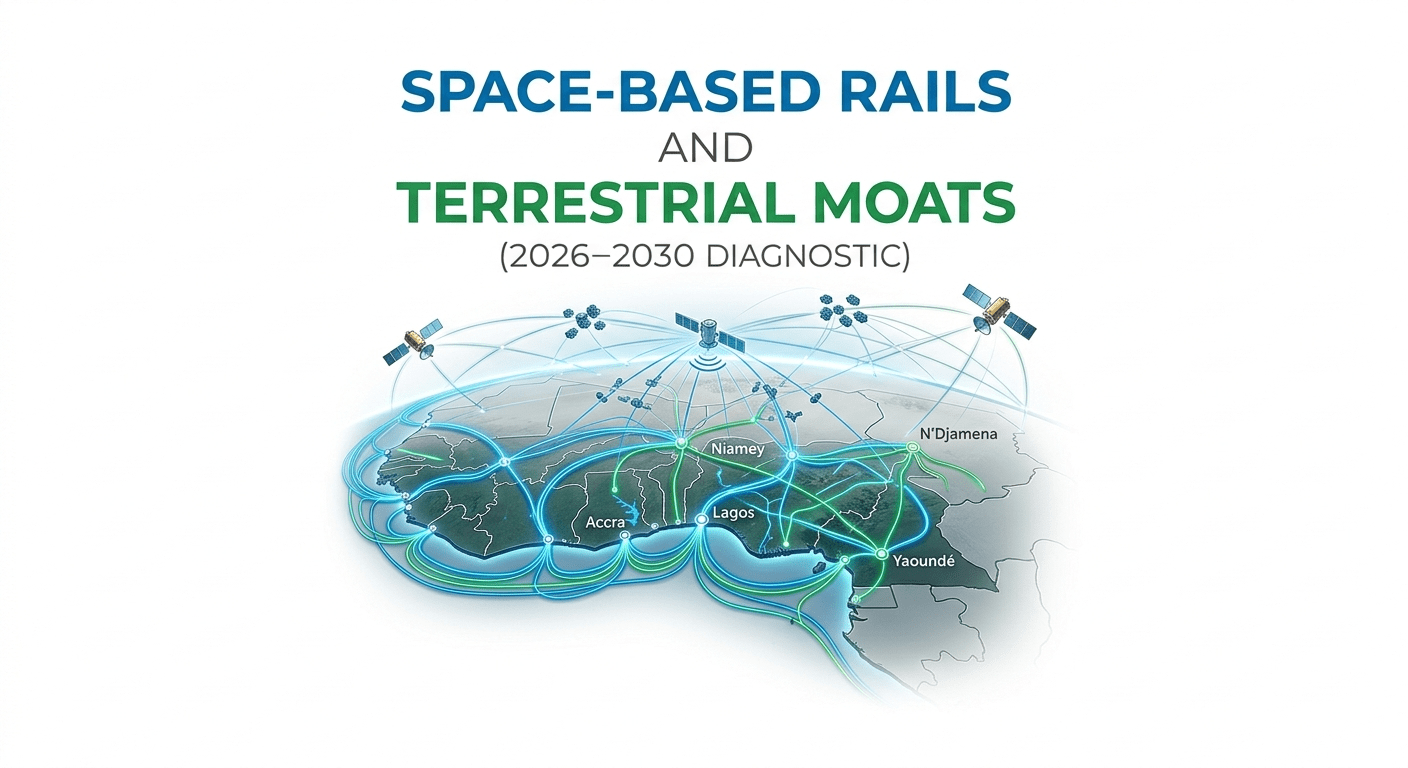
The legacy of “Geostationary” (GSO) satellites—high-latency, high-cost, and static—is over. As of the WATRA 4th Working Groups Meeting in April 2026, the region has moved to integrate Non-Geostationary Satellite Orbit (NGSO) systems (like Starlink and OneWeb) as a primary resilience layer.
1. The “Open-Access” Spectrum Mandate
Under the WATRA Strategic Plan 2026–2030, member states are adopting a unified regulatory framework for NGSO systems.
The Inter-Satellite Link (ISL) Requirement: Regulators now mandate that NGSO providers utilize inter-satellite laser links. This ensures that even if all local ground stations (teleports) are offline, traffic can be routed in-orbit to a functional gateway in a neighboring jurisdiction, eliminating the “Single Point of Failure” risk.
Spectrum Roadmap 2026: The NCC’s Draft Spectrum Roadmap (2026–2030) has officially earmarked the Ka and Ku bands for high-throughput NGSO services, ensuring that the 5G rollout is augmented by satellite backhaul in rural “blind spots.”
2. Strategic Landing Rights & Data Residency
The new regulations shift from “Laissez-faire” to Sovereign Oversight.
Local Landing Mandates: For an NGSO operator to serve the West African market, they must now establish Regional Gateways. This prevents “Data Flight,” where local traffic is routed to Europe and back, reducing latency from 600ms (legacy GSO) to sub-30ms (modern NGSO).
The “Kill-Switch” Protocol: Following the 2024 outages, WATRA’s technical report on NGSO regulation includes an Emergency Routing Clause. In the event of a total submarine cable cut, NGSO providers must provide “Critical Infrastructure Priority,” ensuring government, defense, and emergency services (like L-Guard) remain online at zero-latency cost.
PART II: THE TERRESTRIAL MOAT — NIGERIA’S CROSS-BORDER FIBER REVOLUTION
While the sea provides the volume, the land provides the stability. The Project BRIDGE (D-VIBE) initiative, backed by a $2 billion investment from the AfDB, World Bank, and private sector, is turning Nigeria into the “Digital Pivot” of Africa.
1. The “Four-Neighbor” Interconnect (Project BRIDGE)
As of April 2026, Nigeria’s terrestrial fiber backbone is expanding from 35,000 km to 120,000 km. This isn’t just internal; it is about Regional Mesh Networking.
| Neighbor | Status (Q2 2026) | Strategic Purpose |
| Benin | Operational | Dual-homing with Togo’s Equiano landing for Cotonou-Lagos redundancy. |
| Niger | Under Construction | Providing Niamey with a “Dry-Pipe” to the Atlantic via Abuja. |
| Cameroon | Active Sync | Connecting the Douala landing station to the Calabar-Lagos axis. |
| Chad | Strategic Link | Chad has fast-tracked the N’Djamena-Mberé route to link through Cameroon and Nigeria, securing its “Landlocked Sovereignty.” |
2. The “Dry-Path” Redundancy
In the IndexPrima diagnostic, we track the move toward Physical Path Diversity.
The Lagos-Kano-Maradi Axis: This terrestrial route now acts as a high-speed bypass. If a submarine cable is cut in the Gulf of Guinea, Nigerian traffic can now be routed northward through terrestrial links to Niger and then through the Trans-Saharan fiber to the Mediterranean cables in Algiers or Tunis.
Right-of-Way (RoW) Harmonization: Under the NCC’s “Renewed Hope” Development Plan, 28 Nigerian states have now waived or slashed RoW fees, allowing private operators like MainOne (an Equinix Company) and Glo-1 to build deep-inland fiber caches that act as “Data Buffers” during maritime disruptions.
PART III: CYBER-KINETIC DEFENSE — THE WATRA CYBERSECURITY FRAMEWORK
Resilience is not just about “pipes”; it is about Code Security. The 2026–2030 strategy integrates cybersecurity directly into the infrastructure layer.
The Regional CERT (Computer Emergency Response Team): WATRA is establishing a regional “Cyber-Watch” that monitors the health of both the terrestrial and NGSO links.
Attack Surface Hardening: As the region moves toward 5G and IoT (managed by the Hustle Academy talent pool), the framework mandates Hardware-Level Encryption for all cross-border fiber interconnections to prevent intercept or kinetic sabotage.
THE DIAGNOSTIC VERDICT: THE “INVERSE FLIP” OF CONNECTIVITY
By 2030, the IndexPrima forecast predicts that West Africa will no longer be “dependent” on the sea. The $216 Billion Digital Economy will sit on a “Tri-Layer Shield”:
Marine: High-capacity submarine cables (The Volume).
Terrestrial: Cross-border fiber meshes (The Redundancy).
Space: NGSO satellite constellations (The Fail-Safe).
The “Index” Take: In 2026, a single cable cut is a nuisance; a regional blackout is an act of economic war. By hard-coding NGSO regulations and bridging the terrestrial gap to Benin, Niger, and Cameroon, Nigeria and WATRA are building a “Digital Fortress.” We are moving from a region that is “online” to a region that is “unplug-proof.”