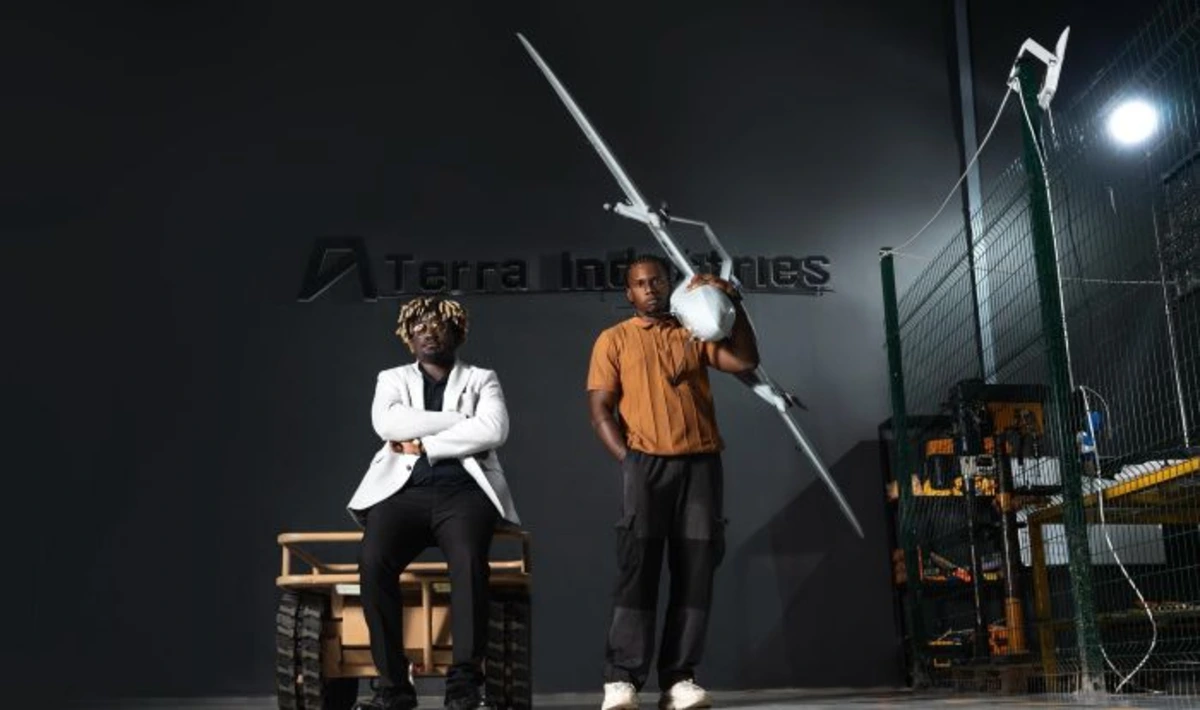
Terra Industries has added a further $18 million to its seed round, bringing the total to $52 million, the largest seed round ever raised by an African startup. Norleo Space Investments and angel investor Grant Gordon joined as new backers, alongside returning investors 8VC, Silent Ventures, Nova Global, Belief Capital, and SV Angel. The Nigerian defence-technology startup says the capital will fund its first international office, in London, alongside expanded manufacturing capacity, faster deployment of its products across the Global South, and a bigger engineering, operations, and business development team.
This is Terra’s third capital raise in eight months, and each one has landed bigger than the last. The company disclosed an initial $11.75 million seed round in January, at the time the largest funding round in African defence tech. A month later, it added another $22 million in a round led by Lux Capital that pushed its valuation past $100 million. This latest $18 million tranche closes the seed stage out entirely at $52 million, a threefold jump from where the company started the year, with the round’s continued interest from early backers suggesting conviction that’s deepened with each check rather than a one-time bet.
Founded in 2024 by CEO Nathan Nwachuku and CTO Maxwell Maduka, both still in their early twenties, Terra designs and manufactures autonomous defence systems, including drones, sentry towers, and unmanned ground vehicles, aimed at helping governments and infrastructure operators monitor and secure critical assets. Those systems run on ArtemisOS, Terra’s proprietary software platform, which the company says handles real-time threat detection, autonomous mission planning, and coordinated responses across a deployed fleet. Terra has taken to describing itself as the “Anduril of Africa,” a reference to the well-known US defence startup, and is building what it calls a vertically integrated defence pipeline built around affordability, autonomy, and the operational realities of the markets it actually serves.
A meaningful share of this new capital is going toward physical manufacturing capacity, not just headcount. Terra already runs Pax-1, a 15,000-square-foot facility in Abuja, Nigeria, and is building out Pax-2, a 34,000-square-foot factory in Accra, Ghana, more than double the size of its existing plant. Due to come fully online in the fourth quarter of 2026, Terra says Pax-2 will be the largest drone factory on the continent once operational.
The funding isn’t chasing a hypothetical market. Terra says its technology already protects nationally critical assets worth roughly $11 billion across several African countries, with contracts concentrated among governments and infrastructure operators in sectors like oil and mining. The company reports around $100 million in active contracts and expects tens of millions of dollars in revenue this year, a genuine commercial base rather than a pre-revenue story built entirely on investor enthusiasm.
Nwachuku has framed the London office as a deliberate split between where Terra builds and where it operates. Manufacturing stays firmly in Africa, anchored in Abuja and Accra, while London becomes home to the company’s operations and AI teams, chosen for its access to the institutions that shape global defence and infrastructure markets, along with a deeper pool of relevant technical talent. It’s a structure that lets Terra keep its production cost base and local market knowledge in Africa while building the kind of international credibility and talent pipeline that large defence contracts and future funding rounds tend to reward.
Terra’s manufacturing-heavy strategy fits a pattern showing up across defence tech globally right now: investors increasingly rewarding companies that can prove they can build at scale, not just demonstrate a working prototype. US-based Mach Industries recently raised $300 million at a $1.8 billion valuation with manufacturing capacity central to its pitch, while Berlin’s Stark raised over 500 million euros, more than 80% earmarked for production, despite its Virtus drones reportedly failing to hit a single target across four live-fire trials months earlier. That comparison is worth sitting with: in this investment climate, manufacturing scale is doing real work to build investor confidence, sometimes even ahead of hardware fully proving itself in the field. Terra’s bet is that pairing serious production capacity with contracts it’s already fulfilling puts it on firmer ground than that pattern alone would suggest.
What’s Next
Nwachuku has already signalled where this is heading. “Our Series A is going to be a big one for the company,” he said following the February round, and Terra’s ambitions extend well past its current footprint, with plans to expand into the Gulf, South America, and South Asia as part of what the company describes as building sovereign defence infrastructure for the Global South. For a company not yet two years old, the pace so far suggests those plans aren’t just aspirational talk.