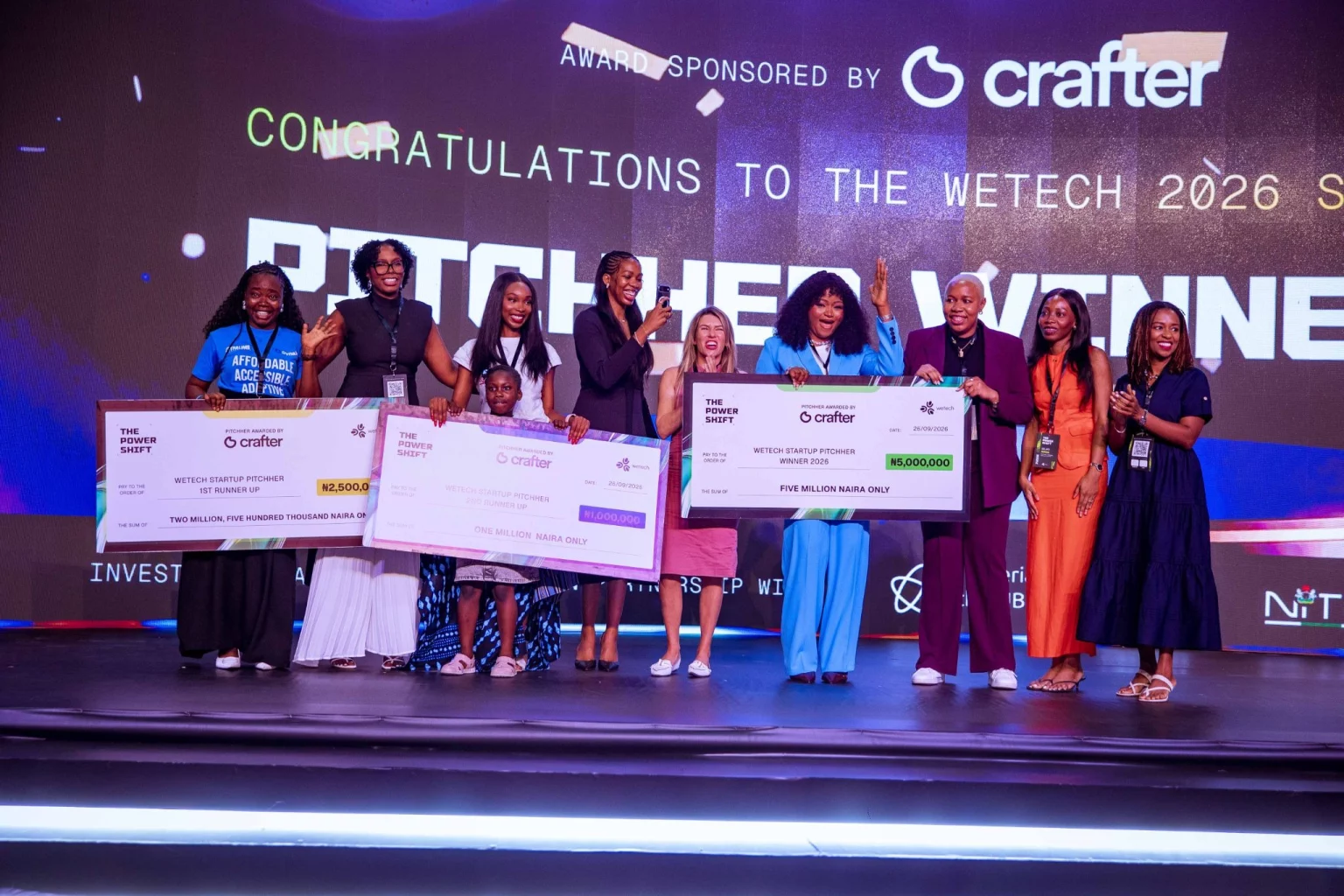
Three Nigerian women-led startups have shared ₦8.5 million after Wetech’s PitchHer 2026 competition, and the figures around the prize say as much about the funding gap as the prize itself. Wakamedics, a mobile fertility care company led by Victoria Okorie-Duru, won ₦5 million as overall winner. Dynalimb Technologies, co-founded by Blessing Aniefiok, took ₦2.5 million as first runner-up, and TFB Studios AI, founded by Misi Chanel Ogunlana, received ₦1 million as second runner-up. The awards came at the end of an eight-week investment-readiness programme for 25 women founders, from which six reached the final pitch. At roughly ₦1,330 to the dollar, the rate implied by a TechCity conversion on October 9, the whole pool comes to about $6,400, with the top prize near $3,800. That is small cash, and the programme’s own organisers call it “catalytic capital,” not a funding round.
The programme itself is better documented than the prize. Wetech Women Foundation designed it with the UK-Nigeria Tech Hub, and according to a sponsored write-up on Techpoint it was open to Nigeria-based, women-founded or co-founded startups at pre-seed stage that intended to raise within 12 to 18 months. Applications closed on July 10 and the programme began on August 3. A live mock pitch panel at the end of week six chose six finalists, who then got two weeks of coaching and pitched at the Wetech 2026 conference, “The Power Shift,” on September 26 at the Landmark Centre in Lagos. The sessions covered the problem, the market, the business model, financial assumptions and intended use of capital. Crafter AI sponsored PitchHer 2026, the Office for Nigerian Digital Innovation under NITDA and the UK-Nigeria Tech Hub supported the readiness programme, and Tech4Dev was the technical partner. Who actually funded the ₦8.5 million pool is not stated in the results coverage, and the sponsored article attributes the programme’s funding to the UK government’s Digital Access Programme, while its page metadata names the Foreign, Commonwealth and Development Office, so check with the organisers if you need the answer.
The finalists pitched to a panel that included Lola Masha of Antler, Dolapo Morgan of Ventures Platform, Nela Duke-Ekpenyong of Obudu Capital, Lexi Novitske of Norrsken22 and Gabriella Uwadiegwu, who is co-founder and president of Wetech and a syndicate investor at Archangel Fund. Wetech’s own president sitting on the panel is worth stating plainly, though nothing we found suggests it affected the result. The only published selection mechanism is the week-six mock pitch, and no scoring criteria were released. The six finalists were Wakamedics, Dynalimb, TFB Studios AI, Anjolaoluwa Ajayi’s ACAD AI, Onyeka Nweze’s Unikorrn and Kamnsi Arachie’s JEWE Energy & Mobility. The three that did not place received no prize money, according to the report.
Now the winners’ claims, which are all company-reported and not independently audited. Wakamedics says it has grown more than 2.3 times in under two years without venture funding and has generated over ₦150 million in 2026 alone. If that is right, the ₦5 million prize equals about 3% of its revenue this year. A July 2026 Techpoint profile says it launched in September 2022 as a fertility laboratory, now offers home sample collection, telemedicine and a licensed clinic, and reports more than 1,500 women tested and more than 200 pregnancies supported, though it did not disclose revenue and the company says it has won about seven grants. It was also overall winner at the Lagos State Employment Trust Fund’s Female Founders and Funders Programme demo day in July 2025, so this is a repeat win, not a first. Dynalimb says it has more than doubled over the past year and projects ₦80 million in revenue in 2026. ThisDay reported in February that it makes 3D-printed prosthetic arms and legs from a workshop in Uyo, has delivered more than 500 devices and received a $10,000 grant from Standard Chartered’s Women in Tech Nigeria Accelerator, so ₦2.5 million is a small share of a business already attracting outside support. TFB Studios AI says it has $65,000 in grants and $15,000 in revenue in its first 10 months, which means its grants alone are roughly ten times the entire PitchHer pool.
That contrast is the real finding. For companies already earning tens or hundreds of millions of naira, a prize of ₦1 million to ₦5 million will not change the balance sheet, so the value lies elsewhere: investor exposure, coaching, a credible endorsement and the introductions that come with a panel of well-known funds. The organisers say as much, writing that the real measure of impact will be how the three companies turn the money into traction and proof points that unlock much larger capital. The programme’s own scorecard is modest and honest on its face: 25 founders trained, six finalists, three funded and ₦8.5 million deployed. Whether any of the 25 raise follow-on investment in the next 12 to 18 months, the window the programme used for eligibility, is the number that would show whether readiness training converts to capital.
The competition sits against a funding gap that is real, though the figures vary by source and definition. The announcement cites 26% of women in Sub-Saharan Africa as entrepreneurs and only 1% of venture capital reaching them, and we could not trace that pairing to a published study. Other trackers give different numbers: TechCabal, citing Briter’s Africa Venture Pulse, says male-led startups took about 75% of the more than $2 billion raised through August 2025 and companies with at least one female founder about 10%, while an unsourced 2024 figure puts women-led startups at about 2% of venture funding. The gap between 1%, 2% and 10% mostly reflects whether a tracker counts women-led companies or companies with at least one woman founder. For founders reading this, the practical lesson is to track the definition behind any statistic you quote to investors, and to treat competitions like PitchHer as a route to exposure and not as a substitute for revenue or a funding round. Applications for the 2026 edition have closed, and the organisers post updates at event.wetech.africa.
Sources: Wetech 2026 conference and PitchHer results, via Condia; Techpoint sponsored article on the PitchHer programme (brand-written content); TechCabal’s report on PitchHer 2026, Techpoint profile of Wakamedics founder Victoria Duru; Business Post on the 2025 Female Founders and Funders demo day; ThisDay on Dynalimb Technologies; TechCabal on Africa’s gender funding gap; TechCity on the OPay filing, for the October 9 naira conversion.
A note for startup founders: you can find this post, and every post we publish from here on, at raiseready.indexprima.com.