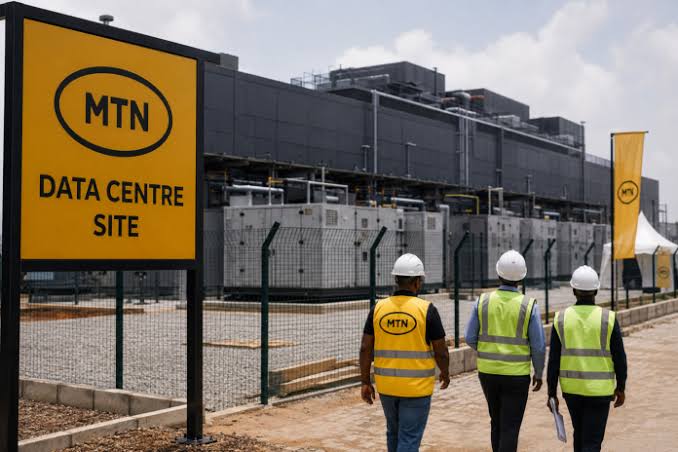
Virginia-based technology company Cybastion has announced plans to invest $75 million in Douala, Cameroon, on a project that pairs an AI-powered data center with a dedicated power plant built specifically to run it. The announcement came out of the inaugural US-Cameroon Bilateral Economic and Commercial Dialogue, held August 27 and 28 in Yaoundé, and while $75 million is a modest figure next to some of the other projects unveiled at the same event, the decision to build a power plant alongside the data center rather than simply plugging into Cameroon’s existing grid is the detail that actually explains how serious this project is.
The Real Bottleneck Isn’t Capital, It’s Electricity
AI-powered data centers are extraordinarily power-hungry by design, running racks of processors that need constant, stable electricity to function reliably, and that requirement runs straight into Cameroon’s most persistent infrastructure weakness. Cameroon’s National Centre for Information Technology Development, the government’s own IT development agency known as CENADI, has flagged energy vulnerability as a central obstacle to building out the country’s computing infrastructure, and grid stability is widely recognised as the primary constraint on deploying any kind of high-performance computing in the country. Rather than betting a $75 million data center on a national grid known for unreliable supply, Cybastion is building its own power source alongside it, a structural decision that removes the single biggest operational risk the project would otherwise face. It’s a more expensive way to build, but it’s also the difference between a data center that can credibly promise uptime to paying customers and one that can’t.
A Play for Digital Sovereignty, Not Just Server Space
There’s a second layer to why this project matters beyond solving its own power problem. Cameroon currently depends heavily on foreign data hosting providers for storing sensitive data and running public digital services, a dependency that carries real costs in latency, cost, and control over where a country’s own information actually lives. By locating AI-capable data processing physically inside Cameroon, Cybastion’s project is being framed, including by Cameroonian commentators, as a step toward greater digital sovereignty, keeping more of the country’s growing digital footprint on domestic infrastructure rather than routed through servers in Europe or North America. That framing lines up with a broader continental pattern: as African governments push forward with digitising public services and growing AI adoption, the absence of local, reliable data center capacity is increasingly seen as a strategic vulnerability, not just a commercial inconvenience.
Part of a Much Bigger $7 Billion Conversation
Cybastion’s project didn’t emerge in isolation. It was one of several announcements unveiled during the first-ever Bilateral Economic and Commercial Dialogue between the US and Cameroon, an event that collectively identified nearly $7 billion in investment, trade, and expansion opportunities spanning critical minerals, energy, digital infrastructure, transport, forestry, and logistics. The single largest individual project on that list dwarfs Cybastion’s investment considerably: Hydromine’s proposed Grand Eweng Hydropower project on the Sanaga River, valued at $3.5 billion and targeting 1,040 megawatts of generating capacity, alone accounts for roughly half the entire $7 billion figure. Other notable projects include a proposed $2 billion airport for the Douala metropolitan area from Illinois-based A. Epstein and Sons International, a $230 million plan to build modern theatre halls across Yaoundé, Douala, and Bamenda, an $83 million equipment sale from New Jersey’s Hoffman Equipment, and a FedEx-linked warehouse facility planned for Douala International Airport. New York fintech Azamra also announced plans to facilitate investment from Cameroon’s diaspora and speed up cross-border digital payments, though without disclosing a specific investment figure.
The Numbers That Complicate the Optimism
It’s worth holding the $7 billion headline figure, and Cybastion’s $75 million slice of it, against Cameroon’s actual current trade relationship with the United States, which remains genuinely modest at roughly $704.6 million in 2025. Cameroon has also been excluded from the African Growth and Opportunity Act, the US trade programme that gives eligible African countries preferential access to American markets, since January 2020, a policy gap that continues to shape how much American capital actually flows into the country regardless of how many opportunities get identified on paper. A business climate forum organised by the American Chamber of Commerce in Cameroon just a day before the dialogue itself was candid about the obstacles still standing in the way: a real data-infrastructure deficit, limited internet connectivity nationally, demanding cybersecurity requirements, and persistent difficulty securing financing for projects at this scale. As Ecofin Agency put it plainly in its own coverage of the dialogue, American operators no longer dispute that Cameroon’s digital market has real potential. What remains genuinely uncertain is the country’s capacity to turn that potential into bankable, financeable projects that actually get built.
What Happens Between Now and the Next Dialogue
Every project announced at this dialogue, Cybastion’s included, is explicitly described as an opportunity at some stage of development rather than committed, deployed capital. Joint working groups from both governments are expected to keep advancing the broader agenda before the next dialogue, which the United States is expected to host in 2027, giving both sides roughly a year to move projects like Cybastion’s from stated intention toward actual groundbreaking. For a $75 million data center and power plant that’s betting its entire operational premise on solving Cameroon’s electricity reliability problem before it can even open, that gap between announcement and construction is exactly where the real test of this project’s seriousness will play out.