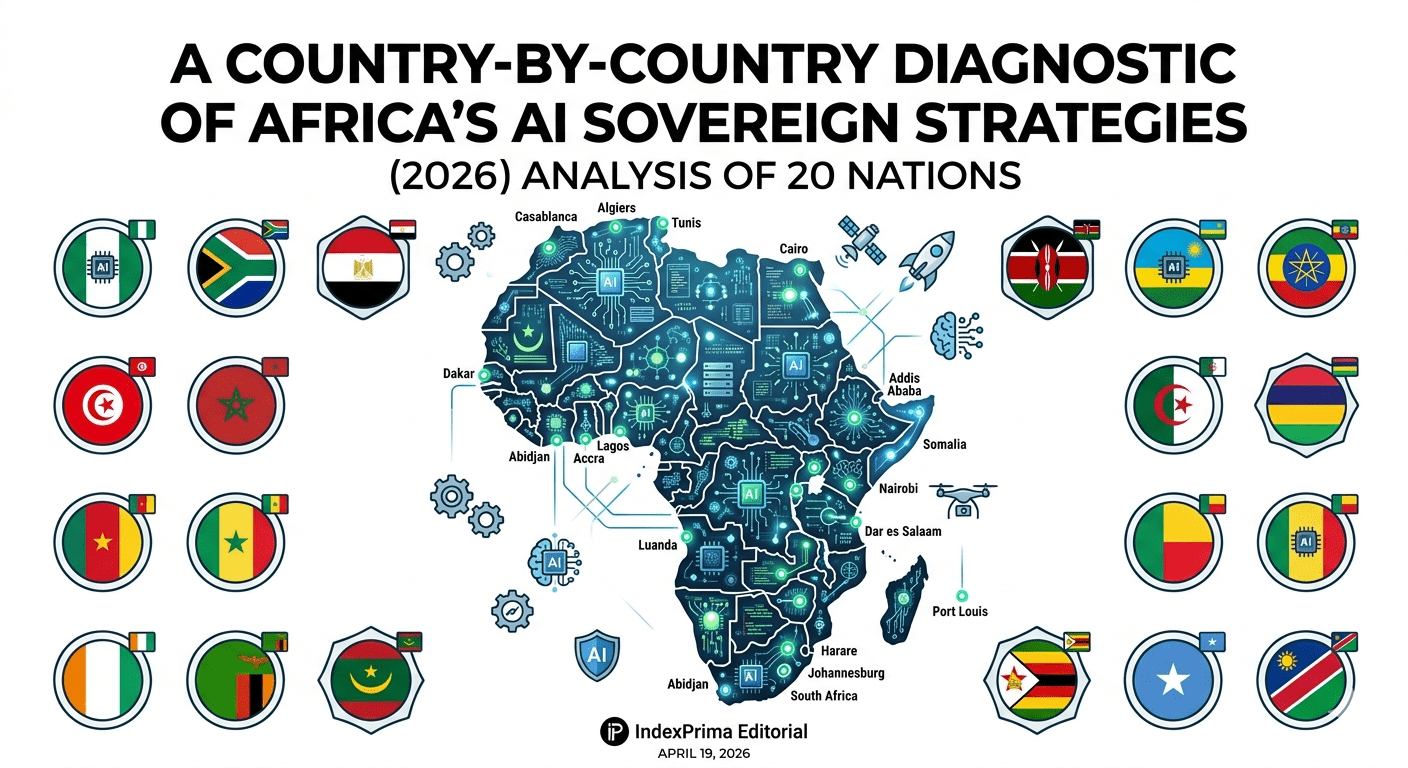
The narrative that Africa is a monolith has been thoroughly dismantled by the digital age, but nowhere is this more evident than in the “AI Race.” According to the comprehensive research series by Talal Abueisa, Africa is currently operating as a multi-speed continent. As of 2026, we see a distinct stratification: the Pioneers (South Africa, Mauritius, Egypt), the Accelerators (Nigeria, Kenya, Rwanda, Ethiopia), and the Sovereign Builders (Zimbabwe, Cameroon, Zambia).
While the global North focuses on AGI and compute-wars, Africa’s AI journey is defined by Utility. It is a journey of “Hard-Coding” national survival through precision agriculture, multilingual LLMs, and decentralized governance. This article synthesizes the strategies of 20 nations to provide a diagnostic of the continent’s digital future.
I. The Powerhouses: Scale, Data, and Institutionalization
1. Nigeria: The Adoption Giant
Nigeria presents a unique paradox: Adoption ahead of Policy. With a population exceeding 220 million, Nigeria’s AI trajectory is continent-defining.
-
The Data: 70% of Nigeria’s online population is already utilizing generative AI, compared to a global average of 48%.
-
The Strategy: The National AI Strategy (2025) rests on five pillars, including the ambitious M-ATLAS, a multilingual AI model covering 500+ local languages.
-
Human Capital: The 3MTT Program and DL4ALL initiatives aim for 95% digital literacy by 2030, leveraging a 40% women participation mandate to ensure inclusive growth.
2. South Africa: The Regulatory Standard-Setter
Ranked 42nd globally on the 2024 Responsible AI Index, South Africa is Africa’s most advanced AI nation from a structural perspective.
-
The Blueprint: The Draft National AI Policy, set for finalization in 2026/2027, avoids a single “AI Authority” in favor of a sector-specific, multi-regulator model.
-
Economic Impact: AI is projected to add $52.2 billion to the South African economy by 2030. As the 2025 G20 President, South Africa has used its platform to establish an AI Action Task-force, signaling its intent to lead global South AI governance.
3. Egypt: The Regional Bridge
Egypt’s second-generation AI strategy (2025–2030) is a masterclass in structure.
-
The Goal: Raising ICT contribution to 7.7% of GDP by 2030.
-
Sovereignty: The launch of KARNAK, a national LLM, focuses on Arabic-language digital sovereignty. Egypt is positioning itself as the bridge between the African and Middle Eastern AI ecosystems, hosting “Ai Everything MEA 2026.”
II. The Executioners: Agility as a Competitive Advantage
4. Rwanda: The Speed of Governance
Rwanda remains the continent’s “sandbox” for innovation. It didn’t just write a policy; it moved to implementation with clinical speed.
-
Global Partnerships: Collaborations with Anthropic and a $50M healthcare AI partnership with OpenAI and the Gates Foundation place Rwanda at the center of AI diplomacy.
-
Infrastructure: The $2B Kigali Innovation City serves as the hardware and software anchor for these ambitions.
5. Mauritius: The Intelligent Island
The first African nation to publish an AI strategy (2018), Mauritius has now solved its “execution gap” by establishing a dedicated National AI Unit.
-
Incentives: Tax incentives of up to Rs 150,000 for AI investments and mandatory AI education in universities ensure a steady pipeline of talent and capital.
6. Ethiopia: The State-Led Engine
Ethiopia’s approach is centralized and massive. The Ethiopian Artificial Intelligence Institute (EAII) is the sole execution engine, driving a 42% budget increase for AI in 2025.
-
Real-World Wins: AI-driven fertilizer optimization has already led to a 25% yield increase in pilot agricultural zones.
III. The Regional Anchors: Breaking New Ground
7. Cameroon: Central Africa’s Policy Leader
In a region often lagging in digital policy, Cameroon has broken ground with a formal National AI Strategy and a 2024 Data Protection Law. It is positioning itself as the “AI Anchor” for Central Africa, backed by €136M in jobs programs.
8. Kenya: Silicon Savannah 2.0
Kenya’s National AI Strategy (2025–2030) is backed by a $1.14B investment.
-
Sustainability: Kenya is leading the “Green AI” movement, utilizing renewable energy to power water-efficient data centers. Its focus on indigenous knowledge and local languages makes it a benchmark for inclusive policymaking.
9. Morocco: Infrastructure First
Morocco proves that you don’t need a standalone policy if you have world-class infrastructure.
-
The Hub: The Igoudar Dakhla 100MW data center is designed to serve as the processing backbone for West Africa. Morocco currently ranks in the Top 3 in Africa on the Global Innovation Index.
IV. The Strategic Leapfroggers: Pragmatism over Hype
10. Zimbabwe: From Resource to Knowledge
Launched on March 13, 2026, Zimbabwe’s strategy (2026–2030) focuses on the “Come Home to Build” program, leveraging its global diaspora to transfer AI knowledge back to Harare.
11. Zambia: The 100-Day Execution Cycle
Zambia is proving that smaller economies win through discipline. Their National AI Council operates on a phased implementation: a 100-day “Quick Win” cycle followed by foundational scaling.
12. Senegal & Benin: The Responsible Pioneers
Senegal has achieved a 12.9% AI diffusion rate, while Benin became one of the first mainland Sub-Saharan nations to integrate AI governance into existing institutions, proving that vision—not just size—matters.
V. Cross-Continental Challenges: The Infrastructure Bottleneck
Despite the policy momentum, Talal Abueisa’s analysis highlights four “Red Zone” challenges that threaten to stall the continent:
-
The Energy Gap: AI is power-hungry. Without consistent electricity, the strategy remains a paper-weight.
-
Imported Bias: Most models are trained on Global North datasets, creating “Data Colonialism” where African nuances are lost.
-
The Brain Drain: Tunisia and Algeria produce world-class engineers who are frequently recruited by European and American firms before they can build locally.
-
Connectivity: While 5G and Satellite internet (Starlink) are expanding, the rural-urban digital divide remains a primary blocker for “AI for all.”
VI. The Path Forward: Where Do We Go From Here?
As Abueisa’s series concludes, the African AI community is at a crossroads. The next phase must move from Country Analysis to Deep Sector Integration.
-
AI Use Cases: Shifting from “what is the policy” to “how many lives did the healthcare AI save?”
-
Tech & Business: Moving from government grants to venture capital. We need more “Paystack-level” exits in the AI space to prove the commercial viability of African LLMs.
-
Regional Integration: As seen with Mauritania leveraging Senegal’s vision, the future is in Regional AI Hubs—where nations share compute-power and datasets to compete globally.
Sovereignty Through Intelligence
Africa is no longer waiting for a seat at the global AI table; it is building its own table. From the “Silicon Savannah” in Kenya to the AI Institutes of Tunisia, the continent is hard-coding its future. The diagnostic is clear: the nations that prioritize Data Sovereignty and Localized Utility will be the ones that bridge the $1 Billion gap and lead the 2030 economy.
Statistical Summary: Africa’s AI Vitals (2026)
| Metric | Leader/Statistic | Impact |
| Highest Adoption | Nigeria (70% of online pop.) | Rapid consumer-led growth. |
| Market Value | South Africa ($52.2B by 2030) | Continental economic anchor. |
| Talent Density | Tunisia (71%+ ICT penetration) | Primary source for AI R&D. |
| Agri-Tech Yield | Ethiopia (+25% yield via AI) | Proof of utility in food security. |
| Investment Hub | Kenya ($1.14B AI Strategy) | Global benchmark for funding. |
Sources & References
-
Primary Deep-Dive: Talal Abueisa, “AI Strategies in Africa: Country-by-Country Analysis,” LinkedIn 2026
-
Regional Policy: GIMAC Regional Payment & AI Integration Report
-
National Frameworks: Government of South Africa, “Draft National AI Policy 2026”
-
Strategic Execution: Ethiopian Artificial Intelligence Institute (EAII) Annual Review 2025
-
Ethics & Governance: UNESCO Network of AI Ethics Experts: Zimbabwe Launch
Index Take: The true “African AI Strategy” is not found in a single document, but in the collective resilience of 20+ nations refusing to be left behind. By 2027, the gap between policy and practice will be the only metric that matters.