The geographic rollout of Low-Earth-Orbit (LEO) satellite connectivity across the African continent has officially moved past the phase of speculative regulatory standoffs. Over the past year, national telecommunications regulators have rapidly transitioned from defensive protectionism to practical, structured market openings.
The latest and perhaps most strategically significant domino to fall in West Africa is Côte d’Ivoire.
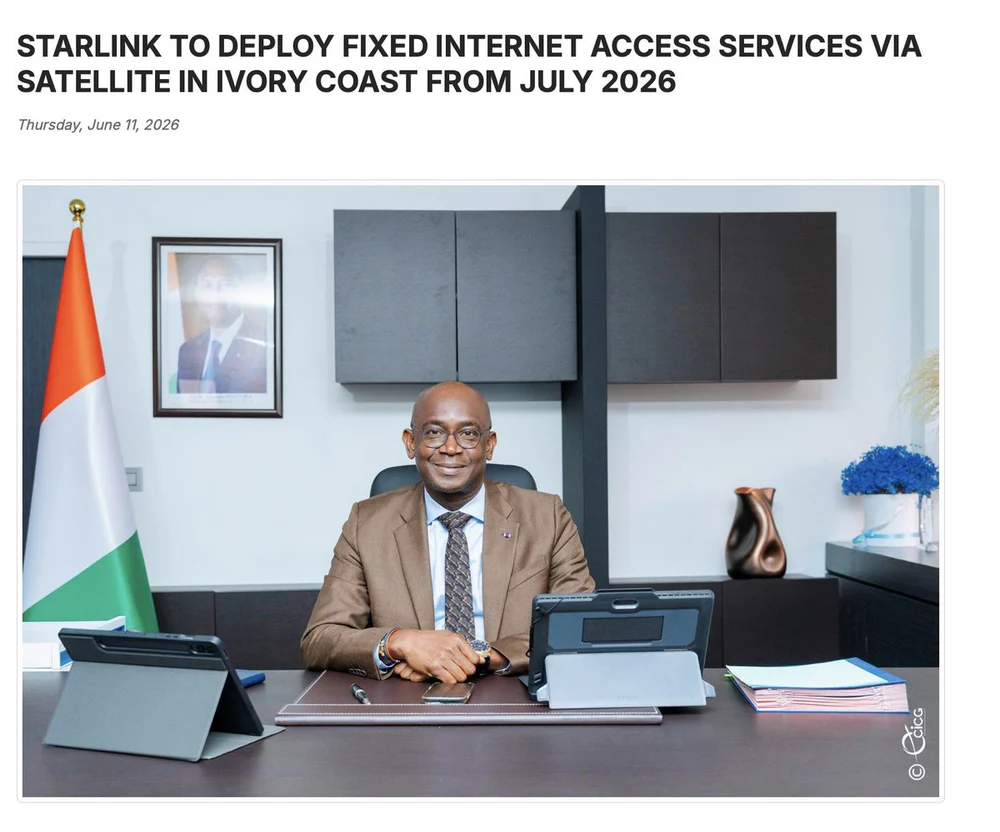
During the government’s digital dialogue program, Gouv’Talk, Djibril Ouattara, the Minister of Digital Transition and Technological Innovation, confirmed that SpaceX’s Starlink will go live commercially across the country in July 2026.
The approval officially marks Côte d’Ivoire as Starlink’s 27th or 28th operational African market. However, beneath the surface-level marketing of “rural connectivity,” Abidjan is executing a highly calculated regulatory experiment. By issuing a strict 12-month provisional authorization rather than an open-ended, permanent license, the Ivorian government is creating a high-stakes operational testing ground—one that forces a head-on collision with entrenched terrestrial telecom giants like MTN and Orange.
1. The Regulatory Sandbox: The 12-Month Probationary Pivot
Unlike earlier African markets that granted Starlink sweeping, permanent licenses out of the gate, the Ivorian regulator (ARTCI) is deploying a heavily guarded framework.
-
The Trial Runway: Starlink Network CIV has been handed a temporary 12-month operating window. The transition to a permanent authorization is entirely conditional, tied directly to an evaluation of its actual service quality, local compliance, and structural impact on the domestic market.
-
The Fiscal Hook: Crucially, the final long-term specifications and permanent regulatory fees will be tied to the company’s actual revenue generation within the country. This model effectively prevents Starlink from draining capital out of the domestic ecosystem without paying its fair share into local infrastructure funds.
The Policy Strategy: This provisional model acts as a regulatory sandbox. It gives the state the leverage to observe Starlink’s operational data, assess how it affects local telco revenues, and adjust the rules before handing over a permanent market footprint.
2. LEO vs. GEO: Entering a Weaponized Satellite Ecosystem
In many African nations, Starlink enters an infrastructure vacuum, deploying high-speed internet to rural communities that have never seen a fiber optic line or a cellular tower.
In Côte d’Ivoire, the terrain is radically different. Starlink is landing in a heavily weaponized satellite market.
                     COTE D'IVOIRE'S BROADBAND SKY WARS

  THE GEO / TELCO ALLIANCE:                 THE LEO DISRUPTOR:
  ┌────────────────────────┐                ┌────────────────────────┐
  │ • MTN & Orange Rails   │                │ • Starlink LEO Fleet   │
  │ • Eutelsat Konnect (GEO)│ ◄── [BATTLE] ──►│ • Direct-to-Consumer   │
  │ • Deep Local Distribution│               │ • High-Speed, Low Latency│
  └────────────────────────┘                └────────────────────────┘
Just months ago, in April 2026, MTN Côte d’Ivoire and Orange solidified multi-year agreements with Eutelsat Konnect to deploy high-throughput Geostationary (GEO) satellite capacity across the country. These legacy telcos are utilizing their existing mobile money networks, local distribution booths, and corporate relationships to sell satellite broadband as an integrated business feature.
Starlink’s entry forces a direct architectural comparison: its low-latency LEO network offers vastly superior speeds compared to GEO alternatives, but it lacks the deep, localized retail distribution, regulatory favor, and mobile money payment integrations that MTN and Orange have spent decades building.
Structural Matrix: The Ivorian High-Speed Connectivity Landscape
| Connectivity Vector | Starlink Network CIV | Telco Partnered GEO (Eutelsat / MTN / Orange) | Terrestrial 5G Rollout (Launching July 2026) |
| Architectural Layer | Low-Earth-Orbit (LEO) Satellites | Geostationary (GEO) Satellites | Terrestrial Fiber Nodes & Towers |
| Regulatory Status | 12-Month Provisional License | Permanent Tier-1 Telecom Licenses | Allocated Telecom Spectrum |
| Primary Advantage | Elite high-speed throughput & ultralow latency. | Deep localized retail distribution & mobile wallet billing. | Extreme density for high-population urban centers. |
| The Core Bottleneck | High upfront hardware cost for average rural households. | Higher latency spikes due to high-altitude orbital positioning. | Capital-intensive last-mile infrastructure limits rural reach. |
3. The July Convergence: LEO Launch Meets the 5G Wave
Starlink’s entry cannot be looked at in isolation; it is part of an aggressive, multi-layered digital overhaul orchestrated by Abidjan. July 2026 is shaping up to be one of the most consequential months in the country’s technological history.
Coinciding with Starlink’s commercial launch, the Ministry is triggering a nationwide 5G infrastructure rollout, systematically targeting all cities with populations exceeding 25,000 inhabitants.
The state is executing a clear dual-track connectivity blueprint. Urban centers are being flooded with high-density, localized terrestrial 5G networks, while rural agricultural zones—specifically the vital cocoa-producing regions in the central-west and the isolated northern corridors—are being handed immediate, off-grid satellite access via Starlink. By integrating satellite connectivity into the state-managed Universal Telecommunications Service (via ANSUT), the government is bypassing traditional tower deployment timelines to connect rural health centers, schools, and farmers in real time.
The Index Take
Côte d’Ivoire’s approach to Starlink should be viewed as a blueprint for how modern sovereign states deal with global big-tech infrastructure.
Instead of banning the technology or handing it unchecked market dominance, the Ivorian government has positioned itself as an active toll-collector and gatekeeper. The 12-month provisional license is a brilliant piece of regulatory leverage. It allows the country to immediately reap the benefits of high-speed LEO satellite infrastructure to close its rural connectivity gap, while simultaneously giving local telcos time to adjust their pricing and ensuring that Starlink can be taxed effectively based on local revenue performance.
As the launch begins next month, the true test won’t be technological capacity—the satellites are already overhead. The true test will be affordability and unit distribution. If Starlink can design local commercial partnerships or device subsidies that align with Côte d’Ivoire’s 40% smartphone penetration reality, they won’t just challenge MTN and Orange; they will fundamentally redefine the economic operating system of Francophone West Africa’s most dominant digital hub.
Sources & References
-
[1] CIO Africa Infrastructure Bureau: Starlink Set for Côte d’Ivoire Commercial Launch
-
[2] Connecting Africa Telecom Log: Starlink to Go Live in Côte d’Ivoire in July Under Provisional Terms
-
[3] Space in Africa Intelligence: Starlink Granted 12-Month Operating Licence in Ivory Coast Ahead of July Launch
-
[4] FurtherAfrica Regional Logistics: Starlink Africa Expansion Deepens Footprint with Ivorian License Approval