Tanzanian founders have had their best funding run in years. Now they are asking the government to fix the rules and back a new venture fund.
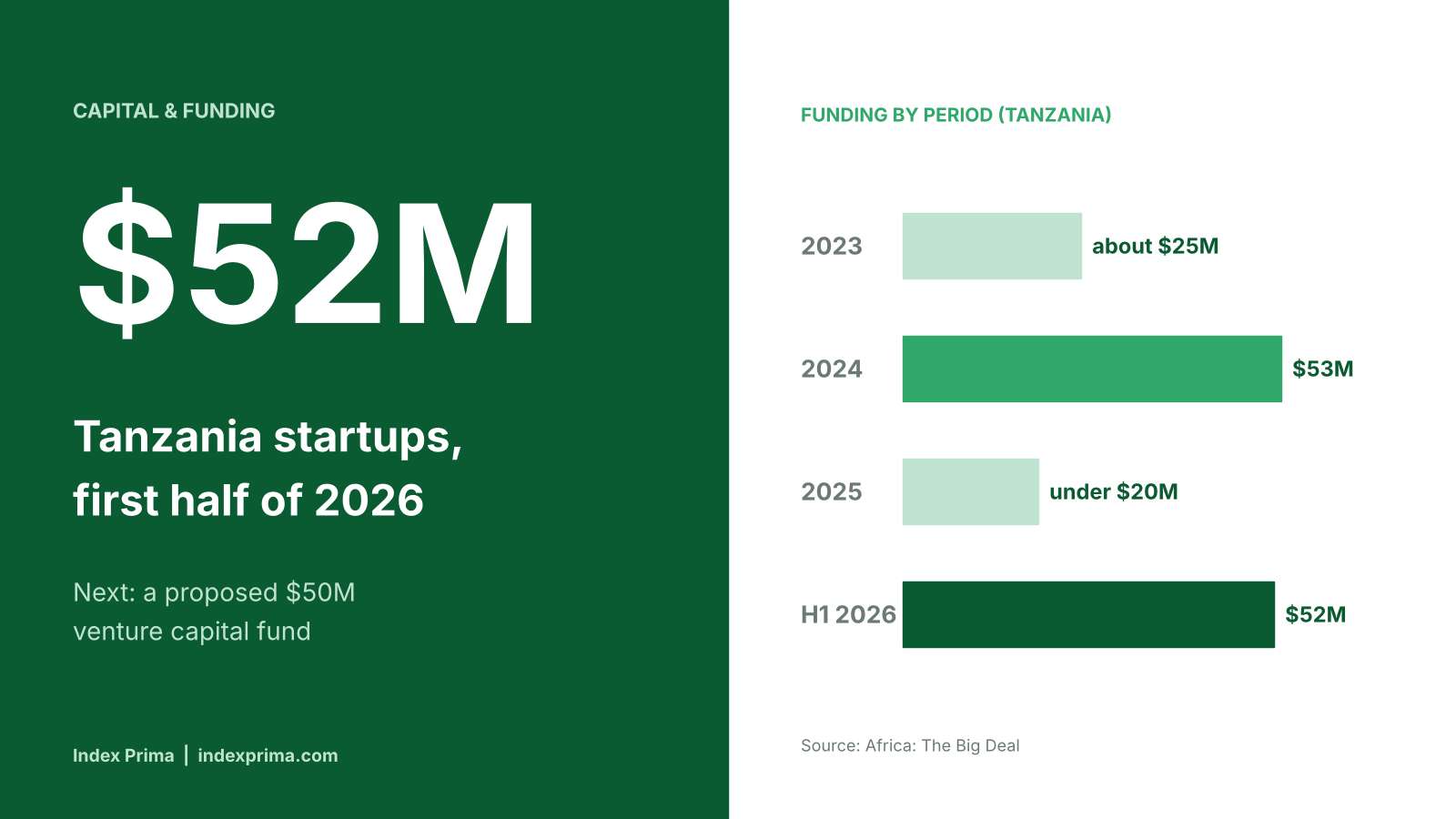
Tanzanian startups raised about $52 million in the first half of 2026, according to Africa: The Big Deal. That is almost as much as the $53 million the tracker counted for all of 2024. Officials said on 20 October that the year’s total has already reached about $90 million. To keep the momentum, the Tanzania Startup Association (TSA) has proposed a $50 million venture capital fund. It would rely on the government and private investors. A startup policy is also still to come.
Look at where the year started. The Big Deal counted about $25 million in 2023 and under $20 million in 2025. Stakeholders linked the slow 2025 to the election cycle, when investors put decisions on hold. Praygod Japhet of the TSA says the rebound shows that “the investment climate has stabilized.”
The money is also reaching more companies. At least ten Tanzanian startups raised $100,000 or more in the first half. Morocco and Ghana hit the same mark. The report describes funding spread across early and growth-stage firms, not a few giant deals. That matters, because across Africa a few big rounds often take most of the cash.
Tanzania still has ground to cover. In the same six months, Egypt raised about $327 million and Kenya about $126 million. Côte d’Ivoire raised $45 million and Morocco $28 million. The TSA says the sector has drawn more than $400 million over five years and expects over $120 million in 2026.
The gap that hurts most sits in the middle. Angel investors usually write cheques of $5,000 to $50,000. Banks reportedly ask for collateral worth 125% of a loan and three years of audited accounts. A startup that has outgrown angels, but cannot meet a bank’s terms, has few places to go for $50,000 to $1 million. That is the gap the new fund wants to close.
TSA presented the plan on 20 October in Dar es Salaam, during Tanzania Startup Week. The week, which ran from 19 to 23 October, was co-hosted with the Ministry of Finance, the Capital Markets and Securities Authority (CMSA) and the Ministry of Industry and Trade. The proposed Tanzania Venture Capital Fund would be a fund of funds. It would put money into about 18 local and regional venture funds, not straight into startups. Those funds would then back companies with equity cheques of $50,000 to $1 million.
The funding mix is simple on paper. The government would put in 15%, or $7.5 million. Pension funds, other institutions and development finance institutions would supply the other 85%. TSA says the fund could draw in a further $180 million of private money. The Finance Minister, Khamis Mussa Omar, has talked of private shares of 20% to 30%, so the mix is not yet settled.
World Bank leaders back the idea. Country Manager Firas Raad said, “To employ our young workforce, firms need more than debt, they need patient risk bearing equity capital.” Senior Financial Sector Specialist Aun Ali Rahman said, “You are trying to build the entire market across the capital value chain.” A fund of funds, he suggests, can support many fund managers at once.
Rules are the other hurdle. Founders describe the regulatory setting as slow and costly. A fintech may need approval from both the Bank of Tanzania and the Tanzania Communications Regulatory Authority. Tanzanian law has no legal definition of a startup, so these firms often face the same rules as traditional small businesses. CMSA is drafting venture capital and private equity rules, and the Ministry of Finance is reviewing the draft. No final date has been given.
The government has made some moves. President Samia Suluhu Hassan announced a youth startup policy in June 2025, but no launch date has been set for it or for the fund. A Sh5 billion loan scheme for young entrepreneurs, about $1.9 million, has opened for applications. The World Bank’s $310 million FAST project focuses on access to finance, and innovation hubs are planned in eight regions.
Why it matters: East Africa’s startup map is more than Kenya. Tanzania has a young workforce, a big domestic market and a rising count of startups that investors are now willing to back. A fund aimed at the $50,000 to $1 million stage could help firms that angels cannot fund and banks will not lend to. But money alone will not be enough. Founders also need clear licensing rules and a legal identity for startups.
What to watch next: the final startup policy and its date, CMSA’s venture capital rules, how much the government and the private sector put into the fund, and whether the 2026 total reaches the $120 million the TSA expects.
Sources: Trendsnafrica on Tanzania’s H1 2026 funding, citing Africa: The Big Deal; The Rio Times on Tanzania’s $90 million, citing The Citizen; TanzaniaInvest on the proposed venture capital fund; FurtherAfrica on Tanzania’s rebound. Regulatory details are as reported in the original article.
A note for startup founders: Don’t practice on investors. Practice on AI first. RaiseReady by Index Prima is an AI fundraising simulator for African founders: upload your pitch deck, get a readiness score and face a tough AI investor before the real meeting. Find this post, and every post we publish, at raiseready.indexprima.com.